Skip to main contentSkip to search barSkip to navigationSkip to footer
Logo of the University of Applied Sciences and Arts Northwestern Switzerland
  • DE
  • EN
  • Home
  • Degree programmes
  • Continuing education

Ten Schools One Goal

The FHNW comprises 10 schools with different specializations. Select a school to see its specific courses, study programmes and information.

Applied Psychology

Architecture, Construction and Geomatics

Art and Design

Music

Computer Science

Life Sciences

School of Education

Social Work

Engineering and Environment

Business

  • Research

    • Research fields
    • Projects
  • Updates and insights

    • News and stories
  • Events

  • Media corner

  • About the School of Engineering and Environment

    • People directory
    • Management Board
  • Institutes

    • Institute of Automation
    • Institute of Bioenergy and Resource Efficiency
    • Institute of Business Engineering
    • Institute of Electric Power Systems
    • Institute of Humanities and Social Sciences
    • Institute of Polymer Engineering
    • Institute of Mathematics and Natural Sciences
    • Institute of Polymer Nanotechnology
    • Institute of Optometry
    • Institute of Product and Production Engineering
    • Institute for Sensors and Electronics
    • Institute of Thermal and Fluid Engineering
    • Laboratories of the School of Engineering and Environment
Logo of the University of Applied Sciences and Arts Northwestern Switzerland
  • About the School
    • FHNW School of Engineering and Environment
    • Degree Programmes
    • Continuing Education
    • Collaboration in Research and Services
  • Social Media
    • LinkedIn
    • Instagram
    • Facebook
    • TikTok
    • YouTube
  • About FHNW
    • Organisation
    • Schools
    • Locations
    • FHNW Library
    • Media Relations
  • Support
    • IT Support
    • Inside FHNW
    • Webmail
  • Data Protection
  • Imprint
  • Accessibility
  • Research

    • Research fields
    • Projects
  • Updates and insights

    • News and stories
  • Events

  • Media corner

  • About the School of Engineering and Environment

    • People directory
    • Management Board
  • Institutes

    • Institute of Automation
    • Institute of Bioenergy and Resource Efficiency
    • Institute of Business Engineering
    • Institute of Electric Power Systems
    • Institute of Humanities and Social Sciences
    • Institute of Polymer Engineering
    • Institute of Mathematics and Natural Sciences
    • Institute of Polymer Nanotechnology
    • Institute of Optometry
    • Institute of Product and Production Engineering
    • Institute for Sensors and Electronics
    • Institute of Thermal and Fluid Engineering
    • Laboratories of the School of Engineering and Environment

Type a search term and search continuing education,degree programmes, events, documents and other content.

  • Engineering and Environment
  • Research and services
  • Research
  • Projects
Projects

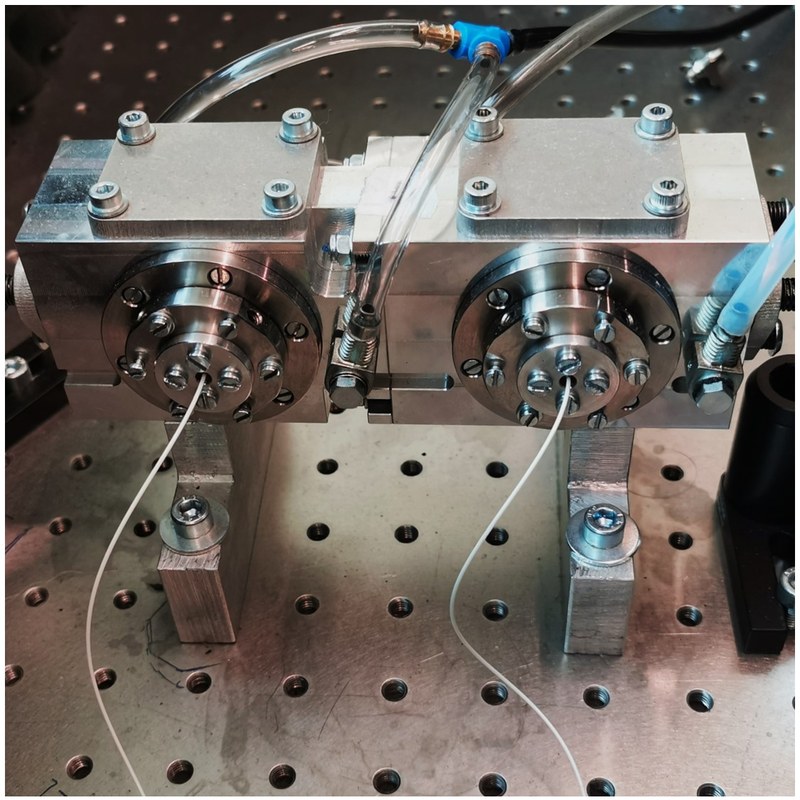
Measurement of soot particles with photothermal interferometry, FHNW School of Engineering and Environment

School of Engineering and Environment


The FHNW Institute for Sensors and Electronics is working on a new measurement method for detecting atmospheric soot particles.
Project details

Starting situation

Atmospheric soot particles are mainly created by burning biomass and diesel fuel. Soot particles are known for their negative effect on our health. They also influence our climate because they absorb sunlight and thus heat up the atmosphere.

Result

Our approach consists of measuring and examining the soot particles using so-called photothermal interferometry (PTI). In this process, soot particles are detected because of their very pronounced light absorption. The main difference to today's standard measurement methods is that the PTI method is very sensitive and hardly affected by measurement artefacts, as the measurement takes place in situ.

Initially, we used photothermal interferometers with free-space lasers. Currently, we are working on miniaturizing and simplifying the method by using optical fibers and photonic integrated circuits (PIC).

Our latest publication shows the proof-of-concept of such a miniaturized interferometer, which is characterized, among other things, by the fact that it can be operated "passively": The 3x3 couplers used as beam-combining optics make it possible to operate the system without quadrature control.

The design has the potential to be further miniaturized, as a future interferometer can be built on a centimeter-sized chip, which will further improve the current detection limit.

References and documentation

The development of our free-beam interferometer: https://doi.org/10.5194/amt-13-7097-2020

Our waveguide-based interferometer: https://doi.org/10.1364/ao.476868, https://doi.org/10.5281/zenodo.10077921

Project information

Execution

FHNW Institute for Sensors and Electronics

Duration

3 years

Funding

Swiss National Science Foundation, EMPIR, Eurostars, Innosuisse, H2020

Team

Prof. Dr. Ernest Weingartner (Lead), Dr. Gregor Jundt, Jonas Bilal, Tobias Rüggeberg, Peter Steigmeier

School of
Engineering and Environment FHNW University of Applied Sciences and Arts Northwestern Switzerland

  • About the School
    • FHNW School of Engineering and Environment
    • Degree Programmes
    • Continuing Education
    • Collaboration in Research and Services
  • Social Media
    • LinkedIn
    • Instagram
    • Facebook
    • TikTok
    • YouTube
  • About FHNW
    • Organisation
    • Schools
    • Locations
    • FHNW Library
    • Media Relations
  • Support
    • IT Support
    • Inside FHNW
    • Webmail
Logo FHNW - 20 Years
Logo Swiss Universities
Logo European University Association
© University of Applied Sciences and Arts Northwestern Switzerland (FHNW)
  • Data Protection
  • Imprint
  • Accessibility
  • DE
  • EN