How can electric PostBuses be charged efficiently without overloading the power grid? In collaboration with IBB Energie AG, FHNW developed an intelligent battery storage control system that optimises the use of solar power and minimises peak loads during both electricity consumption and feed-in to the grid.
Technology
Battery energy storage system (BESS)
Energy management system (EMS)
Forecast-based system control
Background
In addition to private electric mobility, public transport is also being gradually electrified. Since 2021, electrically powered Postbuses have been operating at Brugg railway station. Integrating charging stations into the low-voltage grid is a challenge for grid operation due to the high charging capacities involved. The challenge is both financially and technically.
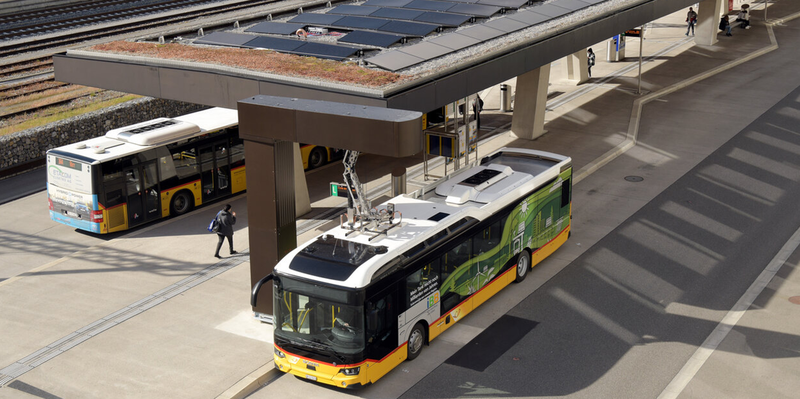
At the Brugg site, a photovoltaic (PV) system on the bus station roof supplies electricity that shall primarily be used for Postbus operations. For this purpose, IBB Energie AG, as the grid operator, together with FHNW, sized a storage solution and procured it in 2022.
In this project, a control system designed by FHNW and implemented in the battery storage system is used to optimize the local grid conditions — specifically by minimizing peak power loads at the grid connection point, both for consumption from and feed-in to the grid.
Goals
Design of a control system to simultaneously maximize the local consumption of PV-generated electricity for the electric Postbus and minimize peak power loads at the grid connection point, both for electricity consumption from and feed-in to the grid
Implementation of the designed control system in the batterysystem, commissioning, and operational support including continuous evaluation and optimization
As part of a later service project from 2025 onwards: Development and implementation of a concept for the additionalintegration of the batterysysteminto a balancing power pool
Results
Thanks to the forecast-based control system (forecast of PV production and energy consumption at the charging station), the battery’s state of charge can be maintained within specified limits. This ensures that battery capacity is always available both for discharging (supplying charging power for the Postbus) and for charging (absorbing PV production). The control system also ensures that the necessary grid consumption and feed-in are distributed evenly over time. As a result, consumption peaks are reduced from 150 kW to 30 kW, while feed-in peaks are limited to an average of 60% of the maximum PV production capacity on summer days, whereas with pure self-consumption optimization the feed-in peak would reach 100%.
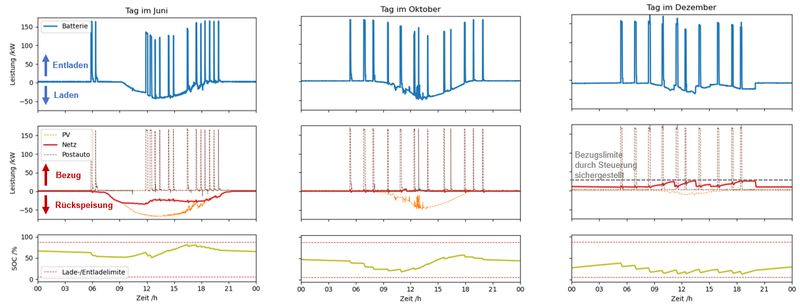
Site measurement results in of different operating situations: summer with production surplus (left), transition period with balanced energy over the day (middle), winter with consumption surplus (right) Charging station of the Postbus at the Brugg train station with PV system on the bus station roof 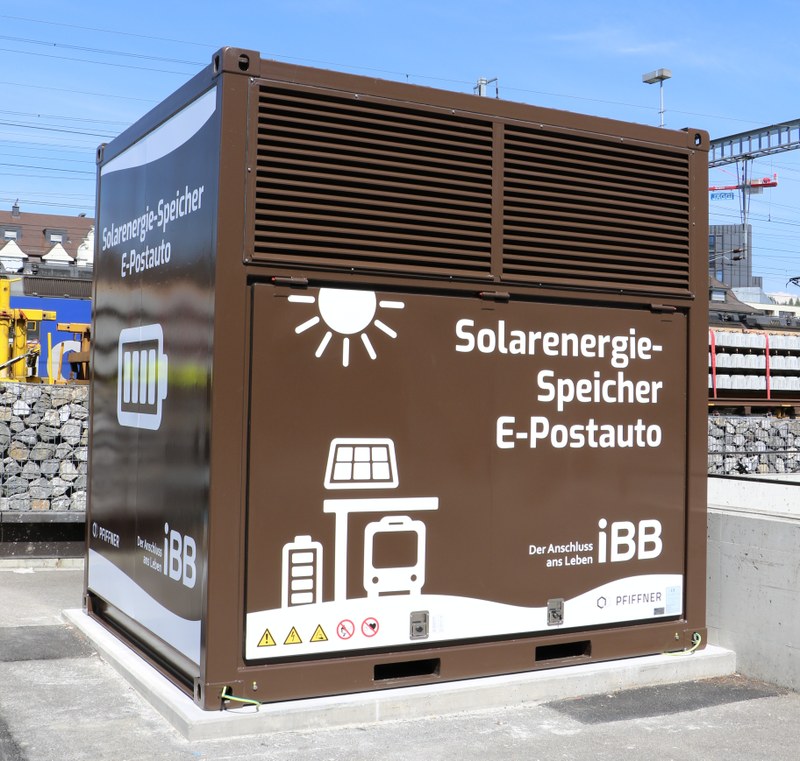
Grid coupled BESS
Projektdetails
- Type
- Research project
- Research field
- Energy and environment, Electrical engineering
- Topics
- Electrical engineering and measurement technology, Energy, Environment and sustainability
- School
- Hochschule für Technik und Umwelt FHNW / Institute of Electrical Power Systems
- Partners
- IBB Energie AG, Pfiffner Systems AG
- Duration
- February 2022 to January 2023, Since then, ongoing operational support and optimisation
- Project lead
- Thomas Tarnowski
