Precision Wound Closure with Light: How Gold Nanorods Enable Gentle Laser Tissue Soldering
Closing wounds on the palate after oral surgery remains a clinical challenge. Sutures are difficult to place in this sensitive tissue and can cause discomfort during healing. In the Nano-Argovia project Na-LTS, a light-activated wound patch containing gold nanorods is being developed as a potentially gentler, suture-free alternative.
Laser Tissue Soldering (LTS) is an emerging technique that uses heat to crosslink proteins and seal tissue without conventional sutures. One of the key challenges is generating sufficient heat to achieve strong tissue bonding while preventing thermal damage to the surrounding tissue.
To address this challenge, the FHNW NanoLab, together with partners is developing multifunctional wound patches incorporating custom-engineered gold nanorods.
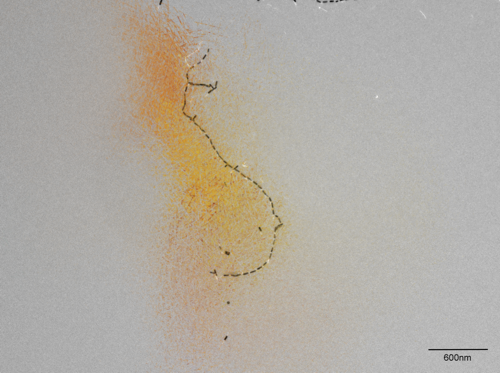
Why Gold Nanorods?
Unlike conventional spherical gold nanoparticles, gold nanorods can be tailored to efficiently absorb near-infrared (NIR) laser light. When integrated into the wound patch, they convert light directly into localized heat within the biological solder layer.
This localized photothermal effect promotes controlled protein crosslinking and tissue adhesion while minimizing heat exposure to the surrounding tissue. The nanorods are synthesized using a seed-mediated growth process and stabilized with a polyethylene glycol (PEG) coating, ensuring good biocompatibility and reliable performance.
Current Project Status
The synthesis and optical characterization of the gold nanorods have been successfully established. Ongoing work focuses on optimizing nanoparticle distribution within the multilayer patch system and refining laser parameters to maximize bonding strength and treatment efficiency.
In the future, this technology could support gentler and more precise wound closure strategies for oral surgery and other delicate tissue applications.
Project Presented at SSB+RM 2026
The project was selected for an oral presentation at the 30th Annual Meeting of the Swiss Society for Biomaterials and Regenerative Medicine (SSB+RM 2026) in Lugano, Switzerland.
The work was presented by Dogukan Güçtemur, project team member and Master’s student at ETH Zürich, under the title:
“Laser Tissue Soldering (LTS) on the Palate: Development of a Multilayer Patch System with Integrated Gold Nanorods for Optimized Wound Closure“.
Project Information
| Project | Nano-Argovia Na-LTS |
| Full Project Title | Nano-Optimized Materials for Efficient Laser Tissue Soldering |
| Funding | Swiss Nanoscience Institute (SNI), Nano-Argovia Program |
| Project Partners | FHNW School of Life Sciences, Institute of Chemistry and Bioanalytics (FHNW NanoLab), Institute for Pharma Technology and Biotechnology, Institute for Medical Engineering and Medical Informatics, Institute of Product and Production Engineering, and Thommen Medical AG |
| Research Focus | Development of a multilayer, light-activated wound patch incorporating gold nanorods for optimized laser tissue soldering and suture-free wound closure |
| Application Area | Oral surgery and regenerative medicine |
| Key Technology | Near-infrared (NIR)-responsive gold nanorods for localized photothermal heating |
| Current Status | Optimization of nanoparticle integration, laser parameters, and tissue bonding performance |
Interested in nanoparticle engineering or next-generation medical adhesives? Get in touch with our team to learn more about this research.
Contact

Head of nanoLab
FHNW – School of Life Sciences
nanoLab
Hofackerstrasse 30
4132 Muttenz
Switzerland
Comments
No comment posted about Precision Wound Closure with Light: How Gold Nanorods Enable Gentle Laser Tissue Soldering