Do you want to understand economic contexts and actively contribute to shaping the law? On the German programme in Wirtschaftsrecht, you will combine legal thinking with business manage-ment expertise in a practical and versatile way, offering excellent career prospects at the intersec-tion of law and business.
Factsheet
- Degree
- Bachelor of Science FHNW in Wirtschaftsrecht
- Study mode
- Flexitime, Part-time and Full-time
- Learning environment
- Online and Onsite
- ECTS points
- 180
- Next start
- 14.9.2026
- Duration
- 3 to 4 years
- Language
- German (occasionally also modules in English)
- Place
- Brugg-Windisch
- Staying abroad
- Possible
- Application fee
- CHF 200
- Semester fee
- CHF 750 for residents of Switzerland (for details, see fees)
At a glance
- Personalised support: The course includes a comprehensive personal development programme. Whether you want to enhance your personal or social skills, or simply discuss your studies, we offer the right support for you.
- Flexibility: The programme is highly flexible in both content and scheduling. For part-time students, for example, you only need to dedicate one day per week to your studies.
- Practical focus: You benefit not only from lecturers with extensive practical experience but also from hands-on learning through project-based methods, moot courts, and law clinics.
Why study this?
With the Bachelor’s degree in Wirtschaftsrecht, you operate at the intersection of business and law– approaching challenges in an interdisciplinary, solution-oriented, and practical way.
As a graduate, you will be able to analyse and resolve business law issues, understand regulatory frameworks, and provide expert guidance to companies, authorities, and organisations. Your studies equip you with exactly what today’s job market demands: legal reasoning, economic insight, and a strong sense of ethical responsibility.
What will set you apart after graduation are solid, practice-oriented skills in law and economics, a keen awareness of legal opportunities and risks, effective conflict resolution abilities, and communication skills tailored to the commercial law environment.
Career prospects
The Bachelor's degree in Wirtschaftsrecht provides you with a foundation for a career in, for example, the following professional environments:
Management consulting & compliance
You will work with clients to analyse and optimise business models, assess risks and develop legally compliant solutions.
Human resources & employment law
You draft employment contracts, support change processes and ensure that working conditions are legally sound and fair.
Contract management & auditing
You will review contracts, clarify legal issues and provide support for transactions and audits.
Authorities & Administration
You will strengthen official legal services, help draft regulations and clarify legal issues from the perspective of the public sector.
Justice & Legal Services
You will support judicial authorities or law firms in preparing and conducting legal proceedings.
Prospects for master's studies
Want to continue studying after your bachelor's degree? Starting in the autumn semester of 2026/27, our Bachelor’s degree in Wirtschaftsrecht will allow you to enrol in a Master's programme at the Faculty of Law of the University of Lucerne, subject to certain conditions (Passerelle). Prerequisite: You must have completed the corresponding specialisation ‘Preparation for Master's at UNILU’ during your last two semesters with us.
Structure & programme contents
Study content
In the Bachelor's degree in Wirtschaftsrecht, you combine legal thinking with economic understanding – step by step, thoroughly, and with plenty of room to shape your own path. You can choose between the full-time or part-time/flexible model and tailor your studies to your personal interests. About two-thirds of the content comes from the field of law, and roughly one-third from economics, with the final balance determined by you. The range of modules is broad and closely aligned with current economic and societal developments: alongside traditional legal subjects, the curriculum also includes topics such as the legal aspects of digitalisation and sustainability.
Study structure
Study full-time or part-time
Full-time
The programme can be completed in six semesters in the full-time model. It is also possible to take individual modules online.
Part-time/flex
The programme can be completed in eight semesters in the part-time/flexible model. Individual modules are taken online.
Degree course structure
Standardised Assessment Stage
Your studies begin with an introductory week in September (calendar week 37), followed by a one-week assessment phase – a shared starting period for all students. During this time, you acquire both methodological and foundational knowledge. You also work in a practical, hands-on way and explore whether the programme suits you. The assessment phase provides guidance and lays the foundation for the rest of your studies.
Individualised main study programme
In the main programme, you deepen your knowledge of business law in areas such as labor law, compliance and corporate governance, legal challenges of digital business models, and sustainability and law. A broad range of elective modules allows you to shape your individual profile. Are you interested in HR? Marketing? Or would you like to prepare for a university-level law master’s programme under certain conditions? The choice is yours. You can also take advantage of numerous additional offerings (languages, contemporary history, and more).
Moreover, you will work on projects addressing real-world questions and conclude your studies with an independent bachelor’s thesis.
Personal development programme
Equally important as technical knowledge in today’s workplace are so-called soft skills – that is, personal and social competencies. Our unique programme, which combines mentoring conversations, course offerings, and opportunities for self-reflection, supports you in your personal development. You decide how far you want to go and which aspects of your personality you wish to develop.
Projects and Practical Experience
Practical and application-oriented learning is a key focus of the Bachelor’s degree in Wirtschaftsrecht. A special module area, ‘Projects and Practical Experience’, allows you to apply what you’ve learned to real legal cases. Learning by doing is central to our approach: already in the first semester, you engage with legal cases that have recently attracted media attention. Later, you will simulate a court trial with your fellow students (Moot Court module) and provide supervised legal advice (Law Clinic project).
The programme concludes with a bachelor’s thesis, where you can apply your knowledge in collaboration with companies and showcase your skills to potential employers.
Specialisations
In the specialisation module area, you can deepen your knowledge in a topic of your choice. There are more than ten different options available, including a specialisation in law (Preparation for UNILU Master’s) and another in a law-related field such as compliance management.
International
The FHNW School of Business offers numerous opportunities to gain international experience – from semesters abroad and double degrees to summer/winter schools, as well as virtual exchange formats and international projects. These opportunities will help you to develop professionally and personally, and will also prepare you for an international career.

Gain international experience during your studies
Requirements and admission
Direct admission
With the following qualifications you are directly admitted to the programme:
- Professional Baccalaureate, commercial
- Type Economics
- Type Services
- Higher Business Vocational School HF Diploma (36 ECTS credits can be transferred)
Admission only with practical experience
With the following qualifications, you need at least one year of commercial work experience after completion of upper secondary education:
- Professional Baccalaureate, other than commercial
- General Baccalaureate
- International Baccalaureate
- Specialised Middle School Baccalaureate
- German University of Applied Sciences Entry Diploma entitling studies in all federal states of Germany (minimum grade 2.5)
- Higher Vocational School
Admission only with entrance exam
You can take an entrance exam with the following qualifications:
- Federal PET Diplomas + 1 year of commercial work experience
- EFZ (Federal Certificate of Competence) and minimum age of 25 years
Foreign degrees
For foreign degrees, please enquire at the admissions office.
The equivalence of certificates will be checked after registration with all the required documents.
Prospective students who present a foreign certificate of eligibility to study (school leaving certificate) but do not fully meet the admission requirements will be admitted to the entrance examination. In addition, at least 12 months (100%) of commercial work experience must be demonstrated.
International Baccalaureate
The International Baccalaureate is recognised as a university entrance qualification if the final diploma shows 32 out of 42 points (without bonus points) and six subjects in accordance with the subject catalogue. At least 3 subjects must be completed at Higher Level (including one mathematics or science subject). Commercial work experience of at least 12 months must also be demonstrated.
German university entrance qualifications
The general higher education entrance qualification (Abitur) with an average grade of 2.5 or better is considered sufficient for admission. Additional commercial work experience of at least 12 months must be proven. The subject-specific national university entrance qualification (Fachhochschulreife / Fachabitur) with an average grade of 2.5 or better enables admission to the programme. Commercial work experience of at least 12 months must also be proven.
Lateral Entry
Transfer from other universities or higher education institutions is generally possible but requires an equivalency assessment.
Language Skills
Good to very good proficiency in German (both spoken and written) is required for the programme. English skills at a B2 level are recommended, especially for modules with an international focus.
Organisational matters
Fees and Grants
Tuition fees qualify for attendance of any Bachelor course within FHNW, independent of the particular enrolment at a faculty.
Registration fee (1) | once | CHF 200 |
Personal course fee (2) | per semester | CHF 750* |
Copying and materials | per semester | CHF 100 |
Teaching materials, books, projects | per year | CHF 1000 |
Diploma fee | once | CHF 300 |
(1) A separate registration fee has to be paid for each programme you register for.
(2) Applies to:
- Students whose civil law residence is in Switzerland or the Principality of Liechtenstein at the start of their studies
- as well as Swiss citizens living abroad
- or foreign students with civil law residence in a Swiss canton who hold a residence permit not issued for the purpose of studying.
For other students, please contact the admissions office.
*Personal course fee for EU or EFTA citizens: CHF 1 000.00 per semester
*Personal course fee for Non-European citizens: CHF 5 700.00 per semester
The determination of the semester fee requires the complete and correct completion of the Student Personal Data Form, which is sent to students before the start of their studies. The Student Personal Data Form including additional documents must be signed and submitted before the start of the studies.
Registration and deadlines
1. Registration
Start of studies in September: We recommend early registration by April 30. Depending on your previous education, the following documents must be enclosed with the application:
- University entrance qualification incl. report card (vocational baccalaureate certificate, baccalaureate certificate, etc.)
- Federal diploma of higher education
- Residence permit (if available)
- Exmatriculation attestation (if available)
2. Timetable
You will receive your timetable for the first semester in July.
3. Introduction week
Mandatory introduction days will be held in week 37, just before your first semester begins. Exact dates will be provided in August.
3. Introduction week
Mandatory introduction days will be held in week 37, just before your first semester begins. Exact dates will be provided in August.4. Autumn semester (from week 38)
- Duration: 14 weeks (from mid-September to Christmas)
- Block week: week 45
- Examinations: Early January to the beginning of February
5. Spring semester (from week 8)
- Duration: 15 weeks (mid-February to the beginning of June)
- Block week: Week before Easter
- Examinations: June to beginning of July

Compensation for disadvantages
Students with disabilities and chronic illnesses can apply for compensation for disadvantages.
The aim of compensation for disadvantages is to eliminate or reduce the disadvantages resulting from disabilities and chronic illnesses during studies by means of suitable measures. The term refers to the adaptation of the conditions under which learning and/or examinations take place, but not a modification of the learning objectives or a waiver of subjects. Compensation for disadvantages can be applied both in the admission procedure and in the degree programme.
Military and Civil Service
The FHNW will help you coordinate your studies and compulsory military service in the best possible way. You can find all the information on training credits, credit transfer options, postponements and advice centers under the following link.
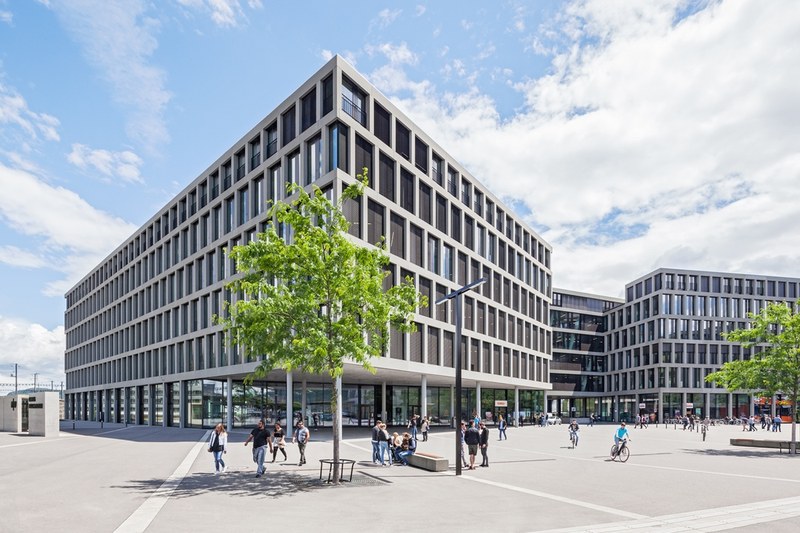
Study location
Student life
Advising and information events
Info-Events
Loading...
Contact

Mira Jeggli
- Phone
- +41 56 202 78 61
- mira.jeggli@fhnw.ch

Dr. iur. Judith Natterer Gartmann
- Phone
- +41 56 202 78 61 (Central office)
- judith.natterer@fhnw.ch

Prof. Dr. Ivan Köhle
- Phone
- +41 56 202 72 73 (Direct)
+41 56 202 77 44 (Central office) - ivan.koehle@fhnw.ch
Registration
Bachelor of Science WirtschaftsrechtSeptember 2026
- Date
- 14.9.2026
- Duration
- 3 to 4 years
- Place
- Brugg-Windisch
- Application start
- 3.11.2025