Skip to main contentSkip to search barSkip to navigationSkip to footer
Logo of the University of Applied Sciences and Arts Northwestern Switzerland
  • DE
  • EN
  • Home

Ten Schools One Goal

The FHNW comprises 10 schools with different specializations. Select a school to see its specific courses, study programmes and information.

Applied Psychology

Architecture, Construction and Geomatics

Art and Design

Music

Computer Science

Life Sciences

School of Education

Social Work

Engineering and Environment

Business

  • Study offerings

    • All degree programmes
    • Bachelor programmes
    • Master programmes
    • Bachelor info events
    • Master info events
  • Study information

    • Why FHNW School of Business
    • Should I study Business?
    • Regulations
    • Student organisations
    • Success stories
  • Study internationally

    • Semester abroad
    • Double Degrees (Bachelor)
    • Dual Degrees (Master)
    • International student projetcs
    • Summer schools and intensive programmes
    • COIL (Collaborative International Learning)
    • Virtual exchange
  • Continuing education offerings

    • All continuing education programmes
    • MBA - Master of Business Administration
    • MAS - Master of Advanced Studies
    • DAS - Diploma of Advanced Studies
    • CAS - Certificate of Advanced Studies
    • Courses and seminars
    • Info events
  • Research

    • Research fields
    • All projects
  • Collaborate with us

    • Student projects
  • International

    • International office
    • China Centre
    • Partner universities
    • Study internationally
    • Study in Switzerland (Incoming Students)
  • Updates and insights

    • News and stories
    • Reports and publications
  • Events

    • All events
    • Information events
  • Media Relations

  • About the School of Business

    • Management
    • How we teach
    • Institutional partnerships
    • Career services
    • People directory
  • Institutes

    • Institute for Finance
    • Institute for Nonprofit- and Public Management
    • Institute for Human Resource Management
    • Institute of Management
    • Institute for Information Systems
    • Institute for Competitiveness and Communication
Logo of the University of Applied Sciences and Arts Northwestern Switzerland
  • About the School
    • Degree Programmes
    • Continuing Education
    • Research and Services
    • News and Events
  • Social Media
    • Facebook
    • Instagram
    • YouTube
    • LinkedIn
    • TikTok
  • About FHNW
    • Organisation
    • Schools
    • Locations
    • FHNW Library
    • Media Relations
  • Support
    • IT Support
    • Inside FHNW
    • Webmail
  • Data Protection
  • Imprint
  • Accessibility
  • Study offerings

    • All degree programmes
    • Bachelor programmes
    • Master programmes
    • Bachelor info events
    • Master info events
  • Study information

    • Why FHNW School of Business
    • Should I study Business?
    • Regulations
    • Student organisations
    • Success stories
  • Study internationally

    • Semester abroad
    • Double Degrees (Bachelor)
    • Dual Degrees (Master)
    • International student projetcs
    • Summer schools and intensive programmes
    • COIL (Collaborative International Learning)
    • Virtual exchange
  • Continuing education offerings

    • All continuing education programmes
    • MBA - Master of Business Administration
    • MAS - Master of Advanced Studies
    • DAS - Diploma of Advanced Studies
    • CAS - Certificate of Advanced Studies
    • Courses and seminars
    • Info events
  • Research

    • Research fields
    • All projects
  • Collaborate with us

    • Student projects
  • International

    • International office
    • China Centre
    • Partner universities
    • Study internationally
    • Study in Switzerland (Incoming Students)
  • Updates and insights

    • News and stories
    • Reports and publications
  • Events

    • All events
    • Information events
  • Media Relations

  • About the School of Business

    • Management
    • How we teach
    • Institutional partnerships
    • Career services
    • People directory
  • Institutes

    • Institute for Finance
    • Institute for Nonprofit- and Public Management
    • Institute for Human Resource Management
    • Institute of Management
    • Institute for Information Systems
    • Institute for Competitiveness and Communication

Type a search term and search continuing education,degree programmes, events, documents and other content.

Master of Science Business Information Systems, FHNW School of Business

School of Business


  • Business
  • Degree programmes
  • Study offerings
  • All degree programmes
All degree programmes
Register now and secure your study place!
bild-msc-bis

In an increasingly connected and digital economy, experts are needed who operate at the intersection of business and IT. The MSc in Business Information Systems prepares you to strategically leverage information systems and drive innovation within organisations.


Factsheet

Degree
Master of Science FHNW in Business Information Systems
Study mode
Full-time and Part-time
Learning environment
Onsite
ECTS points
90
Next start
14.9.2026
Duration
1.5 to 2.5 years
Language
English
Place
Olten and optional Muttenz
Staying abroad
Possible
Application fee
CHF 200
Semester fee
CHF 750 for residents of Switzerland (for details see fees)

At a glance

  • International focus: Entire programme taught in English with optional study abroad opportunities.
  • Flexible study model: Full-time or part-time options with individually chosen specialisations.
  • Strong career prospects: High demand for professionals at the intersection of business and IT.
  • Practice-oriented and innovative: Applied projects and up-to-date content on digitalisation and innovation.
  • PhD option: Possibility to pursue a doctorate in cooperation with partner universities.

Why study this?

Why study Business Information Systems?

In the MSc Business Information Systems, you deepen your expertise at the intersection of business and IT. You learn how to strategically use information systems to develop business models, optimise processes, and drive innovation. In practice-oriented modules and projects, you work on real-world challenges and develop solutions that can be directly applied in companies. Your Master’s thesis allows you to explore a topic of your choice in depth – often in cooperation with a company or in an international context.

The programme has an international focus. All courses are taught in English, and you have the opportunity to complete a semester abroad or pursue a double degree with a partner university.

What skills will you acquire?

  • Interdisciplinary expertise: You will deepen your knowledge in key areas of business information systems – from business process management and business intelligence to strategic innovation – combining business thinking with technological implementation.
  • Practice-oriented learning: Through real-world projects, case studies, and your Master’s thesis, you will apply what you have learned directly and develop solutions to current challenges in the digital economy.
  • Tailored specialisations: You select elective modules based on your interests – for example, in artificial intelligence, agile business analysis, or data-driven innovation – and design your studies accordingly.
  • International environment: The entire programme is taught in English and prepares you for global work environments. Opportunities for exchange semesters and double degrees with partner universities are available.

New responsibilities

caroline-binder.jpg
Caroline Binder, Alumna

"Through the Master’s programme I have become more familiar with processes. This knowledge has enabled me to take on new responsibilities in my job and contribute to the implementation of a new system."

News

What career opportunities are available after graduation?

With the MSc in Business Information Systems, you are well prepared for demanding roles in the digital economy. Whether in consulting, IT management, business analysis, or innovation, your interdisciplinary expertise makes you a sought-after professional. You are ready to take responsibility at the interface between technology and management and to actively support organisations in their digital transformation. A career in academia is also possible – for example, by pursuing a PhD.

Business Analyst

Analysing and optimising business processes through the targeted use of information systems.

IT Project Manager

Responsibility for planning, implementation and success of IT and digitalisation projects.

Enterprise Architect

Designing the IT strategy and aligning it with business goals.

Digital Innovation Manager

Developing and implementing digital business models and innovative solutions.

IT Consultant / Strategy Consultant

Advising organisations on the introduction and improvement of information systems.

Product Owner / Requirements Engineer

Acting as the interface between business and IT; defining and prioritising requirements.

Chief Digital Officer (CDO)

Strategic responsibility for digital transformation (with professional experience).

Leadership in IT or Business Development

Executive roles at the intersection of technology, management and innovation.

Academic Career / Doctorate

Pursuing a scientific career in the field of business information systems.


Structure and programme contents

In the Master’s programme in Business Information Systems, you learn how to actively shape the digital transformation of organisations. You combine business thinking with technological expertise and develop innovative solutions that make a real impact in practice. The core modules cover topics such as business process management, business intelligence, and strategic business development. Elective modules like artificial intelligence, agile business analysis or data-driven innovation allow you to tailor your studies to your individual interests.

Through applied projects and your Master’s thesis, you work on real-world challenges and demonstrate your ability to solve complex problems with practical relevance.

Practice orientation

In the MSc Business Information Systems, practical experience is not just taught – it is lived. You work on real business cases, apply cutting-edge tools and methods, and develop implementable solutions. Many elements of the programme are developed in direct collaboration with companies – including your Master’s thesis, which often addresses concrete industry needs. This gives you valuable hands-on experience and builds a strong professional network while you study.

  • Real project work: You tackle current issues from the business world – often in close cooperation with industry partners.
  • Practice-oriented Master’s thesis: Your thesis is directly linked to real-world problems and delivers tangible value to companies.
  • State-of-the-art tools and methods: You apply technologies and frameworks that are widely used in the field.
  • Lecturers from practice: You learn from professionals who are active in the industry and share their insights directly.
  • Build your network: During your studies, you establish connections with companies and professionals – a real advantage for launching your career.

Study structure

The MSc Business Information Systems adapts to your life – not the other way around. You can study full-time or part-time and structure your programme flexibly. This allows you to successfully balance studies, work and personal life.

Full-time study (3 semesters)

As a full-time student, you can fully focus on your Master’s programme and typically complete your studies in three semesters. You take five modules per semester, each taught in a half-day session – either in the morning (08:15–12:00) or in the afternoon (13:15–17:00). The timetable is published before module enrolment, allowing you to align your choices with your preferences. Lectures are held from Tuesday to Saturday. The study content is structured as follows:

  • Semester 1: Core Modules & Innovation Thinking Project
  • Semester 2: Elective Modules & Master Thesis Proposal
  • Semester 3: Completion of the Master Thesis

The programme can be flexibly adapted to your personal situation.

Part-time study (5 semesters)

The part-time programme allows you to combine your studies with work or family commitments. You typically take three modules per semester, spread over approximately three half-days per week. Many part-time students choose to attend lectures on Saturdays and one additional weekday. Modules are scheduled in half-day blocks – either in the morning (08:15–12:00) or in the afternoon (13:15–17:00). The timetable is available before module enrolment so you can plan around your weekly schedule. The programme structure is as follows:

  • Semesters 1–2: Core Modules & Innovation Thinking Project
  • Semesters 2–5: Elective Modules – freely distributed across the remaining semesters
  • Later in the programme: Research Proposal & Master Thesis
Flexible study model

The flexible study model allows you to structure your Master’s programme to suit your life. You decide the pace, the modules and the duration of your studies – whether full-time, part-time, or a combination of both. Each module is taught in a half-day format, either in the morning (08:15–12:00) or afternoon (13:15–17:00), and you choose which days you attend. An individual study plan over four, six or more semesters is possible. This way, you can successfully balance your studies with work, family or other responsibilities – without compromising on quality.

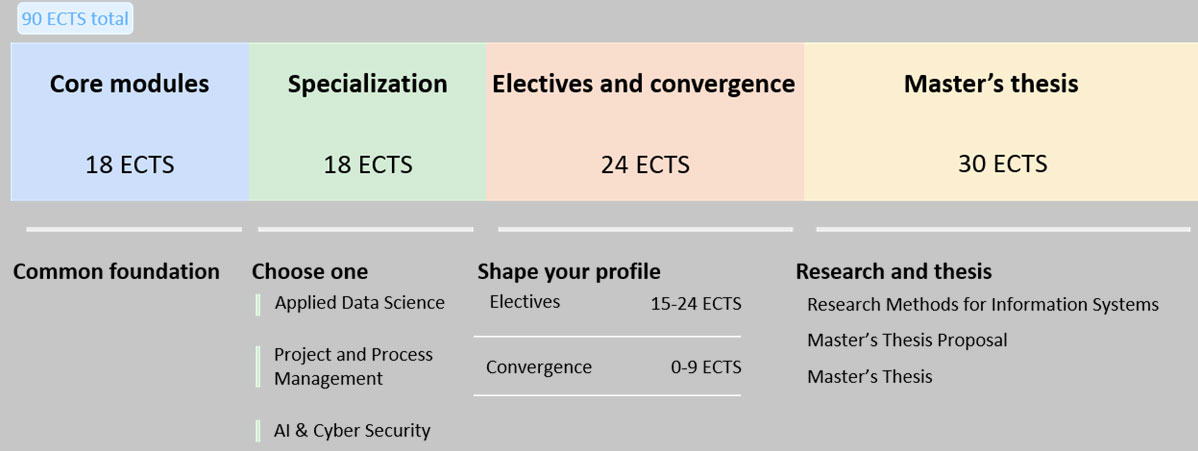
Structure and modules

The MSc in Business Information Systems is structured in a modular format and offers you plenty of flexibility to shape your individual focus areas. You combine solid theoretical knowledge with practical application – and design your studies in a way that aligns with your interests and career goals.

Core Modules

The core modules cover key topics in the field of Business Information Systems and form the academic foundation of your Master's programme.

Module

ECTS

Alignment of Business and IT

6

Business Intelligence

6

Business Process Management

6

Strategic Business Innovation

6

Minimum number of ECTS credits in this module group

24

Elective Modules

The elective modules allow you to customise your degree and focus on areas aligned with your personal interests and career goals.

Module

ECTS

Agile Business Analysis

6

Applied Computational Intelligence

6

Artificial Intelligence for Business Processes

6

Artificial Intelligence in Drug Discovery

3

Business Analytics: Quantitative Methods

6

Challenging International Managers and Leaders

6

Cloud Computing

6

Cyber Security and Cyber Resilience

6

Cyber Security in Health*

3

Data Governance and Information Management

6

Data Science

6

Digital Transformation in Healthcare

6

Digitalisation of Business Processes

6

E-Business and Mobile Business

6

Emerging Topics for Business Information Systems

6

Human-Machine Interaction and Bias Mitigation

3

Innovation in the Digital Age

6

International Field Trip

6

IT Governance, Risk and Compliance

6

Knowledge Processing and Decision Making

6

Lean Entrepreneurship

6

Machine Learning in Medicine

3

Managing IT in a Digitised World

6

Model-based Design of Cyber-Physical Solutions

6

Qualitative Decision Making and Knowledge Management

6

Supply Chain Management

6

User-Centered Design and Usability Testing

3

Independent Learning Module*

6

Minimum number of ECTS credits in this module group

36

*Modules offered by other FHNW faculties or by approved learning partners abroad may replace one of the elective modules listed above.

Research and Innovation Projects

Applied research is a core element of the MSc in Business Information Systems. Through your own research projects, you expand the state of practice and develop new solutions. This deepens your understanding of key concepts and prepares you to become an innovation driver in your organisation.

Module

ECTS

Research Methods for Information Systems

6

Master Thesis Proposal

6

Master Thesis

18

Minimum number of ECTS credits in this module group

30

Research Methods for Information Systems
This advanced course covers both qualitative and quantitative methods. It prepares you for your Master’s thesis by developing key intellectual and practical skills, including how to frame research problems, review literature, formulate questions, apply conceptual frameworks, choose appropriate methodologies, and conduct ethical research. You gain confidence in conducting research across international business contexts and learn to collect, analyse, and critically report on empirical data.

Master Thesis Proposal
In this module, you explore a topic of personal interest and develop a master thesis proposal, including a problem statement, literature review, and research design.

Master Thesis
In the Master Thesis, you address a concrete, practically relevant topic in the field of Business Information Systems. There are two types of Master's theses:

  • Application-Oriented Research: The thesis must be research-based – generating new knowledge, applying scientific methods, and presenting results transparently. It should address a practical business problem and demonstrate real-world impact. Research may be conducted in collaboration with a company in Switzerland or abroad.
  • New Business: This thesis focuses on an innovation with startup potential. It must cover both the technical innovation and the corresponding market research. These two aspects may be explored in two interlinked Master's theses.

International

Double Degree and international exchange opportunities

One of the critical steps in developing a global mindset is familiarity and comfort with non-home country settings. Understanding other countries’ economic, social, political and cultural systems and imprints is key. We offer the opportunity to enhance the Master of Science in Business Information Systems with additional degrees.

University of Camerino (Italy)
In cooperation with the University of Camerino, you can complete an exchange semester and additionally earn a Master's degree in Computer Science.

Institut Teknologi Bandung (Indonesia)
Together with the School of Business and Management at the Institut Teknologi Bandung (ITB), you can obtain a Master's degree in Management.

Additional Degree in International Management at FHNW (Switzerland)
After completing your degree, you can transfer ECTS credits and pursue an additional Master's degree in International Management at FHNW.

Additional Degree in Medical Informatics at FHNW (Switzerland)
As a further option, you can transfer your ECTS credits to pursue a Master's degree in Medical Informatics at FHNW after completing your degree.

Partner universities

A semester abroad at one of our partner universities allows you to combine your studies with international experience. Research projects or your Master’s thesis can often be realised in cooperation with partner universities and local companies.

Cape Peninsula University of Technology (South Africa)
We have established a successful partnership with the Cape Peninsula University of Technology in Cape Town, South Africa.

University of Pretoria, Department of Informatics (South Africa)
The Department of Informatics at the University of Pretoria is another one of our partner universities and offers many opportunities for international experience.

International field trips

Our international study trips take you to places where digital innovation and economic transformation are a lived reality – for example:

  • Silicon Valley (USA)
  • Shenzhen (China)
  • South Africa

You’ll visit companies, meet with senior leaders, take part in cultural activities and apply your knowledge in a final analytical paper. These field trips give you in-depth insights into global markets, systems and ways of thinking.

You will receive ECTS credits for participating in a field trip.


Requirements and admission

Entry requirements

The admission requirements for the Master of Science in Business Information Systems include:

  • Business Informatics
  • Business Information Technology
  • Information Systems
  • Business Administration*
  • Management*
  • Economics*
  • Computer Science*
  • Information Technology*
  • Information Science*
  • Industrial Engineering*
  • or a comparable subject area
  • Good to very good proficiency in English
  • Work experience

Bachelor’s degrees marked with * will be reviewed in detail based on the transcript of records. Missing modules may be completed through a Pre-Master programme.

All applicants who meet the formal requirements will be invited to an interview.

The number of places in the programme is limited.

Pre-Master

If applicants do not yet meet all the academic requirements for the MSc in Business Information Systems, the admissions committee may require them to complete a Pre-Master programme prior to starting the Master's degree.

The following three courses are available:

  • Pre-Master Business Administration
  • Pre-Master Business Process Management
  • Pre-Master Information Systems

These Pre-Master courses are delivered in a distance-learning format. Students required to take a course will receive an access code and individual guidance on how to successfully complete it.

Once the required Pre-Master courses have been successfully completed, students are officially enrolled in the MSc in Business Information Systems.


Organisational matters

Fees

Fee

Frequency

Amount

Application fee

once

CHF 200

Personal tuition fee*

per semester

CHF 750

Copying and material costs

per semester

CHF 100

Student organisation

per semester

CHF 10

Leave of absence

per semester

CHF 100

Diploma fee

once

CHF 300

*Personal tuition fee:

  • CHF 750 per semester for Swiss citizens and holders of a Swiss residence permit not issued specifically for study purposes.
  • CHF 1,000 per semester for EU/EFTA citizens and holders of an EU/EFTA residence permit not issued specifically for study purposes.
  • CHF 7,500 per semester for all other students.

For more information on fees and regulations, please refer to the official document:
Fees and regulations (PDF in German, valid from academic year 2025/2026)

Application

The number of places in the programme is limited.

Apply now

Location

FHNW Campus Olten
Von Roll-Strasse 10
4600 Olten

Lectures for the MSc in Business Information Systems are mainly held at the Olten campus. It is also possible to take elective modules from the School of Life Sciences at the Muttenz campus.

Downloads & Regulations

Flyer Master Business Information Systems (PDF)
Study Regulations of the FHNW School of Business (in German)
Mandatory Notebook Requirement for Students at the FHNW School of Business

The study and examination regulations of the FHNW School of Business define all relevant aspects of your programme. They include information on curriculum structure, performance assessments, examination procedures, and other important rules.


Advising and information events

Info-Events

Loading...

Contact

Nida Sheikh

Nida Sheikh

Administrative Assistant Admission Master of Science in Business Information Systems
Phone
+41 62 957 29 61
E-Mail
nida.sheikh@fhnw.ch
Uri Nahum

Prof. Dr. Uri Nahum

Head of Programmes Intelligent Information Systems
Phone
+41 62 957 21 91
E-Mail
uri.nahum@fhnw.ch

Registration

Places are limited. Please apply early in order to secure entry: until April 30 (start in September) or October 31 (start in February)

Master of Science Business Information Systems
September 2026

Date
14.9.2026
Duration
1.5 to 2.5 years
Place
Olten and optional Muttenz
Application start
3.11.2025
Register

FHNW Campus Olten

FHNW University of Applied Sciences and Arts Northwestern Switzerland

Von Roll-Strasse 10
4600 Olten

+41 84 882 10 11ccc.olten@fhnw.chRoute plannerMore information

School of
Business FHNW University of Applied Sciences and Arts Northwestern Switzerland

  • About the School
    • Degree Programmes
    • Continuing Education
    • Research and Services
    • News and Events
  • Social Media
    • Facebook
    • Instagram
    • YouTube
    • LinkedIn
    • TikTok
  • About FHNW
    • Organisation
    • Schools
    • Locations
    • FHNW Library
    • Media Relations
  • Support
    • IT Support
    • Inside FHNW
    • Webmail
Logo FHNW - 20 Years
Logo Swiss Universities
Logo European University Association
Logo AACSB International
© University of Applied Sciences and Arts Northwestern Switzerland (FHNW)
  • Data Protection
  • Imprint
  • Accessibility
  • DE
  • EN