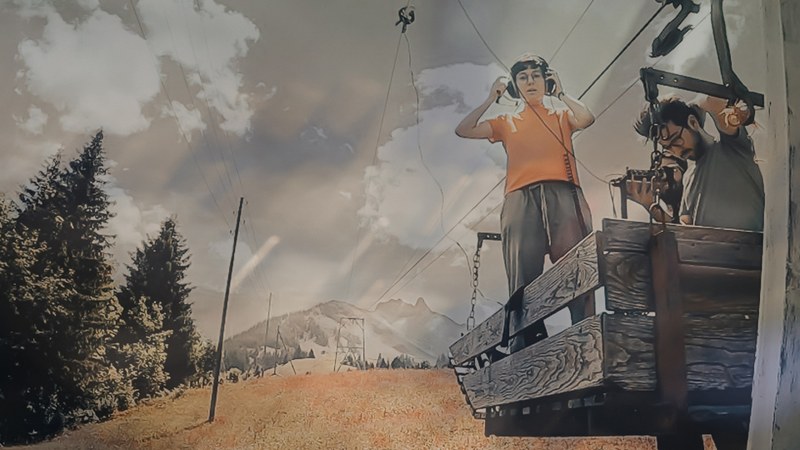
Thinking of choosing a specialisation or Music Pedagogy as a second master’s degree? Why not both? Students who have already completed a master’s degree in Performance, instrument/voice have the opportunity to combine artistic-scientific research with a teaching qualification for their own instrument as part of an MA in Music Pedagogy. This dual profile expands your professional opportunities: Acquiring in-depth research skills through one's own pedagogical-focused research project and simultaneously developing the own practical teaching skills.
Factsheet
- Degree
- Master of Arts FHNW in Musikpädagogik, Studienrichtung instrumental/vokal, Zweites künstlerisches Hauptfach Music and Research
- Study mode
- Full-time
- Learning mode
- Onsite
- ECTS credits
- 120
- Next start
- 14.9.2026
- Duration
- 4 semesters
- Stay abroad
- To be clarified individually
- Application fee
- 200 CHF
- Semester fee
- Second major 800 CHF
At a glance
- Become familiar with research methods and discourses in music education research and present your own research findings in written and oral form.
- Parallel practical pedagogical training for your own instrument; degree with the MA in Music Education (instrumental/vocal) required for employment at music schools.
- Special features: peer-to-peer learning, participation in project and ensemble activities
- offers the prospect of subsequent doctoral studies
- Requires a diploma in MA instrumental or vocal performance (or equivalent training)
Why Study This?
The Master's degree in Music Pedagogy with a major in music and research, acquire a dual profile:
Students of this programme find employment as musicians in the independent scene, as teachers, and at institutions engaged in research activities. The dual qualification allows them to work in particular at the interface between different disciplines: they can develop well-founded music education projects, accompany festivals, event series and new performance formats in terms of music education and research, and thus mediate between music education practice and research. In addition, this master's degree can serve as preparation for a doctorate.
With the pedagogical qualification, they are also enabled to subsequently teach their instrument both in musical educational institutions and independently. Nearly all music schools in Switzerland now require prospective teaching staff to have a Master of Arts in Music Pedagogy instrument/voice.
This programme is aimed at musicians who wish to engage in targeted and in-depth research in music education. Enrolment in the Master's programme in Music Pedagogy instrument/voice with a second artistic Major in Music and Research requires a Master's degree in vocal or instrumental performance and enables students to combine their artistic and academic specialisation in Music and Research with a Master's degree in pedagogy for their own instrument. The major Music and Research replaces the artistic major instrumental/vocal.
Prospective doctoral student
The MA MP with Music and Research as a second major is suitable for students who are interested in pursuing a doctorate (artistic-scientific doctorate or Dr. phil.). They benefit in particular from the close cooperation between the MA SP Music and Research and the Musicology Seminar at the University of Basel and the jointly conducted doctoral project Musikwissen (degree: Dr. phil.). The 35 ECTS credits required for admission to Musicology at Master's level can be covered to a large extent by the coursework completed in Music and Research, depending on the individual composition of the curriculum.
Informationen für Studierende/PhD
Structure and programme contents
The BA and MA degree programmes at the Basel Academy of Music are based on modules.
The legally binding structure provides an initial guide to the content and weighting of the subjects on the degree programme.
The detailed content and modalities of the individual subjects can be found in the module descriptions.
The study regulations come into force together with the study and examination regulations of the Basel Academy of Music FHNW and form the legal framework.
Structure
Module descriptions
Study Regulations
Lecturers

Requirements, Admission, Entrance Exam
In order to enter the FHNW Master of Arts in Music Pedagogy programme with a Music and Research major, applicants must be awarded with a Master in Music Performance with an instrumental/vocal major or equivalent as well as they must have passed the entrance exam and were offered a free place at the Academy (limited places). Applicants who have submitted all the necessary registration documents in time and have passed the first round of the entrance exam will be invited to the second round.
For further information on the admission criteria, please see the Studienreglement Master of Arts FHNW in Musikpädagogik.
We expect students to have very good German language skills.
Students who are not German native speakers must present at least a B1 German language certificate (according to the Common European Framework of Reference for Languages).* This certificate must be complete, i.e. all modules (reading, listening, writing, speaking) have been tested separately and passed at a minimum level of B1 overall.
Only certificates that have been certified with the ALTE-Q-Mark seal of approval (e.g. the B1 certificate of the Goethe Institute or the telc certificate) are accepted. The required certificate B1 must be submitted with the confirmation of admission but not later than 31 May.
*For Swiss citizens whose native language is not German, the Matura is considered equivalent to the required language certificate, provided that the subject German was completed with at least a ‘sufficient/genügend’ grade.
For this Study course English knowledge is recommended.
With regard to the artistic-scientific major subject, excellent written and spoken English skills are also strongly recommended (level C1 - C2).
Entrance Exam
The entrance exam is individual for each study programme direction.
Dates
Procedure
Organisational Matters
More Study variations
Projects / Ensembles
Quicklinks
Files and Regulations
Advising and information events
Contact
Student Administration Academy of Music, Klassik
- Phone
- +41 61 264 57 32 (Direct)
- klassik.hsm@fhnw.ch
Prof. Annekatrin Klein
- Phone
- +41 61 264 58 36
- annekatrin.klein@fhnw.ch
Prof. Dr. Anne-May Krüger
- annemay.krueger@fhnw.ch
Information events
Loading...
Registration
MA Music Pedagogy | instrument / voice | Music and Research
- Date
- 14.9.2026
- Duration
- 4 semesters
- Place
- Basel, Campus Musik-Akademie
- Notes
- Mandatory events take place before the start of the semester. Details will be sent out by the student administration.