Skip to main contentSkip to search barSkip to navigationSkip to footer
Logo of the University of Applied Sciences and Arts Northwestern Switzerland
Degree Programmes
Continuing Education
Research and Services
International
About FHNW
DeEn
Locations and ContactFHNW LibraryMedia Relations
Logo of the University of Applied Sciences and Arts Northwestern Switzerland
  • Degree Programmes
  • Continuing Education
  • Research and Services
  • International
  • About FHNW
DeEn
Locations and ContactFHNW LibraryMedia Relations

Apply
MA Contemporary music

Studying Music...
Studying at Bas...
Master of Arts in...
Creative Interp...

Creative Interpretation in New Music

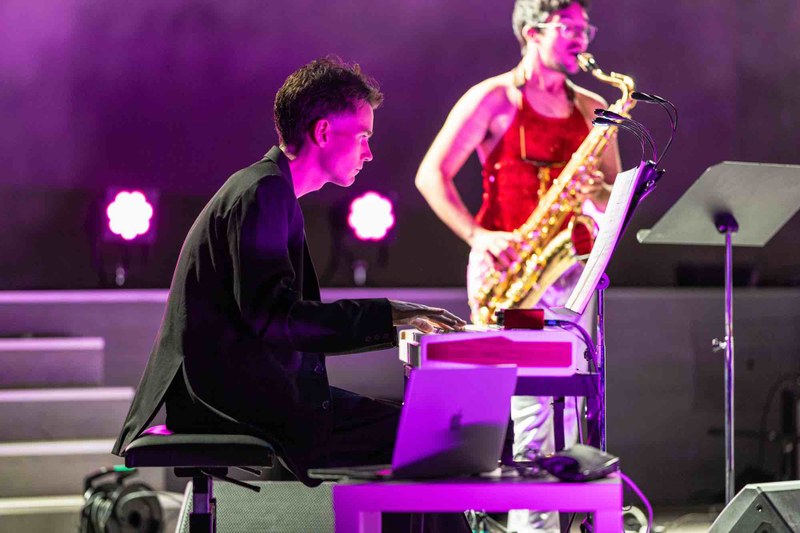
Creative interpretation of new music in the context of sonic space basel: composition, contemporary performance, open creation, audio design and new music theory are brought together here. Collaborations with the beacons of the international new music scene in the context of more than 50 public performances each year guarantee innovation, artistic excellence and a high level of networking opportunities. The work structure is modular, diverse and collaborative.

Key data

Degree
Master of Arts FHNW in Spezialisierter Musikalischer Performance, Creative Interpretation in New Music
ECTS points
120
Study start
Beginning of September
Studying mode
Full time
Duration
4 semesters
Teaching language
German/English
Place
Campus Musik-Akademie Basel
Application fee
200 CHF
Semester fee
750 CHF (CH) | 1000 CHF (EU/EFTA) | 1250 CHF (Not-EU/Not-EFTA) More Fees

You may apply between 15th December and 1st March.

Go to information eventsApply now

Mobile navi goes here!

  • In-depth examination of the broad spectrum of contemporary music-making through collaborative exchange
  • Individual specification of the study programme to a large extent
  • Supplementary modules in theory, reflection, communication and marketing

Why study this?

Learning outcomes

Due to its high level of specialisation, the FHNW Master of Arts in Specialized Musical Performance with Creative Interpretation in New Music Major generally builds on a Master's degree in music pedagogy or musical performance (or equivalent qualification). The core instrumental/vocal skills acquired there are brought up to the highest international standards in the field of contemporary music creation and ensemble work, enabling students to achieve exceptional performances on national and international stages.

Career prospects

Students of this programme find employment in the independent scene and specialised ensembles for contemporary music. They can establish their own ensembles, design and curate festivals, event series and new performance formats in order to position them in the market on both analogue and digital platforms.

Target audience

This study course programme is aimed at musicians who, building on comprehensive instrumental/vocal training, want to engage specifically and in depth with contemporary music, with a view to their professional future in this field.

Study variant available:
The combined master's program – Creative Interpretation in New Music and education in music pedagogy

MA Music Pedagogy | instrument/voice | Creative Interpretation in New Music

Students who already hold a master's degree in Music Performance with an instrumental/vocal major have the possibility to combine in one Master of Arts in Music Pedagogy programme artistic specialization in Creative Interpretation in New Music and pedagogical education in their own instrument. This dual profile considerably expands their career opportunities.  More

Opening horizons with contemporary music?
Is there still something new to discover?

Impressionen of and with Helmut Lachenmann at the Basel Academy of Music

Structure and Content

Alongside their tutoring duties, the programme's artistic directors help students create their personalised study programme and support them at every stage of the Master's thesis process. They also advise students on the choice of lecturers for their individual classes, offered either within the Academy of Music or in other parts of Europe. As part of the Creative Interpretation in New Music Major, students will also take theory, communication and networking modules at the FHNW Academy of Music. They will work with sonic space basel to develop concert and performance projects, which will ultimately be staged at national and international festivals. Collaboration and interdisciplinarity are core components of the curriculum.

Specials

  • In addition to individual lessons, 17 freely selectable lessons at and outside HSM Basel
  • Eduard Brunner Composition Prize: Every year, one of our students is awarded a composition prize worth CHF 5,000 as part of an internal sonic space basel competition.
  • Annual artistic cooperation with a university/college outside Switzerland

zone expérimentale – the contemporary chamber music ensemble

In addition to basic practical and theoretical training, collaboration with the 'zone expérimentale' ensemble on contemporary chamber music is a central focus of the Creative Interpretation in New Music Major. As well as working with tutors from around the world, students will regularly hone their contemporary collective practice at the Studio/LAB for Creative Interpretation in New Music. They will also have the opportunity to attend workshops, seminars, masterclasses and colloquia hosted and given by their Creative Interpretation in New Music Major tutors and/or guest lecturers.

Modules and Reglements

The BA and MA degree programs at the Basel Academy of Music are based on modules.

The legally binding structure provides an initial guide to the content and weighting of the subjects on the degree programme.
The detailed content and modalities of the individual subjects can be found in the module descriptions.
The study regulations come into force together with the study and examination regulations of the Basel Academy of Music FHNW and form the legal framework.

Structure

Structure

Structure MA SP Klassik Contemporary Music in German

Module descriptions

Module descriptions

Below please find the link with all the information on the module descriptions of several FHNW universities.

  • Switch the language settings to English.
  • Filter by semester, Hochschule für Musik Basel FHNW, the desired degree programme or other criteria to display the relevant module information.
  • Use the PDF button to call up a document from each overview and save it for yourself.
  • Course registrations are made via the intranet.
Study Regulations

Study Regulation MA Specialised Musical Performance in German

Lecturers

Loading
Loading

Requirements, Admission, Entrance Exam

Admission criteria

In order to enter the FHNW Master of Arts in Specialized Music Performance programme with a Creative Interpretation in New Music Major, applicants must be awarded a Master in Music Performance with an instrumental/vocal major or a Master in Music Pedagogy or equivalent (with corresponding instrumental/vocal level), as well as they must have passed the entrance exam and were offered a free place at the Academy (limited places). Applicants who have submitted all the necessary registration documents in time will be invited to the online entrance exam.
For further information on the admission criteria, please see the Studienreglement of the Master of Arts FHNW in Specialized Music Performance.

Required skills

  • Excellent knowledge of the “classical/classic” repertoire on own instrument.
  • High instrumental proficiency.
  • Independent, artistic ability and high level of motivation to develop and hone an individual repertoire.
  • High level of motivation to engage with different forms of contemporary music and their aesthetic, technical and historical context. 

Language Skills

Sufficient knowledge of German is recommended but not required.

Entrance Exam

Dates

Registration
You may apply between 15th December and 1st March.
Along with the registration, it is mandatory to submit the following documents: 

  • A curriculum vitae, a motivational letter, a short biography
  • The school leaving qualification, the Bachelor Diploma, the Master Diploma (if available)
  • Wishlist with five chamber music works that you want to acquire during the study course
  • A video with a Programme of 30-40 minutes not less than three works of the 20th/21st century (various genres) of which at least one must be from the past 20 years.
    One representative work (or a movement/excerpt from a work) from the classic classical repertoire
  • List of works with the works/movements/excerpts of the video

On-site
The online-conversation will take place at the end of April. The exact dates may be seen here.

Announcement of the results
The results will be communicated by mail in May.

Procedure

The entrance exam is split into two parts. 

Procedure
First round: Video recording
Applicants must submit a video when registering.
The length of the video should be between 30-40 minutes, with not less than three works of the 20th/21st century (various genres) of which at least one must be from the past 20 years and one representative work (or a movement/excerpt from a work) from the classic classical repertoire.

Video requirements
The single works/movements submitted must indispensably be recorded without any cuts. If applicants submit one straight video with the whole programme, the applicant must set marks after every work/movement so that it is possible for the jury to purposely skip within the video.
Microphone: We recommend using a suitable stereo microphone and place it conveniently. If necessary, you may also use the microphone of a camera, computer, or smartphone. Please record the video from a fixed point of view. The hands and the face of the musician must be visible.
Please upload the video onto YouTube and add the link to your list of works and in the registration tool. Please add the link to your application or send it by mail to  registration.hsm@fhnw.ch until 1st March at the latest.

Second round: Online-Conversation
After reviewing the submitted portfolio, the jury will invite chosen applicants for an online interview (ca. 30 minutes) by videoconference/zoom.

Overview MA Music Pedagogy Creative Interpretation in New Music

Supplementary key data Variant MP Creative Interpretation in New Music

Degree
MA FHNW in Musikpädagogik, Studienrichtung instrumental/ vokal, Zweites künstlerisches Hauptfach Zeitgenössische Musik

Teaching language
German/English
Level B1 is required for the German language in the MA MP.

Semester fee Second major
800 CHF

Learning outcomes

Registration for the second artistic Major Contemporary music as part of the Master of Arts FHNW in Music Pedagogy instrument/voice requires a completed Master's degree in vocal or instrumental performance for voice or piano. The core competencies on the instrument, in singing, in the field of contemporary music creation and ensemble work acquired prior to this programme are pursued to a level that matches the highest international levels. By this way, exceptional standards may be achieved on the national and international concert stage and at competitions. 

In addition to the artistic training, the practice-oriented, concentrated pedagogical training enables the students to teach the instrument studied in the first master's programme professionally in individual and group lessons at musical educational institutions or independently at all levels.

Target audience

This study programme is aimed at musicians who wish to build on their comprehensive instrumental/vocal training by specialising in the field of the Contemporary Music, with a view to a career in this field. Enrolment in the corresponding Master's programme in Music Pedagogy instrument/voice requires a Master's degree in vocal or instrumental performance and enables students to combine their artistic profile with a Master's degree in pedagogy for their own instrument.

Career prospects

The Master's degree in Music Pedagogy instrument/voice (second artistic Major Contemporary music) allows students to acquire a dual profile:
The degree programme equips students to pursue a career as a professional performer in a contemporary music ensemble or in the open music scene. It also provides them with the knowledge and skills to set up their own ensembles, design and curate concert series and other performance formats, and successfully market their ventures on both analogue and digital platforms. Furthermore, the pedagogical Master's qualification enables them to teach their instrument in music education institutions as well as independently.

Structure / Module descriptions

Structure

Second Major: Contemporary Music
Structure MA MP Klassik instrumental/vocal 2Major Contemporary Music in German

Module descriptions

Below please find the link with all the information on the module descriptions of several FHNW universities.

  • At the top right, switch the language settings to English.
  • At the bottom right, filter by semester, Hochschule für Musik Basel FHNW, the desired degree programme or other criteria to display the relevant module information.
  • Use the PDF button at the top left to call up a document from each overview and save it for yourself.
  • Course registrations are made via the intranet.
Admission/Entrance exam

Admission criteria
In order to enter the FHNW Master of Arts in Music Pedagogy programme with a Contemporary Music major, applicants must be awarded with a Master in Music Performance with an instrumental/vocal major or equivalent as well as they must have passed the entrance exam and were offered a free place at the Academy (limited places).
Applicants who have submitted all the necessary registration documents in time and have passed the first round of the entrance exam will be invited to play a live audition. For further information on the admission criteria, please see the Studienreglement of the Master of Arts FHNW in Music Pedagogy.

Required skills

  • Excellent knowledge of the “classical/classic” repertoire on own instrument.
  • High instrumental proficiency.
  • Independent, artistic ability and high level of motivation to develop and hone an individual repertoire.
  • High level of motivation to engage with different forms of contemporary music and their aesthetic, technical and historical context.
  • Pedagogical interest and appropriate aptitude

Language Skills
We expect students to have very good German language skills at the beginning of the studies. Students who are not German native speakers must at least present a B1 German language certificate according to the Common European Framework of Reference for Languages (CEFR) at the beginning of the studies. This certificate must be complete, i.e. all modules (reading, listening, writing, speaking) have been tested separately and passed at least at level B1 overall. Only certificates that have been certified with the ALTE-Q-Mark seal of approval (e.g. the B1 certificate of the Goethe-Institut or the telc certificate) are accepted. The required certificate B1 must be submitted with the confirmation of admission but not later than Mai 31. Exceptions will be decided upon by the head of degree programme.

Aptitude Assessment 
The aptidude assessment is split into several parts:

Procedure
Conversation:
After reviewing the submitted portfolio, the jury will invite chosen applicants for an online interview (ca. 30 minutes) by videoconference/zoom.

Pedagogical aptitude assessment (external applicants)
Candidates who are invited to the second round (on-site audition) are asked to submit a video of a demonstration lesson of 20' duration with a student of their own instrument. The student can be beginner or advanced and there is no age limit. If possible, the lesson should be held in German. If this is not possible for organizational reasons, the lesson must either be held in English or the video must be subtitled accordingly.  The recording must not be older than 6 months. Please upload the video onto Youtube and send the following information/documents by April 10 to registration.hsm@fhnw.ch by mail:

  • the link
  • information about the student (age and characteristics, since when)
  • copies of the sheet music used (if applicable)
  • a short written reflection of your lesson 

Pedagogical aptitude assessment (internal applicants)
For internal applicants, the pedagogical aptitude test takes place on-site during the spring semester (after the head of degree programme has been able to check whether a place is available). The dates will be communicated individually.
The pedagogical aptitude test consists of a demonstration lesson of 20' duration (the allocation of students is taken on by the subject didactics teachers) in German language and a reflection talk following the lesson.

Dates
The exact dates for the aptitude assessment by zoom meeting may be seen here.

Registration
You may apply between 15th December and 15th February. Along with the registration, it is mandatory to submit the following documents:  

To be submitted by PDF:

  • A short biography
  • the school leaving qualification, the Bachelor Diploma, the Master Diploma
  • Wishlist with five chamber music works that you want to acquire during the study course
  • List of works with the works/movements/excerpts of the video 

To be submitted by video (Programme of 30-40 minutes)

  • Not less than three works of the 20th/21st century (various genres) of which at least one must be from the past 20 years
  • One representative work (or a movement/excerpt from a work) from the classic classical repertoire 

Video requirements
The single works/movements submitted must indispensably be recorded without any cuts.
If applicants submit one straight video with the whole programme, the applicant must set marks after every work/movement so that it is possible for the jury to purposely skip within the video.
Microphone: We recommend using a suitable stereo microphone and place it conveniently. If necessary, you may also use the microphone of a camera, computer, or smartphone.
Please record the video from a fixed point of view. The hands and the face of the musician must be visible.
Please upload the video onto YouTube and add the link to your list of works and in the registration tool. Please add the link to your application or send it by mail to registration.hsm@fhnw.ch until 15th February at the latest.

Announcement of the results
The results will be communicated by mail in May.

Organisational Matters

sonic space basel

sonic space basel is a Platform of Basel Academy of Music for Audio Design (BA and MA), Composition (BA and MA and MA SP), MA SP Creative Interpretation in New Music, BA Music Theory Major, MA MP Music Theory, MA SP New Music Theory, MA SP Open Creation and Research. We consider ourselves a laboratory, a communication tool and an information hub for contemporary music.

Projects / Ensembles

At Hochschule für Musik Basel, students have the opportunity to participate in various project and ensemble programmes.
To the overview of the recurring offers.

Quicklinks
  • Welcome: A brief overview
  • Studying in Switzerland
  • Tuition fees & Financing
  • Scholarship
  • Module descriptions
Files and Regulations
  • Dates Entrance Exam on Site
  • List of works for Entrance Exam
  • Study Regulations
  • Semester dates

Contact and Info-Event

Loading
Loading

Registration

You may apply between 15th December and 1st March.

Helmut Lachenmann at the Basel Academy of Music

Basel Academy of Music

Basel Academy of Music

An international institute of higher education and research

No social media links available.

Degree Programmes

MA Specialized Musical Performance Institut Klassik
null null
Student Administration Academy of Music, Klassik
Telephone

+41 61 264 57 32 (undefined)

E-mail

klassik.hsm@fhnw.ch

Address

Leonhardsstrasse 6 4009 Basel

Room

6-001

Availability

Monday - Thursday 10.00 - 12.00 h 14.00 - 16.00 h Friday 10.00 - 12.00 h

Uli Fussenegger

Prof. Uli Fussenegger

Head and Coordination Contemporary Music

Telephone

+41 61 264 56 19

E-mail

uli.fussenegger@fhnw.ch

Address

Hochschule für Musik Basel Leonhardsstrasse 6 4009 Basel

hsm_sp_klassikhsm_researchhsm_sounddesignhsm_kreation.komposition,improvisation_en

What we offer

  • Degree Programmes
  • Continuing Education
  • Research and Services

About FHNW

  • Schools
  • Organisation
  • Management
  • Facts and Figures

Information

  • Data Protection
  • Accessibility
  • Imprint

Support & Intranet

  • IT Support
  • Login Inside-FHNW

Member of: