Skip to main contentSkip to search barSkip to navigationSkip to footer
Logo of the University of Applied Sciences and Arts Northwestern Switzerland
  • DE
  • EN
  • Home
  • Degree programmes
  • Continuing education

Ten Schools One Goal

The FHNW comprises 10 schools with different specializations. Select a school to see its specific courses, study programmes and information.

Applied Psychology

Architecture, Construction and Geomatics

Art and Design

Music

Computer Science

Life Sciences

School of Education

Social Work

Engineering and Environment

Business

  • Research

    • Research fields
    • Projects
  • Updates and insights

    • News and stories
  • Events

  • Media corner

  • About the School of Engineering and Environment

    • People directory
    • Management Board
  • Institutes

    • Institute of Automation
    • Institute of Bioenergy and Resource Efficiency
    • Institute of Business Engineering
    • Institute of Electric Power Systems
    • Institute of Humanities and Social Sciences
    • Institute of Polymer Engineering
    • Institute of Mathematics and Natural Sciences
    • Institute of Polymer Nanotechnology
    • Institute of Optometry
    • Institute of Product and Production Engineering
    • Institute for Sensors and Electronics
    • Institute of Thermal and Fluid Engineering
    • Laboratories of the School of Engineering and Environment
Logo of the University of Applied Sciences and Arts Northwestern Switzerland
  • About the School
    • FHNW School of Engineering and Environment
    • Degree Programmes
    • Continuing Education
    • Collaboration in Research and Services
  • Social Media
    • LinkedIn
    • Instagram
    • Facebook
    • TikTok
    • YouTube
  • About FHNW
    • Organisation
    • Schools
    • Locations
    • FHNW Library
    • Media Relations
  • Support
    • IT Support
    • Inside FHNW
    • Webmail
  • Data Protection
  • Imprint
  • Accessibility
  • Research

    • Research fields
    • Projects
  • Updates and insights

    • News and stories
  • Events

  • Media corner

  • About the School of Engineering and Environment

    • People directory
    • Management Board
  • Institutes

    • Institute of Automation
    • Institute of Bioenergy and Resource Efficiency
    • Institute of Business Engineering
    • Institute of Electric Power Systems
    • Institute of Humanities and Social Sciences
    • Institute of Polymer Engineering
    • Institute of Mathematics and Natural Sciences
    • Institute of Polymer Nanotechnology
    • Institute of Optometry
    • Institute of Product and Production Engineering
    • Institute for Sensors and Electronics
    • Institute of Thermal and Fluid Engineering
    • Laboratories of the School of Engineering and Environment

Type a search term and search continuing education,degree programmes, events, documents and other content.

  • Engineering and Environment
  • About us
  • Institutes
Institutes

Free-space optical communication with a high-altitude balloon, FHNW School of Engineering and Environment

School of Engineering and Environment


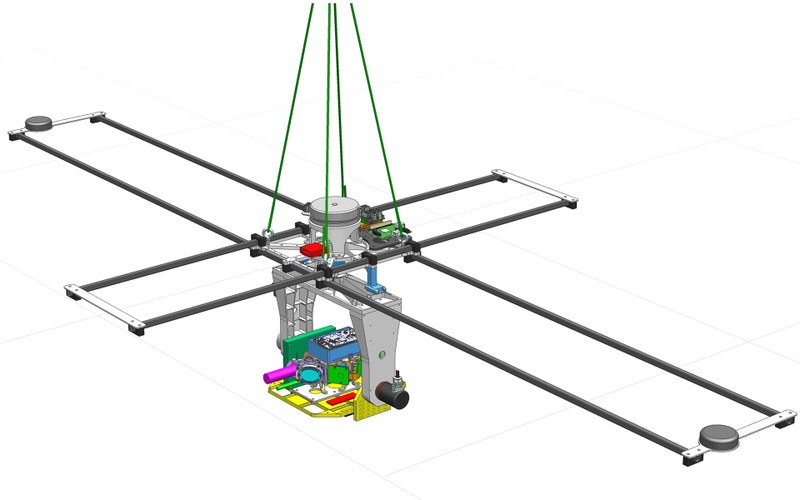
The FHNW Institute for Sensors and Electronics currently develops an optical receiver and a 2-axis gimbal for a high-altitude balloon (HAB) platform to demonstrate free-space optical communication (FSOC).
Project details

University
FHNW School of Engineering and Environment / School of Engineering and Environment, lnstitute for Sensors and Electronics

Technology

Optical sensors and 2-axis gimbal with dc servo-motor control for a high-altitude balloon.

Objectives

Demonstration of free-space optical communication with a HAB platform. We advance on the optical payload and gimbal to also carry out atmospheric scintillation and fading measurements in future experiments.

Starting situation

Free-space optical communication is considered a next-generation technology. Large bandwidth, license-free spectrum, high data rate, less power and low mass requirements make it appealing for high-speed data links. However, atmospheric turbulence is a major challenge that may lead to serious degradation in bit error rate.

In order to measure primary fading causes for FSOC we currently develop a HAB-gimbal system. Other communication schemes, detectors or flight hardware can also be tested under near-space conditions with our system.

Results

A test flight with a HAB to 38.5 km altitude has been carried out. It has been shown that the 2-axis gimbal is capable of stabilizing an optical payload to better than one degree precision.

Projekt-Information

Client

Facebook Connectivity Lab, Menlo Park

Execution

FHNW Institute for Sensors and Electronics, FHNW Institute of Product and Production Engineering

Duration

1 Year

Team

Prof. Dr. Christoph Wildfeuer (Lead), Prof. Dr. Hans-Peter Gröbelbauer, Nico Gradwohl, Simon Gerber

Contact

Prof. Dr. Christoph Wildfeuer

Lecturer for Sensor Technology, Head of the Quantum Technologies working group
Phone
+41 56 202 86 46
E-Mail
christoph.wildfeuer@fhnw.ch

School of
Engineering and Environment FHNW University of Applied Sciences and Arts Northwestern Switzerland

  • About the School
    • FHNW School of Engineering and Environment
    • Degree Programmes
    • Continuing Education
    • Collaboration in Research and Services
  • Social Media
    • LinkedIn
    • Instagram
    • Facebook
    • TikTok
    • YouTube
  • About FHNW
    • Organisation
    • Schools
    • Locations
    • FHNW Library
    • Media Relations
  • Support
    • IT Support
    • Inside FHNW
    • Webmail
Logo FHNW - 20 Years
Logo Swiss Universities
Logo European University Association
© University of Applied Sciences and Arts Northwestern Switzerland (FHNW)
  • Data Protection
  • Imprint
  • Accessibility
  • DE
  • EN