Skip to main contentSkip to search barSkip to navigationSkip to footer
Logo of the University of Applied Sciences and Arts Northwestern Switzerland
  • EN
  • Home
  • Degree programmes
  • Continuing education

Ten Schools One Goal

The FHNW comprises 10 schools with different specializations. Select a school to see its specific courses, study programmes and information.

Applied Psychology

Architecture, Construction and Geomatics

Art and Design

Business

Computer Science

Engineering and Environment

Life Sciences

Music

School of Education

Social Work

  • Research

    • Research fields
    • Projects
  • Updates and insights

    • News and stories
  • Events

  • Media corner

  • About the School of Engineering and Environment

    • People directory
    • Management Board
  • Institutes

    • Institute of Automation
    • Institute of Bioenergy and Resource Efficiency
    • Institute of Business Engineering
    • Institute of Electric Power Systems
    • Institute of Humanities and Social Sciences
    • Institute of Polymer Engineering
    • Institute of Mathematics and Natural Sciences
    • Institute of Polymer Nanotechnology
    • Institute of Optometry
    • Institute of Product and Production Engineering
    • Institute for Sensors and Electronics
    • Institute of Thermal and Fluid Engineering
    • Laboratories of the School of Engineering and Environment
Logo of the University of Applied Sciences and Arts Northwestern Switzerland
  • About the School
    • FHNW School of Engineering and Environment
    • Degree Programmes
    • Continuing Education
    • Collaboration in Research and Services
  • Social Media
    • LinkedIn
    • Instagram
    • Facebook
    • TikTok
    • YouTube
  • About FHNW
    • Organisation
    • Schools
    • Locations
    • FHNW Library
    • Media Relations
  • Support
    • IT Support
    • Inside FHNW
    • Webmail
  • Data Protection
  • Imprint
  • Accessibility
  • Research

    • Research fields
    • Projects
  • Updates and insights

    • News and stories
  • Events

  • Media corner

  • About the School of Engineering and Environment

    • People directory
    • Management Board
  • Institutes

    • Institute of Automation
    • Institute of Bioenergy and Resource Efficiency
    • Institute of Business Engineering
    • Institute of Electric Power Systems
    • Institute of Humanities and Social Sciences
    • Institute of Polymer Engineering
    • Institute of Mathematics and Natural Sciences
    • Institute of Polymer Nanotechnology
    • Institute of Optometry
    • Institute of Product and Production Engineering
    • Institute for Sensors and Electronics
    • Institute of Thermal and Fluid Engineering
    • Laboratories of the School of Engineering and Environment

Type a search term and search continuing education,degree programmes, events, documents and other content.

  • Engineering and Environment
  • About us
  • Institutes
  • Research Projects
Research Projects

SONDER - Service Optimization of Novel Distributed Energy Regions, FHNW School of Engineering and Environment

School of Engineering and Environment


The project focuses on the operation of a battery energy storage system installed in a distribution grid using optimization schemes and load forecasting tools.
Project details

University
FHNW School of Engineering and Environment / School of Engineering and Environment


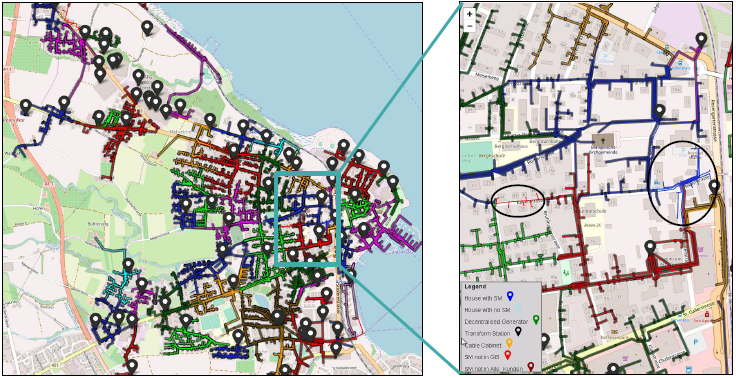
Figure 1: Representation of electric power distribution network in Arbon city

Background

The Swiss Distribution System Operator Arbon Energie AG was motivated to install a central battery energy storage system (BESS) in the distribution grid of Arbon. Albeit the BESS provides ancillary and operation services, there is a discussion for additional services mainly for the higher exploitation of BESS potential, while increasing the economic viability of BESS project. In particular, the BESS will be used to flatten the power demand profile by storing energy during off-peak periods and releasing it during peak load periods. So far, load forecasting is carried out for energy trading purposes, however, more accurate predictions are needed to reduce the power peaks and operate the BESS properly.


Figure 2: Interior of a representative BESS container (Ref. Arbon Energie AG)

Goals

  • Evaluation of the flexibility potential gained by the application of the proposed optimization schemes for the BESS operation.
  • Assessment of advanced graph-based machines learning techniques combined with clustering methods for the improvement of load forecasts in different levels of Arbon distribution network.
  • Combination of the optimization scheme with the most suitable forecasting method to eliminate the forecasting errors and to maximize the profits gained through peak power shaving when operating properly the central BESS unit.

Results

From the evaluation of a centralized BESS control scheme for winter and summer months, the following conclusions were extracted:

  • The BESS can achieve considerable monthly cost reductions of about 10’500 CHF mainly owing to peak power shaving.
  • Peak power shaving of about 1.22 MW can be achieved regardless of the peak power value.
  • The optimization scheme can reduce both global and local maximum powers of the load demand curve.
  • No unexpected peak power increases were noticed during the simulated months when applying the centralized control scheme.
  • The focus should be given on peak power shaving, since the other objectives of the optimization scheme have slight variations that can be omitted.

Figure 3. Results of January when applying the optimization scheme: (a) Power on secondary side of distribution transformer 110/17kV, (b) EPEX spot Price for Switzerland, (c) State of Charge.
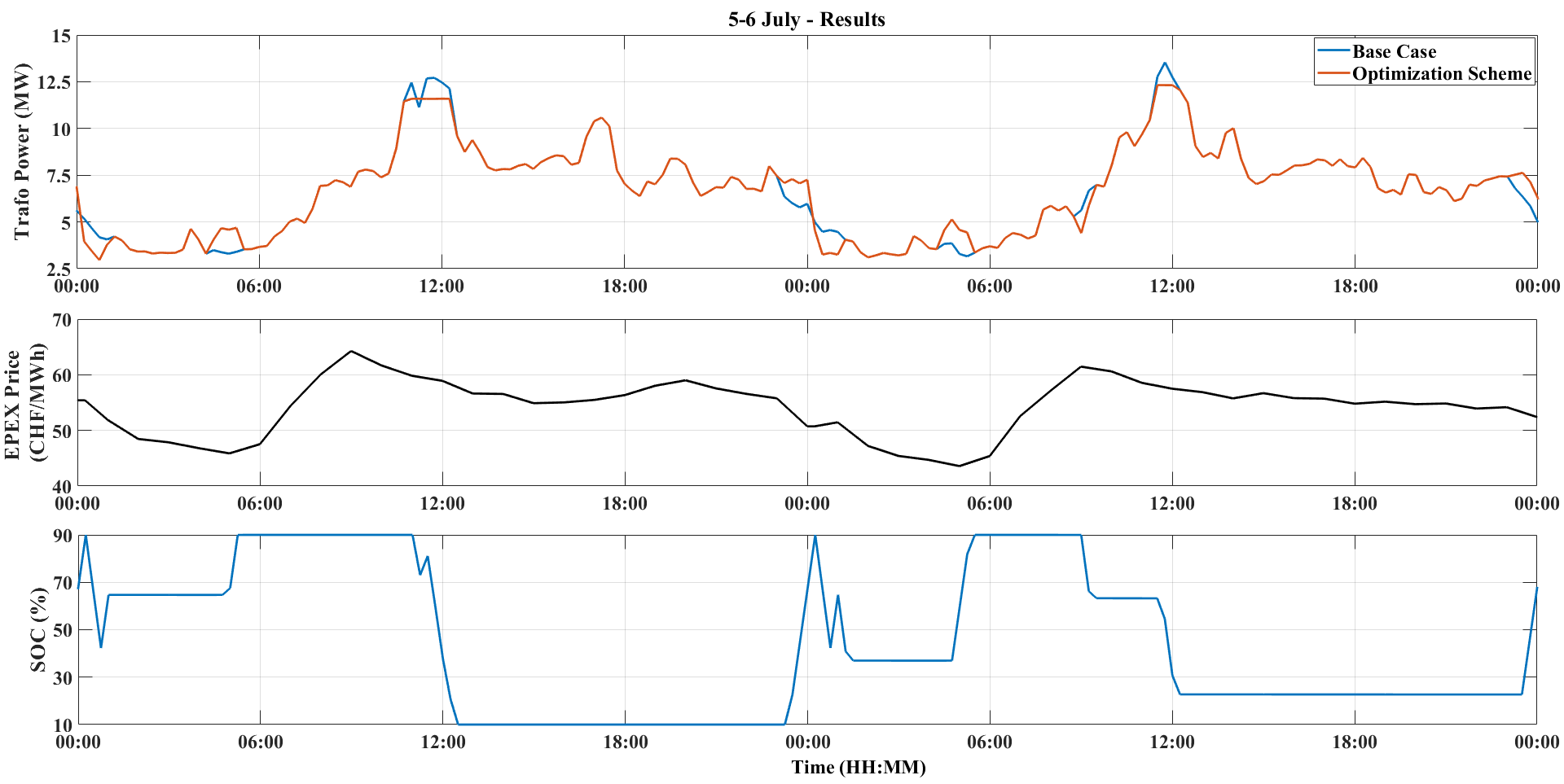

Figure 4. Results of 5-6 July when applying the optimization scheme: (a) Power on secondary side of distribution transformer 110/17kV, (b) EPEX spot Price for Switzerland, (c) State of Charge.

Project information

Client

Arbon Energie AG

Project leadership and execution

Università della Svizzera italiana (USI), Advanced Learning and Research Institute (ALaRI)

Research partner

FHNW Institute of Electric Power Systems, Siemens Schweiz AG, Arbon Energie AG

Duration

36 months (April 2019 – March 2022)

Funding

SFOE

Project team

USI: Cesare Alippi, Slobodan Luković, Andrea Cini
FHNW: Prof. Dr. Martin Geidl, Dr. Nikolaos Efkarpidis
Siemens Schweiz AG: Ingo Herbst
Arbon Energie AG: Silvan Kieber

School of
Engineering and Environment FHNW University of Applied Sciences and Arts Northwestern Switzerland

  • About the School
    • FHNW School of Engineering and Environment
    • Degree Programmes
    • Continuing Education
    • Collaboration in Research and Services
  • Social Media
    • LinkedIn
    • Instagram
    • Facebook
    • TikTok
    • YouTube
  • About FHNW
    • Organisation
    • Schools
    • Locations
    • FHNW Library
    • Media Relations
  • Support
    • IT Support
    • Inside FHNW
    • Webmail
Logo FHNW - 20 Years
Logo Swiss Universities
Logo European University Association
© University of Applied Sciences and Arts Northwestern Switzerland (FHNW)
  • Data Protection
  • Imprint
  • Accessibility
  • EN