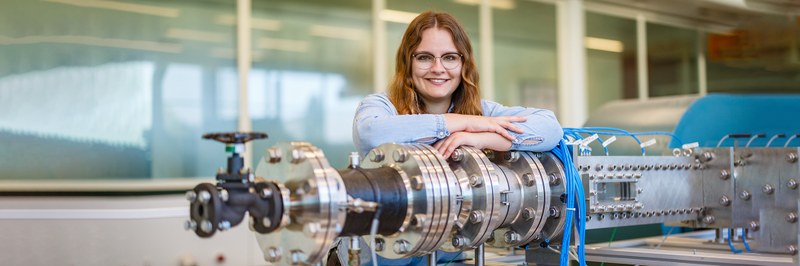
To effectively tackle climate change, the latest technologies must be applied – particularly in the energy sector. The MSE Energy and Environment trains engineers to meet this challenge.
Factsheet
- Degree
Master of Science FHNW in Engineering MSE- Study mode
- Full-time, Part-time/work-study
- Next start
- 22.2.2027
- Teaching language
- Englisch
- Semester fee
- CHF 750 (with residence Switzerland). For all other fees see “fees”.
At a glance
- Develop sustainable energy systems: From renewable energy to energy storage and distribution – analyse, model and optimise systems.
- Master complex processes: Combine energy, environmental and process engineering to develop efficient and resource-saving solutions.
- Specialise individually: Build your own focus in areas such as smart grids, energy conversion, environmental engineering or circular economy.
Why study this?
With a Master’s degree in Energy and Environment, you work on solutions to key challenges such as climate change, energy supply and resource conservation. You analyse and evaluate systems for energy generation, storage and distribution, and develop sustainable technologies while considering environmental, economic and societal aspects.
After graduating, you take on demanding roles in industry, the public sector or service environments. You model and optimise complex processes, develop efficient and resource-saving systems, and provide a solid basis for decision-making in energy and environmental technologies.
With your interdisciplinary expertise, you work on projects at the interface of energy, environmental and process engineering, lead teams and take on responsibility in technical and strategic roles – both nationally and internationally.
Structure and programme contents
Content
In the Energy and Environment profile, you deepen your knowledge in key technologies of sustainable energy and environmental systems and define your individual areas of focus:
- Energy generation: renewable energy, conventional energy technologies, energy conversion
- Energy storage, energy distribution and demand-side management
- Energy systems and grids, including their analysis and optimisation
- Process engineering: physical, chemical and biomass-based processes
- Mechanical, thermal and chemical process engineering
- Circular economy and energy recovery
- Environmental engineering: treatment of air, water and waste
Structure
The MSE programme comprises 90 ECTS credits and is clearly structured: you combine solid theoretical foundations with hands-on project work while continuously developing your individual profile. The modular structure allows you to tailor your studies to your professional goals – in close collaboration with experts from academia, industry and research.
Throughout the programme, you learn to think abstractly while acting in an application- and solution-oriented way. You build strong methodological expertise, understand complex interrelationships and solve problems independently. In practice-oriented projects, you deepen your skills and gain valuable professional experience. You develop products and processes using the latest technologies, acquire solid project management skills and understand business contexts. When tackling complex challenges, you make significant analytical, conceptual and technical contributions to innovative solutions – and, thanks to strong communication skills, operate confidently in international environments.
The MSE programme comprises 90 ECTS credits:
- 30 ECTS by completing the central theoretical modules
- 24 ECTS through your area of specialisation (project work and complementary courses)
- 30 ECTS upon successful completion of the Master’s thesis.
- 6 ECTS - Supplementary courses (EVA) – specialised courses outside the core theory modules, tailored to your individual profile
Tailor your Master’s studies to your needs
The core element of the programme is the individual specialisation within a chosen profile. You develop this specialisation through theoretical and practical work at one of the institutes of the FHNW School of Computer Science, supported throughout your studies by a personal advisor.
Through selected theoretical modules as well as practice-oriented research and development projects, you acquire unique, high-level competencies. Carefully chosen theoretical modules further deepen and broaden your expertise.
- You contact the profile coordinator and/or a potential advisor to explore your specialisation options.
- You apply for a place in the programme.
- The MSE Admissions Committee decides on your admission.
- Once admitted, you select theoretical modules from the available offerings together with your advisor.
- Your module selection and the content of your specialisation are defined in the Individual Study Agreement (ISA).
How to proceed:
The MSE profile Energy and Environment is offered at the following institutes
The School of Engineering and Environment FHNW offers the following MSE profiles
Further MSE profiles at FHNW
School of Architecture, Civil Engineering and Geomatics FHNW
School of Computer Science FHNW
Overview MSE
Admission Requirements and Application
The Master’s programme is designed for Bachelor’s graduates who have achieved very good academic performance during their studies (ECTS grades A or B).
The completed field of study must be related to the competence area of the chosen profile. Holders of an equivalent qualification (e.g. an HTL or University of Applied Sciences diploma) may also be admitted to the programme.
After the application deadline, the documents you submitted with your application will be reviewed, and our Admissions Committee will decide on your acceptance or rejection.
If necessary, an additional admission interview may be arranged.
The MSE programme generally follows directly after completion of a Bachelor’s degree. If you have several years of professional experience after graduation, a more detailed assessment is required.
Organisational matters
How to get started in your studies
Language
Study full-time or part-time
Fees
Dates
Downloads / further Informationen
Contact us
Contact
Application
MSE Profile Energy and EnvironmentMaster of Science in Engineering MSE
- Date
- 22.2.2027
- Place
- FHNW Campus Brugg-Windisch
- Final application date
- 30.9.2026