Skip to main contentSkip to search barSkip to navigationSkip to footer
Logo of the University of Applied Sciences and Arts Northwestern Switzerland
  • DE
  • EN
  • Home
  • Degree programmes
  • Continuing education

Ten Schools One Goal

The FHNW comprises 10 schools with different specializations. Select a school to see its specific courses, study programmes and information.

Applied Psychology

Architecture, Construction and Geomatics

Art and Design

Music

Computer Science

Life Sciences

School of Education

Social Work

Engineering and Environment

Business

  • Research

    • Research fields
    • Projects
  • Updates and insights

    • News and stories
  • Events

  • Media corner

  • About the School of Engineering and Environment

    • People directory
    • Management Board
  • Institutes

    • Institute of Automation
    • Institute of Bioenergy and Resource Efficiency
    • Institute of Business Engineering
    • Institute of Electric Power Systems
    • Institute of Humanities and Social Sciences
    • Institute of Polymer Engineering
    • Institute of Mathematics and Natural Sciences
    • Institute of Polymer Nanotechnology
    • Institute of Optometry
    • Institute of Product and Production Engineering
    • Institute for Sensors and Electronics
    • Institute of Thermal and Fluid Engineering
    • Laboratories of the School of Engineering and Environment
Logo of the University of Applied Sciences and Arts Northwestern Switzerland
  • About the School
    • FHNW School of Engineering and Environment
    • Degree Programmes
    • Continuing Education
    • Collaboration in Research and Services
  • Social Media
    • LinkedIn
    • Instagram
    • Facebook
    • TikTok
    • YouTube
  • About FHNW
    • Organisation
    • Schools
    • Locations
    • FHNW Library
    • Media Relations
  • Support
    • IT Support
    • Inside FHNW
    • Webmail
  • Data Protection
  • Imprint
  • Accessibility
  • Research

    • Research fields
    • Projects
  • Updates and insights

    • News and stories
  • Events

  • Media corner

  • About the School of Engineering and Environment

    • People directory
    • Management Board
  • Institutes

    • Institute of Automation
    • Institute of Bioenergy and Resource Efficiency
    • Institute of Business Engineering
    • Institute of Electric Power Systems
    • Institute of Humanities and Social Sciences
    • Institute of Polymer Engineering
    • Institute of Mathematics and Natural Sciences
    • Institute of Polymer Nanotechnology
    • Institute of Optometry
    • Institute of Product and Production Engineering
    • Institute for Sensors and Electronics
    • Institute of Thermal and Fluid Engineering
    • Laboratories of the School of Engineering and Environment

Type a search term and search continuing education,degree programmes, events, documents and other content.

  • Engineering and Environment
  • Degree programmes
  • Study offerings
  • All degree programmes
  • mse
mse

Photonics and Laser Engineering, FHNW School of Engineering and Environment

School of Engineering and Environment


Lidar systems are revolutionising the mobility of the future, NIR technology is optimizing the agriculture and food industry, microscopy and spectroscopy form the basis of modern medical diagnostics, lasers are used to process materials of every conceivable kind with a high degree of efficiency, and fibre optic technology forms the basis of modern data communications and many laser processing machines. Industry 4.0 and IoT as well as quantum computers are based on photonic technologies. The future belongs to photonics. Be part of this future with the MSE Master’s in Photonics and Laser Engineering.
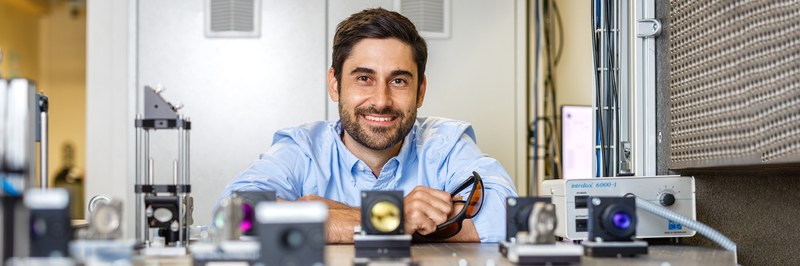
topbild-master-photonics-ht-fhnw.jpg

Graduates of the MSE Photonics and Laser Engineering profile are interdisciplinary all-rounders. They know and understand technologies and tools of photonics, their processes and their analysis. 

  • Laser systems and laser applications
  • Optical engineering and metrology
  • Thin film technology

Typical areas of application are medical technology, biotechnology, additive and subtractive manufacturing, telecommunication, sensor technology and renewable energies.

Professional skills

With the MSE in Photonics and Laser Engineering, you will acquire a basic understanding of the physical principles and processes of photonics. You will be a professional in the use of light and lasers in a wide range of applications from lighting technology to production engineering, from measurement technology to medical technology. You will be able to design and implement photonic sensor systems for automation and production. You will have the capacity to numerically simulate multidisciplinary systems with photonic elements and to combine light-based technologies with mechanical, micromechanical and electro-optical systems.

Photonics and Laser Engineering engineers have the ability to solve complex problems using the most suitable methods. They can quickly gain an overview of the current state of the art, evaluate existing scientific approaches and apply them accordingly. Photonics and Laser Engineeringengineers can assess the feasibility and market benefit of novel photonics systems. They are predestined to lead multidisciplinary project teams and are able to communicate, collaborate, and interact with other fields such as mechanical engineering, electrical engineering, medical and biotechnology, computer science or data sciences.

Outline of profession

Photonics and Laser Engineering makes possible numerous applications, making it an “enabler” of major cross-sectional technologies such as image processing and metrology, medical technology and life sciences, additive and subtractive manufacturing, communications and sensing. At the basis of all of these technologies are the generation, control, detection, and interaction of light.

Graduates of the Photonics and Laser Engineering profile know and understand key photonic components, light-based processes and measurement methods. They use and combine them for novel applications, know how to design photonic systems and how to combine them with electrical and mechanical systems. Photonics and Laser Engineering engineers research novel technologies and implement them in applications. Furthermore, graduates with a master’s degree in Photonics and Laser Engineering are interdisciplinary all-rounders. They are prepared for leading positions with management responsibility in the areas of research and development, intelligent manufacturing, industrial process and quality control as well as automation and digital factories.

Further information

Discover more about studying in the MSE profile Photonics and Laser Engineering. Here you will find more information.

Individual specialisation in the profile Photonics and Laser Engineering

The Institute of Product and Production Engineering (focus is on laser development and laser machining) and the Institute for Sensors and Electronics
(focus is on measurement technologies and optoelectronics) offer this specialization:

Loading

School of
Engineering and Environment FHNW University of Applied Sciences and Arts Northwestern Switzerland

  • About the School
    • FHNW School of Engineering and Environment
    • Degree Programmes
    • Continuing Education
    • Collaboration in Research and Services
  • Social Media
    • LinkedIn
    • Instagram
    • Facebook
    • TikTok
    • YouTube
  • About FHNW
    • Organisation
    • Schools
    • Locations
    • FHNW Library
    • Media Relations
  • Support
    • IT Support
    • Inside FHNW
    • Webmail
Logo FHNW - 20 Years
Logo Swiss Universities
Logo European University Association
© University of Applied Sciences and Arts Northwestern Switzerland (FHNW)
  • Data Protection
  • Imprint
  • Accessibility
  • DE
  • EN