Skip to main contentSkip to search barSkip to navigationSkip to footer
Logo of the University of Applied Sciences and Arts Northwestern Switzerland
  • DE
  • EN
  • FR
  • Home
  • Degree programmes
  • Continuing education

Ten Schools One Goal

The FHNW comprises 10 schools with different specializations. Select a school to see its specific courses, study programmes and information.

Applied Psychology

Architecture, Construction and Geomatics

Art and Design

Music

Computer Science

Life Sciences

School of Education

Social Work

Engineering and Environment

Business

  • Research

    • Research fields
    • Projects
  • Updates and insights

    • News and stories
  • Events

  • Media corner

  • About the School of Engineering and Environment

    • People directory
    • Management Board
  • Institutes

    • Institute of Automation
    • Institute of Bioenergy and Resource Efficiency
    • Institute of Business Engineering
    • Institute of Electric Power Systems
    • Institute of Humanities and Social Sciences
    • Institute of Polymer Engineering
    • Institute of Mathematics and Natural Sciences
    • Institute of Polymer Nanotechnology
    • Institute of Optometry
    • Institute of Product and Production Engineering
    • Institute for Sensors and Electronics
    • Institute of Thermal and Fluid Engineering
    • Laboratories of the School of Engineering and Environment
Logo of the University of Applied Sciences and Arts Northwestern Switzerland
  • About the School
    • FHNW School of Engineering and Environment
    • Degree Programmes
    • Continuing Education
    • Collaboration in Research and Services
  • Social Media
    • LinkedIn
    • Instagram
    • Facebook
    • TikTok
    • YouTube
  • About FHNW
    • Organisation
    • Schools
    • Locations
    • FHNW Library
    • Media Relations
  • Support
    • IT Support
    • Inside FHNW
    • Webmail
  • Data Protection
  • Imprint
  • Accessibility
  • Research

    • Research fields
    • Projects
  • Updates and insights

    • News and stories
  • Events

  • Media corner

  • About the School of Engineering and Environment

    • People directory
    • Management Board
  • Institutes

    • Institute of Automation
    • Institute of Bioenergy and Resource Efficiency
    • Institute of Business Engineering
    • Institute of Electric Power Systems
    • Institute of Humanities and Social Sciences
    • Institute of Polymer Engineering
    • Institute of Mathematics and Natural Sciences
    • Institute of Polymer Nanotechnology
    • Institute of Optometry
    • Institute of Product and Production Engineering
    • Institute for Sensors and Electronics
    • Institute of Thermal and Fluid Engineering
    • Laboratories of the School of Engineering and Environment

Type a search term and search continuing education,degree programmes, events, documents and other content.

  • Engineering and Environment
  • Degree programmes
  • Study offerings
  • All degree programmes
  • optometry
optometry

Career prospects Optometry, FHNW School of Engineering and Environment

School of Engineering and Environment


With their interdisciplinary training, optometry graduates are equipped to assume management functions within the field of vision, working in a largely self-employed capacity and at their own responsibility.

During the last few decades, ophthalmic optics has continued to evolve. Whereas the production of refractive eyeglasses has become automated, the optometric work of opticians has grown significantly in importance.

Optometrists are rapidly becoming the primary care providers in all areas relating to optimisation of vision. Thanks to the excellent training you will receive, you will be in a position to distinguish between normal and pathological variations, referring patients to a specialist where necessary. Training programmes that concentrate almost exclusively on determining refractive errors are no longer in line with contemporary needs. Many pathological changes in the eye could be overlooked, which could lead to irreparable damage..

Professional Outlook

Possible fields of work are optometry, respectively, ophthalmic optics, the health sector or teaching and research. Given the high level of qualification, others areas of employment are possible: in industry in the areas of ophthalmic optics and medical technology as well a special task in ophthalmology.

Competencies of Optometrists

  • Management of businesses in optometrics and opthalmic optics
  • Analysis of customer needs and the development of optimal solutions
  • Screening in the area of vision and ocular health
  • Determination of glasses and contact lens correction, prescription writing based on comprehensive analysis
  • Dispensing of glasses and contact lenses
  • Analysis of binocular status, prescription and implementation of appropriate correction or training measures in children and adults
  • Measurement and correction of complex optical problems of the human visual system.
  • Selection and fitting of appropriate contact lens types for refractive and/or post-operative situations
  • Provision of standard visual aids for the visually impaired

Statements of Optometry Graduates
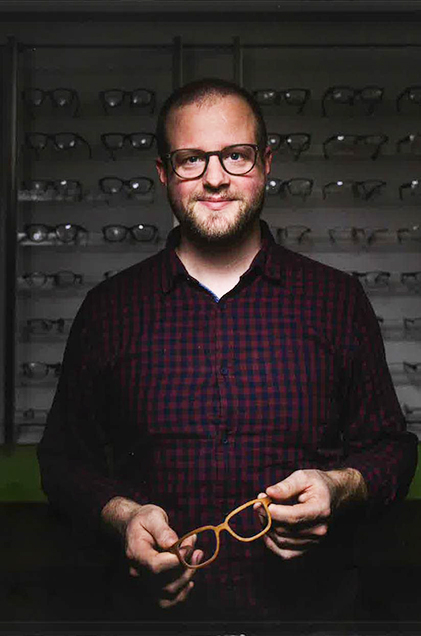
Company: Roost Augenoptik

Position: CEO

«From an optometric perspective, this degree programme is probably one of the leading courses in Europe. I decided to study Optometry in order to  work in a management capacity to ensure the ongoing success of the company I work for. It is both interesting and challenging to work with clients to discover which visual problems they have and to offer a solution for it. Often it is 'only' a question of providing information about further tests or medical treatments or interventions. However, this requires the structured examination and questioning of the customer in order to help him or her in the best way possible. Helping someone to have better vision gives me a great feeling of satisfaction each and every time from anew.»

Company: Centre Lentilles de Contact

Position: Optométriste HES / EurOptom

«Ces trois années à la FHNW d'Olten m'ont permis d'obtenir une base solide en optométrie tant au niveau théorique que pratique afin d'être rapidement efficace et autonome à mes débuts dans le monde du travail. À la sortie de mes études, je me suis orientée vers la contactologie spécialisée que j'exerce actuellement en hôpital et en cabinet. De plus, en parallèle, je suis enseignante aux apprentis opticiens. L’optométrie est un domaine intéressant et varié qui permet de se spécialiser dans des secteurs différents, que ce soit dans les soins, le commercial, la basse vision, la contactologie ou l’industrie.»

School of
Engineering and Environment FHNW University of Applied Sciences and Arts Northwestern Switzerland

  • About the School
    • FHNW School of Engineering and Environment
    • Degree Programmes
    • Continuing Education
    • Collaboration in Research and Services
  • Social Media
    • LinkedIn
    • Instagram
    • Facebook
    • TikTok
    • YouTube
  • About FHNW
    • Organisation
    • Schools
    • Locations
    • FHNW Library
    • Media Relations
  • Support
    • IT Support
    • Inside FHNW
    • Webmail
Logo FHNW - 20 Years
Logo Swiss Universities
Logo European University Association
© University of Applied Sciences and Arts Northwestern Switzerland (FHNW)
  • Data Protection
  • Imprint
  • Accessibility
  • DE
  • EN
  • FR