The Institute of Polymer Nanotechnology FHNW is expanding its equipment and expertise in the field of surface analysis with a brand-new laser microscope.
At the Institute of Polymer Nanotechnology FHNW, the focus is on the functionalisation of polymer surfaces. Functionalisation is carried out by introducing defined surface structures using injection moulding and embossing processes or by specifically changing the surface chemistry. In this way, the researchers give the surface specific properties, such as the ability to repel water.
Particularly in the case of functionalisation through surface structuring, however, it is not enough just to produce the tiny structures. They also have to be made visible and checked, which is an enormous challenge. Yet this is the only way to determine whether the modifications have been successfully, to observe whether the structures are reliably implemented on the component, and ultimately to know whether the surface has the desired properties.
Therefore, with the support of the FHNW Foundation, the institute has acquired a powerful 3D laser scanning microscope of the latest generation. The Keyence VK-X1100 illuminates the examined material surface with the help of an integrated laser and creates a detailed, high-resolution 3D model of the surface via the reflected light.
With a predecessor model, the institute has already been able to gain experience over several years since 2011 and build up corresponding, far-reaching expertise in the field of topographical surface analysis.
More precise, comfortable, and faster
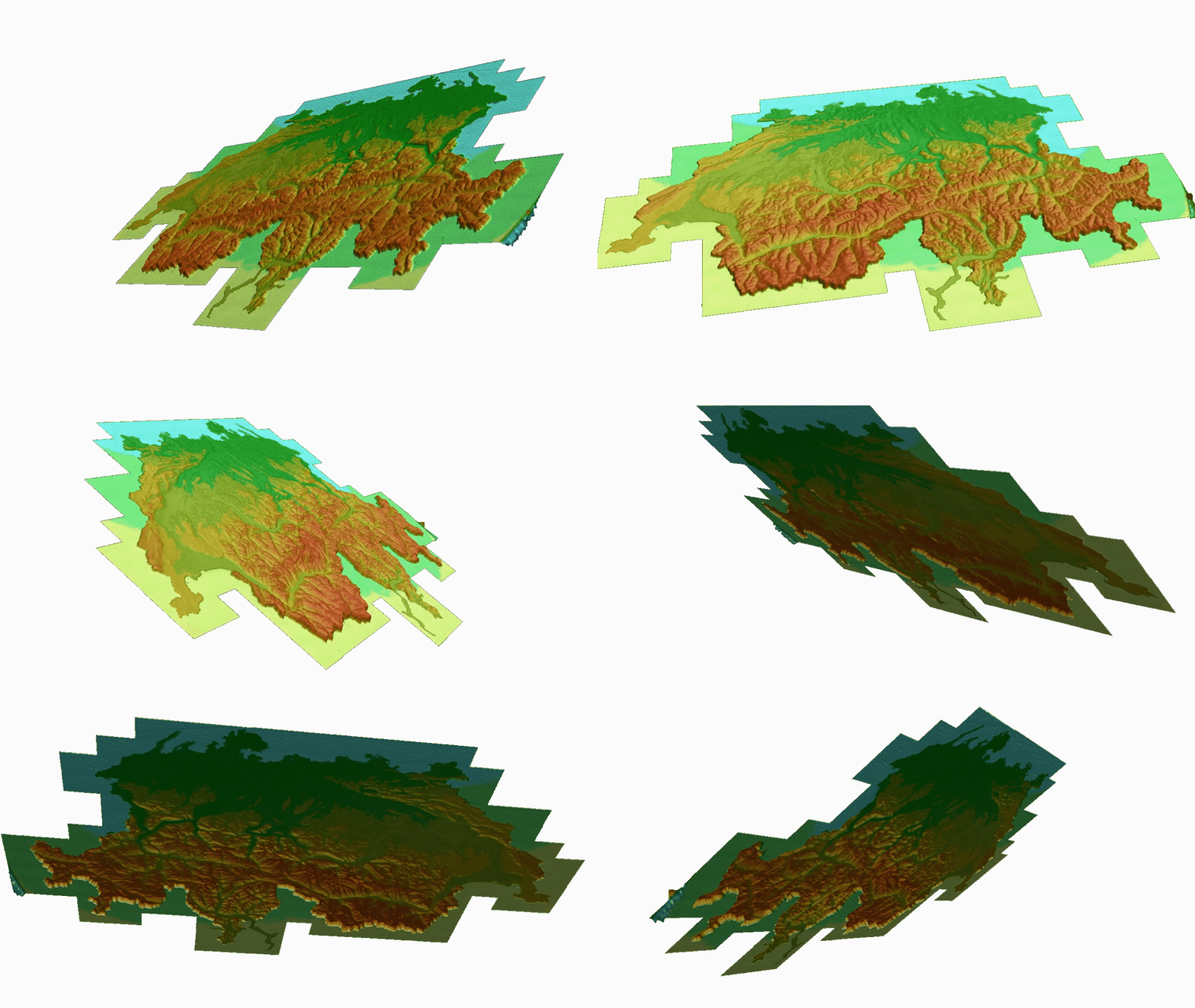
The new microscope offers advantages both in viewing and in the 3D measurement of the surface of the examined objects. When viewing, a colour camera displays fully focused images, i.e. images with practically infinite depth of field. The topography can be represented in the laser-generated 3D models by different colour gradients and measured as desired. The microscope is equipped with a turret changer with six different objectives. This allows structures of varying sizes to be analysed. The device achieves a resolution down to the single-digit nanometre range the height as well as in width of the examined structures at maximum magnification.
The measurements are carried out fully automatically via a motorised sample stage, controlled by a separate powerful workstation. The microscope also offers a significant gain in speed. Single local area measurements with the help of the laser are carried out within a few seconds instead of within minutes as was previously the case. For larger areas, several measurements are combined ("stitched"). In addition, no special sample preparation is necessary and transparent materials can also be measured. Damage to the objects being measured is ruled out due to the contactless measuring principle.
In addition, the institute has purchased various accessories to upgrade the microscope and expand its range of applications. For example, the microscope stands on a hefty granite plate weighing about 300 kg, which minimises vibrations, and it is equipped with a vacuum table to be able to fix the examined samples during the measurement, which is especially important when examining thin foils.
For research projects and services
The new microscope is used daily in research projects in which surface structures on components or tools produced at the Institute or by project partners are measured. In two new projects started at the beginning of 2019, for example, special microstructures for optical applications must be examined.
Within the scope of service orders, the microscope can also be used outside of research projects by industry or other academic institutions. Typical orders usually come from industrial companies of various sectors; and involve measuring the smallest structures on widely different materials or determining the quality and roughness of a surface.
Those responsible at the Institute are looking forward to future work on this high-precision device, which opens the way - figuratively and literally - to shed even more light on the world of the small!