Skip to main contentSkip to search barSkip to navigationSkip to footer
Logo of the University of Applied Sciences and Arts Northwestern Switzerland
  • DE
  • EN
  • Home
  • Degree programmes
  • Continuing education

Ten Schools One Goal

The FHNW comprises 10 schools with different specializations. Select a school to see its specific courses, study programmes and information.

Applied Psychology

Architecture, Construction and Geomatics

Art and Design

Music

Computer Science

Life Sciences

School of Education

Social Work

Engineering and Environment

Business

  • Research

    • Research fields
    • Projects
  • Updates and insights

    • News and stories
  • Events

  • Media corner

  • About the School of Engineering and Environment

    • People directory
    • Management Board
  • Institutes

    • Institute of Automation
    • Institute of Bioenergy and Resource Efficiency
    • Institute of Business Engineering
    • Institute of Electric Power Systems
    • Institute of Humanities and Social Sciences
    • Institute of Polymer Engineering
    • Institute of Mathematics and Natural Sciences
    • Institute of Polymer Nanotechnology
    • Institute of Optometry
    • Institute of Product and Production Engineering
    • Institute for Sensors and Electronics
    • Institute of Thermal and Fluid Engineering
    • Laboratories of the School of Engineering and Environment
Logo of the University of Applied Sciences and Arts Northwestern Switzerland
  • About the School
    • FHNW School of Engineering and Environment
    • Degree Programmes
    • Continuing Education
    • Collaboration in Research and Services
  • Social Media
    • LinkedIn
    • Instagram
    • Facebook
    • TikTok
    • YouTube
  • About FHNW
    • Organisation
    • Schools
    • Locations
    • FHNW Library
    • Media Relations
  • Support
    • IT Support
    • Inside FHNW
    • Webmail
  • Data Protection
  • Imprint
  • Accessibility
  • Research

    • Research fields
    • Projects
  • Updates and insights

    • News and stories
  • Events

  • Media corner

  • About the School of Engineering and Environment

    • People directory
    • Management Board
  • Institutes

    • Institute of Automation
    • Institute of Bioenergy and Resource Efficiency
    • Institute of Business Engineering
    • Institute of Electric Power Systems
    • Institute of Humanities and Social Sciences
    • Institute of Polymer Engineering
    • Institute of Mathematics and Natural Sciences
    • Institute of Polymer Nanotechnology
    • Institute of Optometry
    • Institute of Product and Production Engineering
    • Institute for Sensors and Electronics
    • Institute of Thermal and Fluid Engineering
    • Laboratories of the School of Engineering and Environment

Type a search term and search continuing education,degree programmes, events, documents and other content.

  • Engineering and Environment
  • News and events
  • News and stories
  • All news and stories
All news and stories

Atmospheric plasma for new surfaces, FHNW School of Engineering and Environment

School of Engineering and Environment


Lightning can be tamed for scientific purposes. In this way, they enable previously unimagined possibilities for surfaces on a small scale.
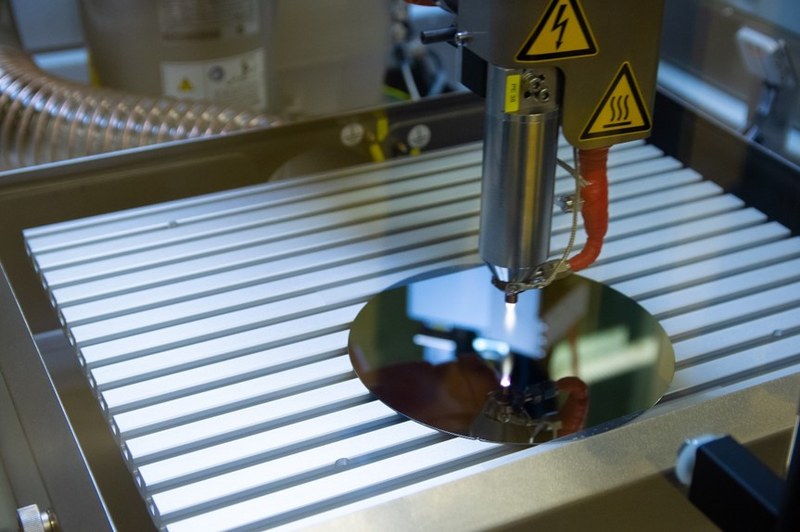
A coating is created: the plasma polymerisation nozzle in use (Source: FHNW).

We usually associate "thunder and lightning" with chaos and devastation. However, lightning can be tamed in the laboratory and harnessed for useful purposes. These tamed lightning bolts excite air to such an extent that the fourth state of aggregation is created: plasma. Plasma also comes in many shapes and colours: the sun, lightning, or the plasma screen.

The Institute of Polymer Nanotechnology FHNW has one of the latest devices on the market, the PTU 1212 laboratory system from Plasmatreat, which can generate plasma continuously under ambient conditions. It is very advantageous because this type of plasma is the easiest to integrate into existing industrial production facilities. In this way, a plasma system can replace several production steps at once and thus simplify, cheapen, and accelerate the process.

New possibilities with plasma

Plasma has unique properties and can be used in a wide range of applications. On the one hand, many processes in the plastics industry are difficult or impossible without pre-treatment. Bonding, printing, back injection, and coating - all these essential steps suffer from the low surface energy of plastic surfaces, the incompatibility of materials and the poor wettability with e.g., adhesives or aqueous paints. Pre-treatment with atmospheric plasma can provide a solution and in many cases is a direct way to solve the problems mentioned.

In addition, the surface chemistry can also be specifically designed with plasma coatings. Chemistry dictates the behaviour of the surfaces in question. For example, very small droplets form on a water-repellent surface. This phenomenon is very useful for water-repellent clothing. However, it's problematic for people who wear glasses, who lose sight as soon as their lenses fog up. This is exactly where plasma can make a big difference and be very selective. Normally water-repellent materials can be made wettable and vice versa.

Environmentally friendly surface functionalisation

However, the applications go much further. Surface chemistry plays a crucial role in bonding materials, for water permeability, friction, adhesion, hardness, electrostatics, corrosion and especially in biology and microbiology. Plasma coatings have the potential to enable innovative solutions in all these areas. Since plasma only chemically alters the absolute outermost layer, the other properties of the material remain intact. For example, the glasses no longer fog up, but remain completely transparent. Furthermore, plasma has a great advantage in that it is a dry process. This eliminates the need for vast quantities of toxic and environmentally problematic chemicals, which are unfortunately still used today in outdated processes.

The Institute of Polymer Nanotechnology FHNW is pushing innovation further and researching how surfaces can be created with plasma, tailored to the respective applications. We take the terror out of lightning and use it for good in the form of plasma.

School of
Engineering and Environment FHNW University of Applied Sciences and Arts Northwestern Switzerland

  • About the School
    • FHNW School of Engineering and Environment
    • Degree Programmes
    • Continuing Education
    • Collaboration in Research and Services
  • Social Media
    • LinkedIn
    • Instagram
    • Facebook
    • TikTok
    • YouTube
  • About FHNW
    • Organisation
    • Schools
    • Locations
    • FHNW Library
    • Media Relations
  • Support
    • IT Support
    • Inside FHNW
    • Webmail
Logo FHNW - 20 Years
Logo Swiss Universities
Logo European University Association
© University of Applied Sciences and Arts Northwestern Switzerland (FHNW)
  • Data Protection
  • Imprint
  • Accessibility
  • DE
  • EN