Skip to main contentSkip to search barSkip to navigationSkip to footer
Logo of the University of Applied Sciences and Arts Northwestern Switzerland
  • DE
  • EN
  • Home
  • Degree programmes
  • Continuing education

Ten Schools One Goal

The FHNW comprises 10 schools with different specializations. Select a school to see its specific courses, study programmes and information.

Applied Psychology

Architecture, Construction and Geomatics

Art and Design

Business

Computer Science

Engineering and Environment

Life Sciences

Music

School of Education

Social Work

  • Research

    • Research fields
    • Projects
  • Updates and insights

    • News and stories
  • Events

  • Media corner

  • About the School of Engineering and Environment

    • People directory
    • Management Board
  • Institutes

    • Institute of Automation
    • Institute of Bioenergy and Resource Efficiency
    • Institute of Business Engineering
    • Institute of Electric Power Systems
    • Institute of Humanities and Social Sciences
    • Institute of Polymer Engineering
    • Institute of Mathematics and Natural Sciences
    • Institute of Polymer Nanotechnology
    • Institute of Optometry
    • Institute of Product and Production Engineering
    • Institute for Sensors and Electronics
    • Institute of Thermal and Fluid Engineering
    • Laboratories of the School of Engineering and Environment
Logo of the University of Applied Sciences and Arts Northwestern Switzerland
  • About the School
    • FHNW School of Engineering and Environment
    • Degree Programmes
    • Continuing Education
    • Collaboration in Research and Services
  • Social Media
    • LinkedIn
    • Instagram
    • Facebook
    • TikTok
    • YouTube
  • About FHNW
    • Organisation
    • Schools
    • Locations
    • FHNW Library
    • Media Relations
  • Support
    • IT Support
    • Inside FHNW
    • Webmail
  • Data Protection
  • Imprint
  • Accessibility
  • Research

    • Research fields
    • Projects
  • Updates and insights

    • News and stories
  • Events

  • Media corner

  • About the School of Engineering and Environment

    • People directory
    • Management Board
  • Institutes

    • Institute of Automation
    • Institute of Bioenergy and Resource Efficiency
    • Institute of Business Engineering
    • Institute of Electric Power Systems
    • Institute of Humanities and Social Sciences
    • Institute of Polymer Engineering
    • Institute of Mathematics and Natural Sciences
    • Institute of Polymer Nanotechnology
    • Institute of Optometry
    • Institute of Product and Production Engineering
    • Institute for Sensors and Electronics
    • Institute of Thermal and Fluid Engineering
    • Laboratories of the School of Engineering and Environment

Type a search term and search continuing education,degree programmes, events, documents and other content.

  • Engineering and Environment
  • News and events
  • News and stories
  • All news and stories
All news and stories

Free-form micro-optics for modern lighting applications, FHNW School of Engineering and Environment

School of Engineering and Environment


CSEM and FHNW are working together on innovative design algorithms and manufactur-ing technologies to enable potential future applications in lighting technology.

The success of LEDs in lighting technology is progressing relentlessly and is constantly enabling new energy-efficient and tailor-made solutions for different markets. The displacement of classic light sources by LEDs brings with it numerous new challenges that need to be solved.

For example, the increasing power density of LEDs increases the thermal requirements for optical components. Efficient diffusers are needed to distribute the emitted light as homogeneously as possible and to make the individual LEDs as such invisible. Furthermore, customer-specific requirements regarding beam shaping are constantly increasing in order to realise ever more complex lighting scenarios.
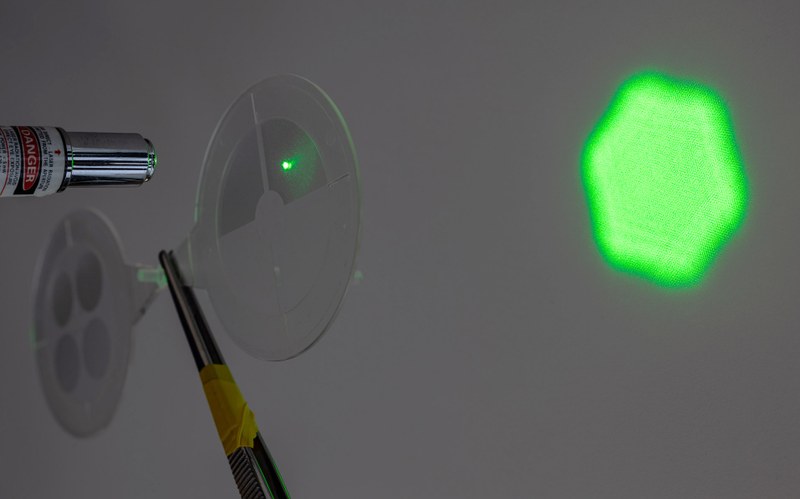
So-called free-form optics are already used today in various LED-based lighting applications. Examples include street lighting, automotive headlights and the backlighting of LED displays. In all these areas today, mainly macroscopic free-form lenses are used, which take up a relatively large volume (especially in terms of thickness) and are highly demanding to manufacture.

For optoelectronic systems, on the other hand, miniaturised optics with increasingly smaller footprints (for example microlens arrays) are more in demand than ever. If it were possible to realise free-form micro-optics with a small thickness in this segment, not only could performance be significantly increased, but entirely new functionalities could also be realised. Potential markets that could benefit from this development include thin-film photovoltaic modules, optical sensors, mobile phone flashlights and augmented reality devices. The applications mentioned all have enormous market potential.

This is the motive for a joint Innosuisse-funded project by CSEM and the Institute of Polymer Nanotechnology FHNW. In the project "Freeform lens and microlens arrays for high-quality lighting systems" (FreeMLA for short), we are jointly developing design algorithms and experimental methods for design, optimisation, fabrication and metrology for freeform micro-optics with customised lighting profiles. In this way, we are contributing to furthering the industrialisation of sophisticated applications in lighting technology.

School of
Engineering and Environment FHNW University of Applied Sciences and Arts Northwestern Switzerland

  • About the School
    • FHNW School of Engineering and Environment
    • Degree Programmes
    • Continuing Education
    • Collaboration in Research and Services
  • Social Media
    • LinkedIn
    • Instagram
    • Facebook
    • TikTok
    • YouTube
  • About FHNW
    • Organisation
    • Schools
    • Locations
    • FHNW Library
    • Media Relations
  • Support
    • IT Support
    • Inside FHNW
    • Webmail
Logo FHNW - 20 Years
Logo Swiss Universities
Logo European University Association
© University of Applied Sciences and Arts Northwestern Switzerland (FHNW)
  • Data Protection
  • Imprint
  • Accessibility
  • DE
  • EN