Skip to main contentSkip to search barSkip to navigationSkip to footer
Logo of the University of Applied Sciences and Arts Northwestern Switzerland
  • DE
  • EN
  • Home
  • Degree programmes
  • Continuing education

Ten Schools One Goal

The FHNW comprises 10 schools with different specializations. Select a school to see its specific courses, study programmes and information.

Applied Psychology

Architecture, Construction and Geomatics

Art and Design

Music

Computer Science

Life Sciences

School of Education

Social Work

Engineering and Environment

Business

  • Research

    • Research fields
    • Projects
  • Updates and insights

    • News and stories
  • Events

  • Media corner

  • About the School of Engineering and Environment

    • People directory
    • Management Board
  • Institutes

    • Institute of Automation
    • Institute of Bioenergy and Resource Efficiency
    • Institute of Business Engineering
    • Institute of Electric Power Systems
    • Institute of Humanities and Social Sciences
    • Institute of Polymer Engineering
    • Institute of Mathematics and Natural Sciences
    • Institute of Polymer Nanotechnology
    • Institute of Optometry
    • Institute of Product and Production Engineering
    • Institute for Sensors and Electronics
    • Institute of Thermal and Fluid Engineering
    • Laboratories of the School of Engineering and Environment
Logo of the University of Applied Sciences and Arts Northwestern Switzerland
  • About the School
    • FHNW School of Engineering and Environment
    • Degree Programmes
    • Continuing Education
    • Collaboration in Research and Services
  • Social Media
    • LinkedIn
    • Instagram
    • Facebook
    • TikTok
    • YouTube
  • About FHNW
    • Organisation
    • Schools
    • Locations
    • FHNW Library
    • Media Relations
  • Support
    • IT Support
    • Inside FHNW
    • Webmail
  • Data Protection
  • Imprint
  • Accessibility
  • Research

    • Research fields
    • Projects
  • Updates and insights

    • News and stories
  • Events

  • Media corner

  • About the School of Engineering and Environment

    • People directory
    • Management Board
  • Institutes

    • Institute of Automation
    • Institute of Bioenergy and Resource Efficiency
    • Institute of Business Engineering
    • Institute of Electric Power Systems
    • Institute of Humanities and Social Sciences
    • Institute of Polymer Engineering
    • Institute of Mathematics and Natural Sciences
    • Institute of Polymer Nanotechnology
    • Institute of Optometry
    • Institute of Product and Production Engineering
    • Institute for Sensors and Electronics
    • Institute of Thermal and Fluid Engineering
    • Laboratories of the School of Engineering and Environment

Type a search term and search continuing education,degree programmes, events, documents and other content.

  • Engineering and Environment
  • News and events
  • News and stories
  • All news and stories
All news and stories

Immobilisation of biomolecules for the detec-tion of the stress hormone cortisol, FHNW School of Engineering and Environment

School of Engineering and Environment


Nutrix AG is a Swiss MedTech company that aims to improve the current state of digital health monitoring. For the development of high-tech sensors for home use, Nutrix is collabo-rating with Dr Sonja Neuhaus and Dr Alok Goel from the Institute of Polymer Nanotech-nology (INKA) at the University of Applied Sciences Northwestern Switzerland (FHNW).

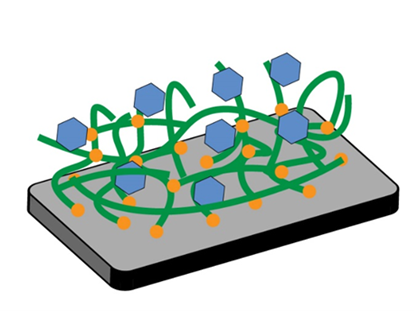
Figure 1: Immobilised biocomponents on a polymer substrate (grey).

With easy-to-use biosensors, people should be able to determine relevant values independently at home. To be able to offer non-invasive and painless methods, the biomarkers are detected in saliva and not, as usual, in blood. To produce a biosensor, specific bioreceptors have to be attached or immobilised on polymer surfaces. If the biomarker belonging to the receptor binds, the biosensor reacts with an easily measurable electrochemical signal.

Among other things, the functionality and stability of the bioreceptors are of central importance for the reliable use of a sensor. However, their direct immobilisation on a polymer is very challenging. The surface functionalisation group at INKA has developed a technology to bind enzymes and other biological components on polymer surfaces. Particular emphasis is placed on the sensitivity of the enzymes and the possible loss of activity due to the effects of heat, irradiation with light or contact with oxygen.
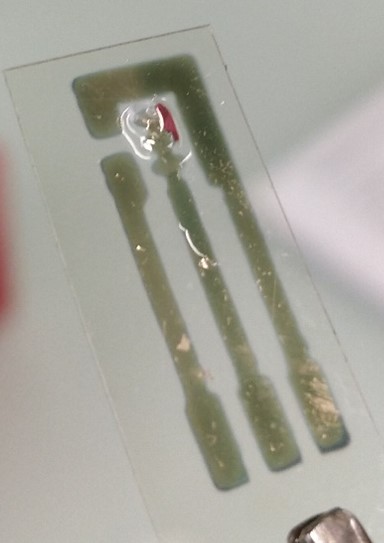
Figure 2: The model enzyme is immobilised on an electrode.

Cortisol is secreted when the body reacts to stress. By measuring cortisol levels, it is possible to assess whether and to what extent someone is under physical or emotional stress. Real-time monitoring over a longer period of time in particular can be used to take countermeasures and prevent chronic stress and stress-related illnesses. However, the currently available cortisol detectors require the assistance of a specialist, are not user-friendly and do not provide real-time results. Nutrix wants to revolutionise the market with a fast and reliable home measurement system. Nutrix and INKA are working together for the first time to implement this idea within the framework of an Innocheck funded by Innosuisse.
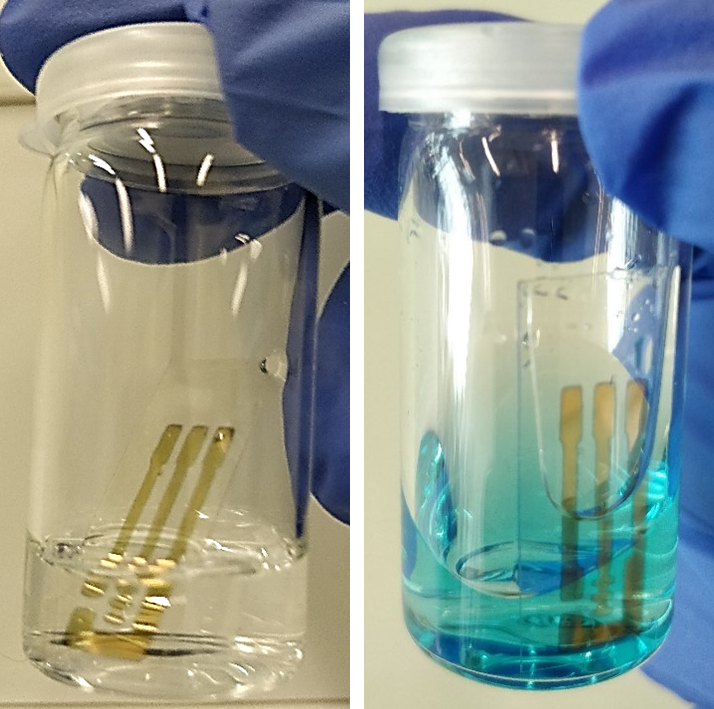
Figure 3: Colour detection of enzyme activity directly after immersion (left) and after 15 minutes (right).

In the first step, the project team developed parameters for the reliable and reproducible immobilisation of functional enzymes on polymer surfaces. Subsequently, a model enzyme was immobilised on the surface and its activity was confirmed with colour detection (Figures 2 and 3).

The findings to date are now being used to realise sensors for the detection of cortisol. Once the feasibility is proven, we will apply for an Innosuisse implementation project with the aim of developing a market-ready product.

We thank Nutrix for the fruitful and very exciting collaboration. We thank Innosuisse for the financial support of this project.

School of
Engineering and Environment FHNW University of Applied Sciences and Arts Northwestern Switzerland

  • About the School
    • FHNW School of Engineering and Environment
    • Degree Programmes
    • Continuing Education
    • Collaboration in Research and Services
  • Social Media
    • LinkedIn
    • Instagram
    • Facebook
    • TikTok
    • YouTube
  • About FHNW
    • Organisation
    • Schools
    • Locations
    • FHNW Library
    • Media Relations
  • Support
    • IT Support
    • Inside FHNW
    • Webmail
Logo FHNW - 20 Years
Logo Swiss Universities
Logo European University Association
© University of Applied Sciences and Arts Northwestern Switzerland (FHNW)
  • Data Protection
  • Imprint
  • Accessibility
  • DE
  • EN