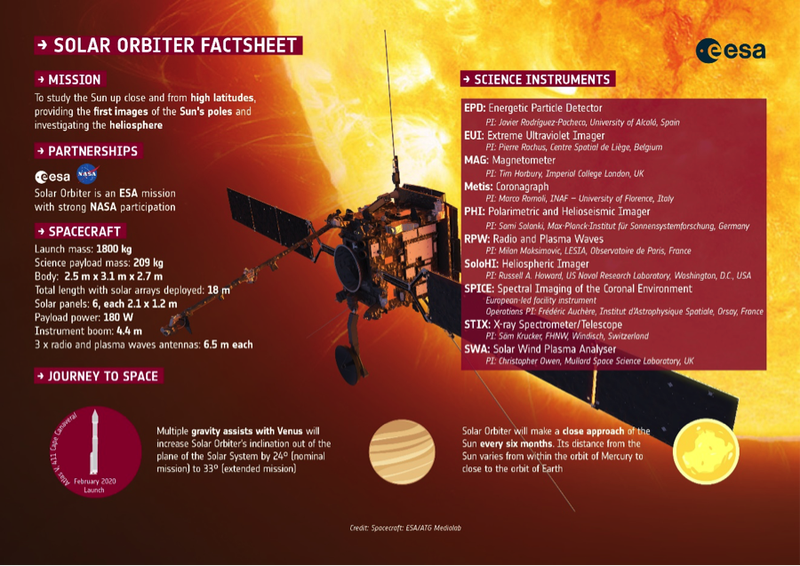
The Solar Orbiter space mission is expected to launch on 10 February 2020 following more than 10 years of preparation. The payload includes STIX, the Swiss X-ray telescope developed at the FHNW University of Applied Sciences and Arts Northwestern Switzerland.
Perched atop an Atlas V rocket, the Solar Orbiter space probe will be blasting off towards the sun from Cape Canaveral on 10 February 2020. The probe is expected to approach to within 45 million kilometres of the sun – that's about a quarter of the distance between Earth and the central star. The latter's hitherto unknown polar regions will also be investigated for the first time. A mission of the European Space Agency ESA, Solar Orbiter also enjoys strong participation from the US space agency NASA.
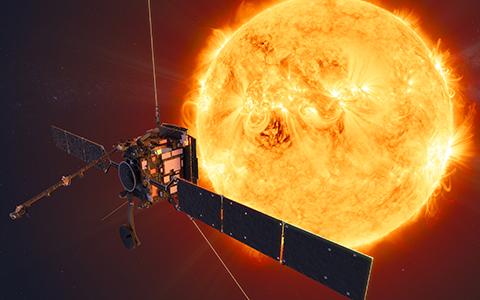
Gaining a better understanding of the sun
The objective of the seven-year mission is to investigate the causes of "solar wind", a stream of charged particles constantly emanating from the sun and saturating the entire solar system. Among other things, these are responsible for the northern lights phenomena. The measurements taken by the 10 instruments on board the spacecraft will attempt to shed light on the mystery of the solar wind.
STIX to observe solar flares
One of the instruments aboard the Solar Orbiter is the STIX X-ray telescope. "We'll be taking images and spectra of X-rays from the sun," said Prof. Dr. Säm Krucker, lead scientist on the STIX project at the FHNW University of Applied Sciences and Arts Northwestern Switzerland. This data contains information about physical states and processes that occur during solar flares, which is when vast amounts of matter and charged particles are flung explosively into space. At those junctures, the solar wind becomes a solar storm, which on Earth is made manifest by vivid polar lights and can cause interference with satellites, aircraft and power grids.
The causes of solar flares are related to the coronal heating problem, one of solar physics' unsolved questions. The temperature of the sun's corona is about one million °C hot, while its surface is "only" 6000°C.
The FHNW School of Engineering under the direction of Säm Krucker is responsible for STIX's development, construction, operation and scientific evaluation. The astrophysicist came up with the idea for an X-ray telescope 18 years ago. The last 10 years have seen him and his team at the FHNW prepare STIX's hardware and software. ESA and the Swiss Space Office, part of the State Secretariat for Education, Research and Innovation SERI, financed the project.
Two years to the first measurements
One of the challenges facing the space probe and its instruments are the enormous temperature differences: the side of Solar Orbiter facing the sun will be coping with temperatures in excess of 500°C, while the opposite side will be as cold as -100°C. A solid titanium heat shield featuring a specially developed black protective layer will be shielding the instruments from the sun – one of the reasons for the satellite's launch weight of 1.8 tonnes.
The launch at Cape Canaveral, Florida, will be followed by a flight of almost two years to enter the sun's orbit, preceded by "gravitational sling-shot” manoeuvres involving Earth and Venus. The probe is expected to begin its measurements in November 2021 and continue its mission until at least December 2025. The researchers are hoping for close synergies with NASA's Solar Parker Probe mission, which launched in August 2018. Solar Orbiter's mission budget stands at around EUR 1.5 billion.
Further information and media kit
STIX: who is involved?
The STIX X-ray telescope has been developed and built under the leadership of the FHNW University of Applied Sciences and Arts Northwestern Switzerland by Swiss companies and research institutions in cooperation with partners from Poland, France, the Czech Republic, Germany, Austria, Ireland and Italy.
Swiss partners involved:
- Almatech SA, Lausanne
- Art of Technology AG, Zurich
- Syderal Swiss SA, Gals
- Maxon Motor AG, Sachseln
- SWSTech AG, Frauenfeld
- Createch AG, Langenthal
- CNC Dynamix AG, Büron
- Ernst Hänni AG, Volketswil
- Heinz Baumgartner AG, Urdorf
- Hasler AG, Vogelsang
- Niklaus SA, Meyrin
- REMOTEC GmbH, Wädenswil
- Ateleris GmbH, Brugg AG
- KOEGL Space, Dielsdorf
Swiss research institutions involved:
- FHNW School of Engineering
- Paul Scherrer Institute PSI
- University of Bern
Switzerland is involved in two further instruments on the Solar Orbiter under the leadership of Prof. Louise Harra, Director PMOD/WRC Davos: EUI (Extreme Ultraviolet Image) and SPICE (Spectral Imaging of the Coronal Environment).