Skip to main contentSkip to search barSkip to navigationSkip to footer
Logo of the University of Applied Sciences and Arts Northwestern Switzerland
  • DE
  • EN
  • Home
  • Degree programmes
  • Continuing education

Ten Schools One Goal

The FHNW comprises 10 schools with different specializations. Select a school to see its specific courses, study programmes and information.

Applied Psychology

Architecture, Construction and Geomatics

Art and Design

Music

Computer Science

Life Sciences

School of Education

Social Work

Engineering and Environment

Business

  • Research

    • Research fields
    • Projects
  • Updates and insights

    • News and stories
  • Events

  • Media corner

  • About the School of Engineering and Environment

    • People directory
    • Management Board
  • Institutes

    • Institute of Automation
    • Institute of Bioenergy and Resource Efficiency
    • Institute of Business Engineering
    • Institute of Electric Power Systems
    • Institute of Humanities and Social Sciences
    • Institute of Polymer Engineering
    • Institute of Mathematics and Natural Sciences
    • Institute of Polymer Nanotechnology
    • Institute of Optometry
    • Institute of Product and Production Engineering
    • Institute for Sensors and Electronics
    • Institute of Thermal and Fluid Engineering
    • Laboratories of the School of Engineering and Environment
Logo of the University of Applied Sciences and Arts Northwestern Switzerland
  • About the School
    • FHNW School of Engineering and Environment
    • Degree Programmes
    • Continuing Education
    • Collaboration in Research and Services
  • Social Media
    • LinkedIn
    • Instagram
    • Facebook
    • TikTok
    • YouTube
  • About FHNW
    • Organisation
    • Schools
    • Locations
    • FHNW Library
    • Media Relations
  • Support
    • IT Support
    • Inside FHNW
    • Webmail
  • Data Protection
  • Imprint
  • Accessibility
  • Research

    • Research fields
    • Projects
  • Updates and insights

    • News and stories
  • Events

  • Media corner

  • About the School of Engineering and Environment

    • People directory
    • Management Board
  • Institutes

    • Institute of Automation
    • Institute of Bioenergy and Resource Efficiency
    • Institute of Business Engineering
    • Institute of Electric Power Systems
    • Institute of Humanities and Social Sciences
    • Institute of Polymer Engineering
    • Institute of Mathematics and Natural Sciences
    • Institute of Polymer Nanotechnology
    • Institute of Optometry
    • Institute of Product and Production Engineering
    • Institute for Sensors and Electronics
    • Institute of Thermal and Fluid Engineering
    • Laboratories of the School of Engineering and Environment

Type a search term and search continuing education,degree programmes, events, documents and other content.

  • Engineering and Environment
  • Research and services
  • Collaboration
  • services
services

3D Scanning and 3D Printing Lab FHNW, FHNW School of Engineering and Environment

School of Engineering and Environment


Optically measure objects in three dimensions and print polymer components using the poly-jet mode modelling process.
3D_scanning_3D_printing-header_ippe_ht_fhnw.png

Our offer

In our laboratory, we support you with optical 3D measurement and optical 3D strain measurement (digital image correlation) of small and medium-sized objects as well as 3D printing of polymer components.

Our 3D scanner captures the entire component geometry in a high-resolution point cloud. The system works without contact and provides three-dimensional measurement data for a wide range of components.

Photogrammetry is used for the non-contact and precise recording of the 3D coordinates of selected points of a measurement object. This means that even larger objects can be measured or point deformation analyses can be carried out.

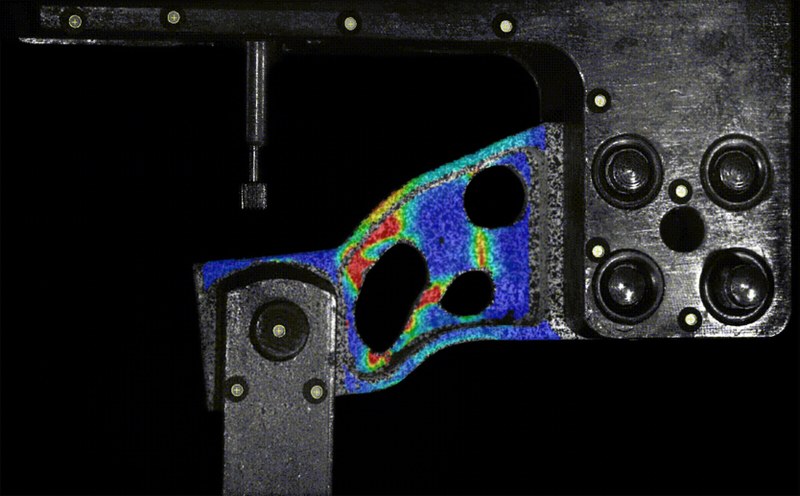
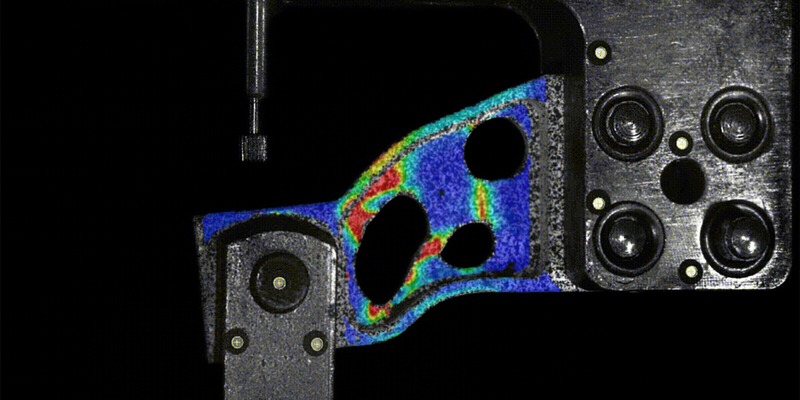
The optical strain measurement system can be used to measure strains or calculate the surface stresses of a known material. Various test sequences are possible, from quasi-static to highly dynamic tests with corresponding analyses in 2D or 3D.

Printing small series and prototypes using the poly-jet modelling process
It is also possible to print small series and prototypes using the poly-jet modelling process. The maximum component size is 294x211x144 mm. Larger components can be split up and glued together to form a whole after printing. Materials are available in various colours and qualities. The mechanical properties of the components produced also allow a subsequent machining process (e.g. tapping, milling, turning and grinding).

Get in touch with us

For more information or to discuss a collaboration, please contact Jürg Küffer.

Infrastructure

Optical 3D measurement technology

3D scanner: GOM ATOS III Triple Scan

Photogrammetry: GOM TRITOP
3D deformation measurement: GOM ARAMIS; up to 10 kHz measuring frequency possible

3D printing

ProJet MJP2500 Plus from 3D Systems

Strain measurement of a component.

The 3D Scanning and 3D Printing Lab is part of the FHNW Institute of Product and Production Engineering
Loading

School of
Engineering and Environment FHNW University of Applied Sciences and Arts Northwestern Switzerland

  • About the School
    • FHNW School of Engineering and Environment
    • Degree Programmes
    • Continuing Education
    • Collaboration in Research and Services
  • Social Media
    • LinkedIn
    • Instagram
    • Facebook
    • TikTok
    • YouTube
  • About FHNW
    • Organisation
    • Schools
    • Locations
    • FHNW Library
    • Media Relations
  • Support
    • IT Support
    • Inside FHNW
    • Webmail
Logo FHNW - 20 Years
Logo Swiss Universities
Logo European University Association
© University of Applied Sciences and Arts Northwestern Switzerland (FHNW)
  • Data Protection
  • Imprint
  • Accessibility
  • DE
  • EN