Skip to main contentSkip to search barSkip to navigationSkip to footer
Logo of the University of Applied Sciences and Arts Northwestern Switzerland
  • DE
  • EN
  • Home
  • Degree programmes
  • Continuing education

Ten Schools One Goal

The FHNW comprises 10 schools with different specializations. Select a school to see its specific courses, study programmes and information.

Applied Psychology

Architecture, Construction and Geomatics

Art and Design

Music

Computer Science

Life Sciences

School of Education

Social Work

Engineering and Environment

Business

  • Research

    • Research fields
    • Projects
  • Updates and insights

    • News and stories
  • Events

  • Media corner

  • About the School of Engineering and Environment

    • People directory
    • Management Board
  • Institutes

    • Institute of Automation
    • Institute of Bioenergy and Resource Efficiency
    • Institute of Business Engineering
    • Institute of Electric Power Systems
    • Institute of Humanities and Social Sciences
    • Institute of Polymer Engineering
    • Institute of Mathematics and Natural Sciences
    • Institute of Polymer Nanotechnology
    • Institute of Optometry
    • Institute of Product and Production Engineering
    • Institute for Sensors and Electronics
    • Institute of Thermal and Fluid Engineering
    • Laboratories of the School of Engineering and Environment
Logo of the University of Applied Sciences and Arts Northwestern Switzerland
  • About the School
    • FHNW School of Engineering and Environment
    • Degree Programmes
    • Continuing Education
    • Collaboration in Research and Services
  • Social Media
    • LinkedIn
    • Instagram
    • Facebook
    • TikTok
    • YouTube
  • About FHNW
    • Organisation
    • Schools
    • Locations
    • FHNW Library
    • Media Relations
  • Support
    • IT Support
    • Inside FHNW
    • Webmail
  • Data Protection
  • Imprint
  • Accessibility
  • Research

    • Research fields
    • Projects
  • Updates and insights

    • News and stories
  • Events

  • Media corner

  • About the School of Engineering and Environment

    • People directory
    • Management Board
  • Institutes

    • Institute of Automation
    • Institute of Bioenergy and Resource Efficiency
    • Institute of Business Engineering
    • Institute of Electric Power Systems
    • Institute of Humanities and Social Sciences
    • Institute of Polymer Engineering
    • Institute of Mathematics and Natural Sciences
    • Institute of Polymer Nanotechnology
    • Institute of Optometry
    • Institute of Product and Production Engineering
    • Institute for Sensors and Electronics
    • Institute of Thermal and Fluid Engineering
    • Laboratories of the School of Engineering and Environment

Type a search term and search continuing education,degree programmes, events, documents and other content.

  • Engineering and Environment
  • Research and services
  • Collaboration
  • services
services

Virtual Lab FHNW, FHNW School of Engineering and Environment

School of Engineering and Environment


Studies in the virtual laboratory enable you to predict and optimise planned experiments in a targeted manner - and thus save time and money. Validated experimental models in the virtual laboratory provide temporally and spatially detailed data and help with the further development of measurement technology and components.
virtuelles-labor-header-itfe-ht-fhnw.jpg

Our Offer

Our virtual laboratory and the corresponding experience and expertise are at your disposal for flow modelling, heat transfer, structural mechanics, acoustics, particle modelling as well as electrical and chemical investigations. Individual or coupled models (multiphysics) are used. Examples of previous virtual analyses include wind loads in photovoltaic modules or temperature and voltage distributions in power semiconductors.

Incidentally, the simulations take place on virtual machines with several hundred computer cores.

The virtual laboratory supports our physical laboratories in thermal and fluid engineering (water laboratory, wind tunnel, combustion, etc.) with preliminary analyses, e.g. for the design of test series in the virtual laboratory with corresponding simulations. In this way, planned experiments can be optimised and the virtual laboratory saves time and costs for experimental prototype development.

  • Evaluation of measurement results from test benches through detailed analyses based on validated post-simulations and specific result analyses.
  • Simulation and optimisation of thermo-mechanical manufacturing and operating processes, flow modelling, atomisation technology, evaporation, etc.
  • Independent investigations with simulations if no test benches are possible or practical, e.g. due to small or large dimensions

Get in touch with us

For more information or to discuss a collaboration, please contact Nobert Hofmann.

Infrastructure
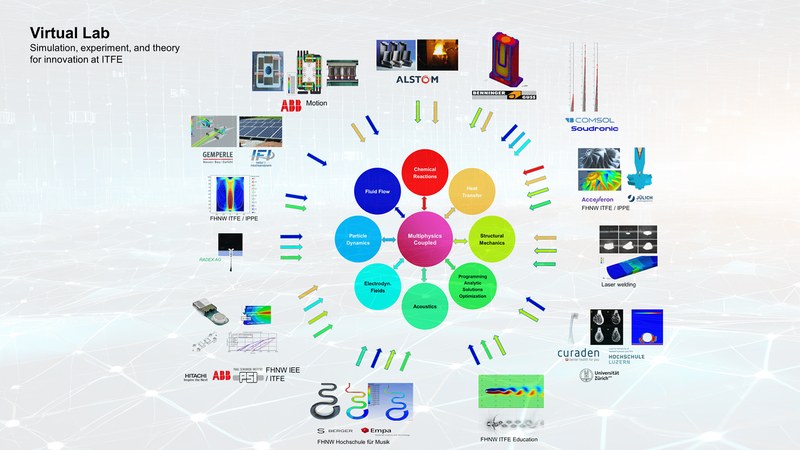
  • Various specific simulation software ANSYS CFX, Fluent, Flow3D, Comsol, ABAQUS, ANSYS, NX.  
  • Software development for automation and optimisation in MATLAB, Python and C. 
  • 2 computer clusters with >400 CPU's, 4TB Ram and virtual environment. 
Overview of simulation options in the Virtual lab

The Virtual Lab is part of the FHNW Institute of Thermal and Fluid Engineering

Loading

School of
Engineering and Environment FHNW University of Applied Sciences and Arts Northwestern Switzerland

  • About the School
    • FHNW School of Engineering and Environment
    • Degree Programmes
    • Continuing Education
    • Collaboration in Research and Services
  • Social Media
    • LinkedIn
    • Instagram
    • Facebook
    • TikTok
    • YouTube
  • About FHNW
    • Organisation
    • Schools
    • Locations
    • FHNW Library
    • Media Relations
  • Support
    • IT Support
    • Inside FHNW
    • Webmail
Logo FHNW - 20 Years
Logo Swiss Universities
Logo European University Association
© University of Applied Sciences and Arts Northwestern Switzerland (FHNW)
  • Data Protection
  • Imprint
  • Accessibility
  • DE
  • EN