Skip to main contentSkip to search barSkip to navigationSkip to footer
Logo of the University of Applied Sciences and Arts Northwestern Switzerland
  • DE
  • EN
  • Home
  • Degree programmes
  • Continuing education

Ten Schools One Goal

The FHNW comprises 10 schools with different specializations. Select a school to see its specific courses, study programmes and information.

Applied Psychology

Architecture, Construction and Geomatics

Art and Design

Business

Computer Science

Engineering and Environment

Life Sciences

Music

School of Education

Social Work

  • Research

    • Research fields
    • Projects
  • Updates and insights

    • News and stories
  • Events

  • Media corner

  • About the School of Engineering and Environment

    • People directory
    • Management Board
  • Institutes

    • Institute of Automation
    • Institute of Bioenergy and Resource Efficiency
    • Institute of Business Engineering
    • Institute of Electric Power Systems
    • Institute of Humanities and Social Sciences
    • Institute of Polymer Engineering
    • Institute of Mathematics and Natural Sciences
    • Institute of Polymer Nanotechnology
    • Institute of Optometry
    • Institute of Product and Production Engineering
    • Institute for Sensors and Electronics
    • Institute of Thermal and Fluid Engineering
    • Laboratories of the School of Engineering and Environment
Logo of the University of Applied Sciences and Arts Northwestern Switzerland
  • About the School
    • FHNW School of Engineering and Environment
    • Degree Programmes
    • Continuing Education
    • Collaboration in Research and Services
  • Social Media
    • LinkedIn
    • Instagram
    • Facebook
    • TikTok
    • YouTube
  • About FHNW
    • Organisation
    • Schools
    • Locations
    • FHNW Library
    • Media Relations
  • Support
    • IT Support
    • Inside FHNW
    • Webmail
  • Data Protection
  • Imprint
  • Accessibility
  • Research

    • Research fields
    • Projects
  • Updates and insights

    • News and stories
  • Events

  • Media corner

  • About the School of Engineering and Environment

    • People directory
    • Management Board
  • Institutes

    • Institute of Automation
    • Institute of Bioenergy and Resource Efficiency
    • Institute of Business Engineering
    • Institute of Electric Power Systems
    • Institute of Humanities and Social Sciences
    • Institute of Polymer Engineering
    • Institute of Mathematics and Natural Sciences
    • Institute of Polymer Nanotechnology
    • Institute of Optometry
    • Institute of Product and Production Engineering
    • Institute for Sensors and Electronics
    • Institute of Thermal and Fluid Engineering
    • Laboratories of the School of Engineering and Environment

Type a search term and search continuing education,degree programmes, events, documents and other content.

  • Engineering and Environment
  • Research and services
  • Research
  • Research fields
  • Mechanical engineering
Mechanical engineering

Finite element simulations, FHNW School of Engineering and Environment

School of Engineering and Environment


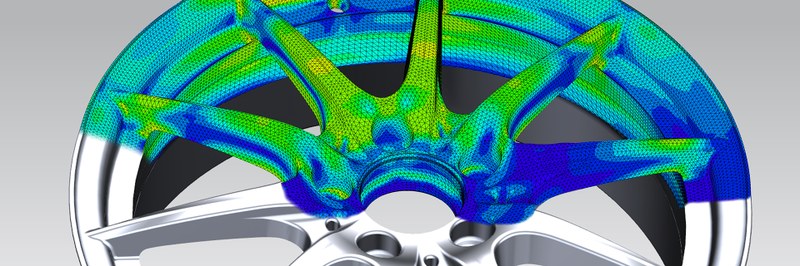
Structural finite element simulations of components and assemblies.
topbild_mas_for.jpeg

Simulation is a powerful tool for assessing the suitability of specific concepts or design variants at an early stage of the product development process. The overall behaviour of a component (or assembly) can be analysed using simulation: structural, thermal, fluid mechanical, electromechanical, chemical, or any coupling of these fields. However, the goal is never to model every detail of component behaviour with the highest possible level of realism. Instead, the focus is on obtaining sufficiently accurate results for the intended application in the most efficient way.
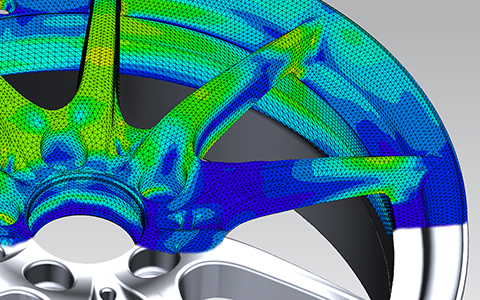
Finite element simulations (FE analyses, computational structural mechanics – CSM) are at the core of our work, complemented by computational fluid dynamics (CFD) simulations. In the field of FE simulation, we address not only linear structural and/or thermal analyses, but also nonlinear problems. Such nonlinearities occur, for example, in elastoplastic or viscoelastic material behaviour, large deformations, multiphysics coupling (thermo-electro-mechanical behaviour, etc.), or when considering damage mechanisms and fracture behaviour.
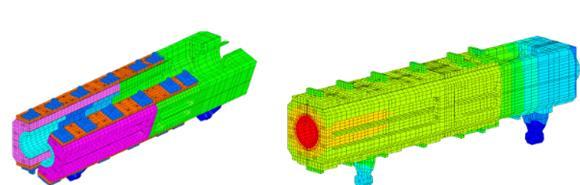
However, simulation alone does not yet create value. Only when a simulation is validated – i.e. when its results have been successfully compared with experimental measurements – does it provide the required added value. Therefore, simulation is very closely linked to experimental work. A major advantage of the Institute of Product and Production Engineering is its extensive experimental infrastructure for mechanical component testing and material analysis. For example, fracture loads, natural frequencies, or force–displacement profiles of forming processes can be measured within a short time and used to validate FE results.

At the Institute of Product and Production Engineering, the primary FE software tools used are NX Nastran, ADINA, ABAQUS, and ANSYS.

School of
Engineering and Environment FHNW University of Applied Sciences and Arts Northwestern Switzerland

  • About the School
    • FHNW School of Engineering and Environment
    • Degree Programmes
    • Continuing Education
    • Collaboration in Research and Services
  • Social Media
    • LinkedIn
    • Instagram
    • Facebook
    • TikTok
    • YouTube
  • About FHNW
    • Organisation
    • Schools
    • Locations
    • FHNW Library
    • Media Relations
  • Support
    • IT Support
    • Inside FHNW
    • Webmail
Logo FHNW - 20 Years
Logo Swiss Universities
Logo European University Association
© University of Applied Sciences and Arts Northwestern Switzerland (FHNW)
  • Data Protection
  • Imprint
  • Accessibility
  • DE
  • EN