Skip to main contentSkip to search barSkip to navigationSkip to footer
Logo of the University of Applied Sciences and Arts Northwestern Switzerland
  • DE
  • EN
  • FR
  • Home
  • Degree programmes
  • Continuing education

Ten Schools One Goal

The FHNW comprises 10 schools with different specializations. Select a school to see its specific courses, study programmes and information.

Applied Psychology

Architecture, Construction and Geomatics

Art and Design

Music

Computer Science

Life Sciences

School of Education

Social Work

Engineering and Environment

Business

  • Research

    • Research fields
    • Projects
  • Updates and insights

    • News and stories
  • Events

  • Media corner

  • About the School of Engineering and Environment

    • People directory
    • Management Board
  • Institutes

    • Institute of Automation
    • Institute of Bioenergy and Resource Efficiency
    • Institute of Business Engineering
    • Institute of Electric Power Systems
    • Institute of Humanities and Social Sciences
    • Institute of Polymer Engineering
    • Institute of Mathematics and Natural Sciences
    • Institute of Polymer Nanotechnology
    • Institute of Optometry
    • Institute of Product and Production Engineering
    • Institute for Sensors and Electronics
    • Institute of Thermal and Fluid Engineering
    • Laboratories of the School of Engineering and Environment
Logo of the University of Applied Sciences and Arts Northwestern Switzerland
  • About the School
    • FHNW School of Engineering and Environment
    • Degree Programmes
    • Continuing Education
    • Collaboration in Research and Services
  • Social Media
    • LinkedIn
    • Instagram
    • Facebook
    • TikTok
    • YouTube
  • About FHNW
    • Organisation
    • Schools
    • Locations
    • FHNW Library
    • Media Relations
  • Support
    • IT Support
    • Inside FHNW
    • Webmail
  • Data Protection
  • Imprint
  • Accessibility
  • Research

    • Research fields
    • Projects
  • Updates and insights

    • News and stories
  • Events

  • Media corner

  • About the School of Engineering and Environment

    • People directory
    • Management Board
  • Institutes

    • Institute of Automation
    • Institute of Bioenergy and Resource Efficiency
    • Institute of Business Engineering
    • Institute of Electric Power Systems
    • Institute of Humanities and Social Sciences
    • Institute of Polymer Engineering
    • Institute of Mathematics and Natural Sciences
    • Institute of Polymer Nanotechnology
    • Institute of Optometry
    • Institute of Product and Production Engineering
    • Institute for Sensors and Electronics
    • Institute of Thermal and Fluid Engineering
    • Laboratories of the School of Engineering and Environment

Type a search term and search continuing education,degree programmes, events, documents and other content.

  • Engineering and Environment
  • Research and services
  • Research
  • Projects
Projects

Aesthesiometer for measuring corneal sensitivity, FHNW School of Engineering and Environment

School of Engineering and Environment


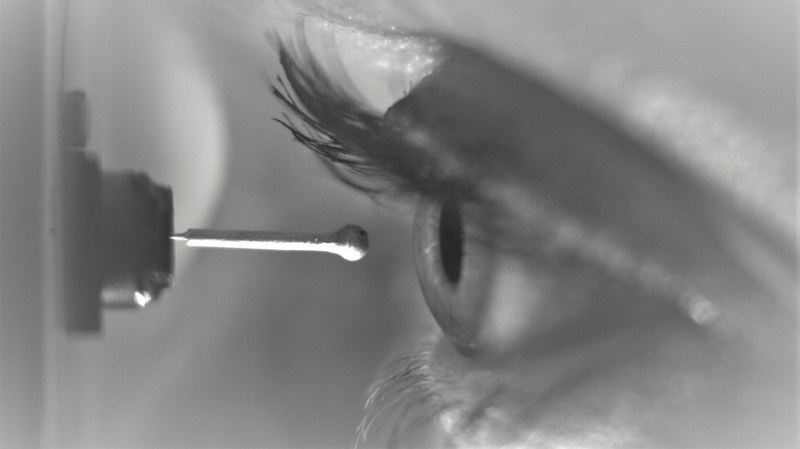
Feasibility study for the development of an aesthesiometer.
Project details

Objectives

All instruments available for corneal sensitivity measurements are compromised by considerable limitations, such as lack of reproducibility/selectivity of measurement and limited practicality in an everyday clinical setup for routine measurements.

Result

Two potential concepts were identified in discussion with international research partners:

  1. A direct, tactile stimulus based on the classic Cochet Bonnet aesthesiometer using a "tip".
  2. A stimulus using fine, pulsed liquid jet / liquid droplets.

For the first approach, the following conditions should be considered:

  • The tip itself must be disposable or must be easily sterilised.
  • The tip may not compromise the integrity of the ocular surface
  • It must be possible to determine the precise moment of contact between the tip and the cornea
  • The "contact force" and "contact duration" should be determined electronically/electromechanically

For the second approach, it has to be explored how a purely mechanical stimulus can be generated with a fine (pulsed) water jet, without adding too much liquid onto the surface of the eye that may have an influence on the measurement. For this purpose, the following parameters are being examined:

  • Pressure (speed) and size (length) of the water jet (impulse)
  • Frequency and repetition rate of the liquid pulse
  • Temperature of the jet / droplets
  • Salt content of the watery solution used

Project information

Implementation

FHNW Institute of Optometry, FHNW Institute for Sensors and Electronics


Project partners

Haag-Streit AG


Duration

33 months


Funding

Innosuisse


Project management

Prof. Dr. Daniela Nosch, Prof. Dr. Markus Loepfe


School of
Engineering and Environment FHNW University of Applied Sciences and Arts Northwestern Switzerland

  • About the School
    • FHNW School of Engineering and Environment
    • Degree Programmes
    • Continuing Education
    • Collaboration in Research and Services
  • Social Media
    • LinkedIn
    • Instagram
    • Facebook
    • TikTok
    • YouTube
  • About FHNW
    • Organisation
    • Schools
    • Locations
    • FHNW Library
    • Media Relations
  • Support
    • IT Support
    • Inside FHNW
    • Webmail
Logo FHNW - 20 Years
Logo Swiss Universities
Logo European University Association
© University of Applied Sciences and Arts Northwestern Switzerland (FHNW)
  • Data Protection
  • Imprint
  • Accessibility
  • DE
  • EN
  • FR