Skip to main contentSkip to search barSkip to navigationSkip to footer
Logo of the University of Applied Sciences and Arts Northwestern Switzerland
  • DE
  • EN
  • Home
  • Degree programmes
  • Continuing education

Ten Schools One Goal

The FHNW comprises 10 schools with different specializations. Select a school to see its specific courses, study programmes and information.

Applied Psychology

Architecture, Construction and Geomatics

Art and Design

Music

Computer Science

Life Sciences

School of Education

Social Work

Engineering and Environment

Business

  • Research

    • Research fields
    • Projects
  • Updates and insights

    • News and stories
  • Events

  • Media corner

  • About the School of Engineering and Environment

    • People directory
    • Management Board
  • Institutes

    • Institute of Automation
    • Institute of Bioenergy and Resource Efficiency
    • Institute of Business Engineering
    • Institute of Electric Power Systems
    • Institute of Humanities and Social Sciences
    • Institute of Polymer Engineering
    • Institute of Mathematics and Natural Sciences
    • Institute of Polymer Nanotechnology
    • Institute of Optometry
    • Institute of Product and Production Engineering
    • Institute for Sensors and Electronics
    • Institute of Thermal and Fluid Engineering
    • Laboratories of the School of Engineering and Environment
Logo of the University of Applied Sciences and Arts Northwestern Switzerland
  • About the School
    • FHNW School of Engineering and Environment
    • Degree Programmes
    • Continuing Education
    • Collaboration in Research and Services
  • Social Media
    • LinkedIn
    • Instagram
    • Facebook
    • TikTok
    • YouTube
  • About FHNW
    • Organisation
    • Schools
    • Locations
    • FHNW Library
    • Media Relations
  • Support
    • IT Support
    • Inside FHNW
    • Webmail
  • Data Protection
  • Imprint
  • Accessibility
  • Research

    • Research fields
    • Projects
  • Updates and insights

    • News and stories
  • Events

  • Media corner

  • About the School of Engineering and Environment

    • People directory
    • Management Board
  • Institutes

    • Institute of Automation
    • Institute of Bioenergy and Resource Efficiency
    • Institute of Business Engineering
    • Institute of Electric Power Systems
    • Institute of Humanities and Social Sciences
    • Institute of Polymer Engineering
    • Institute of Mathematics and Natural Sciences
    • Institute of Polymer Nanotechnology
    • Institute of Optometry
    • Institute of Product and Production Engineering
    • Institute for Sensors and Electronics
    • Institute of Thermal and Fluid Engineering
    • Laboratories of the School of Engineering and Environment

Type a search term and search continuing education,degree programmes, events, documents and other content.

  • Engineering and Environment
  • Research and services
  • Research
  • Projects
Projects

Functional prosthetic legs made of glass fiber reinforced plastic recyclate, FHNW School of Engineering and Environment

School of Engineering and Environment


Worldwide, 35 to 40 million people depend on prostheses and orthopedic services. Project Circleg has therefore the goal to develop a prosthetic leg system that is adapted to the needs of People with an amputation in low to middle income countries.
Project details

University
FHNW School of Engineering and Environment / School of Engineering and Environment, Institute of Polymer Engineering
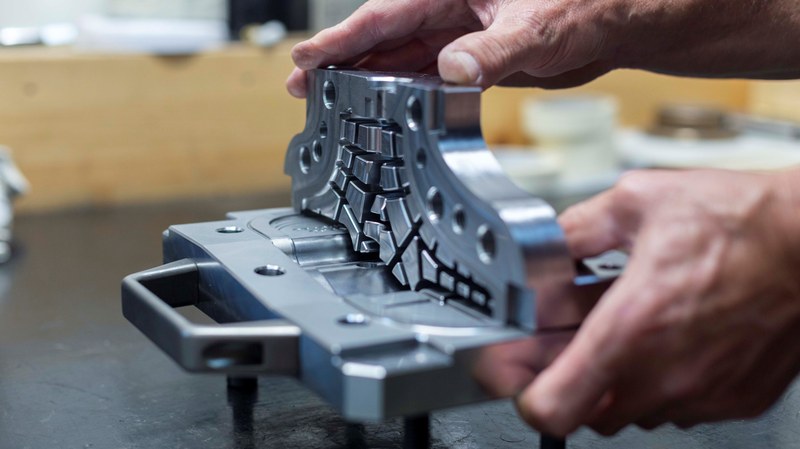
Prototype mold of the Circleg Zero ankle part (Source: Fabian Engel/Project Circleg)

Technology

Glass fiber reinforced plastic recyclate, prototype mold, transfer molding

Background

Prosthetics that are available in developing countries usually lack functionality or availability. For this reason, the company Project Circleg has the goal to develop a functional prosthesis that is cost-effective and appropriate for the user. This prosthesis will initially be marketed in Kenya and Uganda. To use the infrastructure and machines of these countries, the locally available resources are to be utilized. The material for the prosthesis will be PP or PET pellets from recycled plastics. The recycled material will be sourced from the company Mr. Green from Nairobi, Kenya.

Goals

The FHNW Institute of Polymer Technology carried out a material and process investigation and prototype production. For this purpose, a component of the Project Circleg prosthesis system was optimized regarding a prototype production, suitable for plastics and for the production processes locally available in Kenya and Uganda. Subsequently, a tool was designed, manufactured and put into production. The main objective was to produce prototypes from the materials polyethylene terephthalate (PET) and polypropylene (PP) with short glass fibers (GF) and long glass fibers (LFT).

Results

Various combinations of plastic recyclates with glass fibers were created, tested and compared. Once the most promising materials were selected, the second step was to test the feasibility of production.

For this step of the development, a component of the Circleg prosthetic system was selected and the design was adapted according to the plastic construction rules to a simplified injection molding process, and then a prototype mold was developed and manufactured. Since the prosthetic parts are to be manufactured in developing countries, the transfer injection molding process was used. In this process, the plastic granules, as well as the mold, are heated in an oven above the melting temperature of the polymer. The molten polymer is then pressed into the mold by a press and cooled. The advantages of this process are the gentle processing of the fibers, which has an enormous influence on the impact strength of the material, and the lower investment costs in machines and equipment compared to the traditional injection molding process.
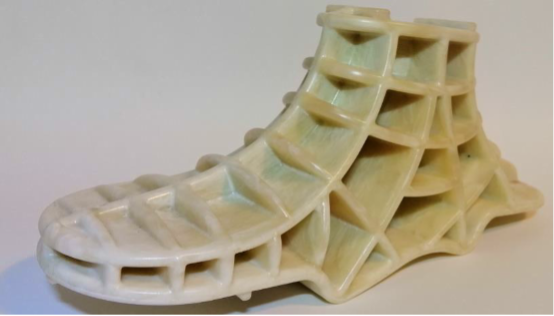
The Circleg Zero ankle part made of PET long fiber granulate in the transfer molding process.

The development of the tool, as well as the production of the prototypes, was carried out in cooperation with the Swiss company Swissfluid AG, which is specialized in the transfer injection molding process. After coordinating the correct parameters and process steps, the production of the first small series was successfully carried out.

Project-Information

Client

Project Circleg

Execution

FHNW Institut of Polymer Engineering

Duration

1 semester

Team

FHNW: Prof. Dr. Christian Rytka, Simone Battaglia,

Project Circleg: Simon Oschwald, Fabian Engel, Daniel Vafi, Laura Magni

Swissfluid AG: Markus Meier

School of
Engineering and Environment FHNW University of Applied Sciences and Arts Northwestern Switzerland

  • About the School
    • FHNW School of Engineering and Environment
    • Degree Programmes
    • Continuing Education
    • Collaboration in Research and Services
  • Social Media
    • LinkedIn
    • Instagram
    • Facebook
    • TikTok
    • YouTube
  • About FHNW
    • Organisation
    • Schools
    • Locations
    • FHNW Library
    • Media Relations
  • Support
    • IT Support
    • Inside FHNW
    • Webmail
Logo FHNW - 20 Years
Logo Swiss Universities
Logo European University Association
© University of Applied Sciences and Arts Northwestern Switzerland (FHNW)
  • Data Protection
  • Imprint
  • Accessibility
  • DE
  • EN