Skip to main contentSkip to search barSkip to navigationSkip to footer
Logo of the University of Applied Sciences and Arts Northwestern Switzerland
  • DE
  • EN
  • Home
  • Degree programmes
  • Continuing education

Ten Schools One Goal

The FHNW comprises 10 schools with different specializations. Select a school to see its specific courses, study programmes and information.

Applied Psychology

Architecture, Construction and Geomatics

Art and Design

Music

Computer Science

Life Sciences

School of Education

Social Work

Engineering and Environment

Business

  • Research

    • Research fields
    • Projects
  • Updates and insights

    • News and stories
  • Events

  • Media corner

  • About the School of Engineering and Environment

    • People directory
    • Management Board
  • Institutes

    • Institute of Automation
    • Institute of Bioenergy and Resource Efficiency
    • Institute of Business Engineering
    • Institute of Electric Power Systems
    • Institute of Humanities and Social Sciences
    • Institute of Polymer Engineering
    • Institute of Mathematics and Natural Sciences
    • Institute of Polymer Nanotechnology
    • Institute of Optometry
    • Institute of Product and Production Engineering
    • Institute for Sensors and Electronics
    • Institute of Thermal and Fluid Engineering
    • Laboratories of the School of Engineering and Environment
Logo of the University of Applied Sciences and Arts Northwestern Switzerland
  • About the School
    • FHNW School of Engineering and Environment
    • Degree Programmes
    • Continuing Education
    • Collaboration in Research and Services
  • Social Media
    • LinkedIn
    • Instagram
    • Facebook
    • TikTok
    • YouTube
  • About FHNW
    • Organisation
    • Schools
    • Locations
    • FHNW Library
    • Media Relations
  • Support
    • IT Support
    • Inside FHNW
    • Webmail
  • Data Protection
  • Imprint
  • Accessibility
  • Research

    • Research fields
    • Projects
  • Updates and insights

    • News and stories
  • Events

  • Media corner

  • About the School of Engineering and Environment

    • People directory
    • Management Board
  • Institutes

    • Institute of Automation
    • Institute of Bioenergy and Resource Efficiency
    • Institute of Business Engineering
    • Institute of Electric Power Systems
    • Institute of Humanities and Social Sciences
    • Institute of Polymer Engineering
    • Institute of Mathematics and Natural Sciences
    • Institute of Polymer Nanotechnology
    • Institute of Optometry
    • Institute of Product and Production Engineering
    • Institute for Sensors and Electronics
    • Institute of Thermal and Fluid Engineering
    • Laboratories of the School of Engineering and Environment

Type a search term and search continuing education,degree programmes, events, documents and other content.

  • Engineering and Environment
  • Research and services
  • Research
  • Projects
Projects

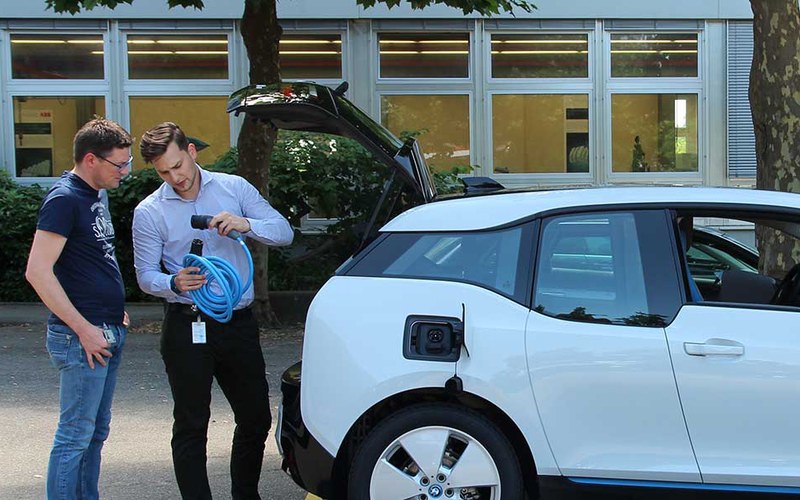
E-mobility: Climate-friendly commuting, FHNW School of Engineering and Environment

School of Engineering and Environment


In collaboration with numerous universities and business partners, both in Switzerland and abroad, FHNW is addressing the problem of commuter traffic.
Project details

Type
Research project

Issues

Car pools, electromobility

Objectives

The FHNW Centre for Resource Efficiency is examining whether car pools and electromobility can contribute to reducing CO2 emissions.

Background

More than 34,000 people commute regularly from their homes in the districts of Lörrach and Waldshut to their place of work in Switzerland. The company ABB Schweiz is situated close to the border and employs staff from Germany, too. A preparatory study on the mobility behaviour of employees indicates that more than 80% of commuters use a car with a combustion engine to get to work, and that they travel on their own. The reason that so few people use public transport it said to be a lack of availability.

Result

The project is looking into whether electromobility could contribute to reducing CO2 emissions in commuter traffic and if so, under what conditions. The results will be published in appropriate form as guidelines for companies who wish to promote ecological mobility among their staff. The Centre for Resource Efficiency is responsible for recording travel data and carrying out ecological assessments.

Project information

Implementation 
Centre for Resource Efficiency FHNW
Projektpartner
Hochschule Offenburg, Landkreis Waldshut, Bundesland Baden-Württemberg, Kanton Schaffhausen, Hochschule Reutlingen, Landkreis Lörrach, Kanton Aargau, ABB
Duration
6 years
Funding
Interreg-V
Project lead

Prof. Dr. Thomas Heim

School of
Engineering and Environment FHNW University of Applied Sciences and Arts Northwestern Switzerland

  • About the School
    • FHNW School of Engineering and Environment
    • Degree Programmes
    • Continuing Education
    • Collaboration in Research and Services
  • Social Media
    • LinkedIn
    • Instagram
    • Facebook
    • TikTok
    • YouTube
  • About FHNW
    • Organisation
    • Schools
    • Locations
    • FHNW Library
    • Media Relations
  • Support
    • IT Support
    • Inside FHNW
    • Webmail
Logo FHNW - 20 Years
Logo Swiss Universities
Logo European University Association
© University of Applied Sciences and Arts Northwestern Switzerland (FHNW)
  • Data Protection
  • Imprint
  • Accessibility
  • DE
  • EN