Skip to main contentSkip to search barSkip to navigationSkip to footer
Logo of the University of Applied Sciences and Arts Northwestern Switzerland
  • DE
  • EN
  • Home
  • Degree programmes
  • Continuing education

Ten Schools One Goal

The FHNW comprises 10 schools with different specializations. Select a school to see its specific courses, study programmes and information.

Applied Psychology

Architecture, Construction and Geomatics

Art and Design

Music

Computer Science

Life Sciences

School of Education

Social Work

Engineering and Environment

Business

  • Research

    • Research fields
    • Projects
  • Updates and insights

    • News and stories
  • Events

  • Media corner

  • About the School of Engineering and Environment

    • People directory
    • Management Board
  • Institutes

    • Institute of Automation
    • Institute of Bioenergy and Resource Efficiency
    • Institute of Business Engineering
    • Institute of Electric Power Systems
    • Institute of Humanities and Social Sciences
    • Institute of Polymer Engineering
    • Institute of Mathematics and Natural Sciences
    • Institute of Polymer Nanotechnology
    • Institute of Optometry
    • Institute of Product and Production Engineering
    • Institute for Sensors and Electronics
    • Institute of Thermal and Fluid Engineering
    • Laboratories of the School of Engineering and Environment
Logo of the University of Applied Sciences and Arts Northwestern Switzerland
  • About the School
    • FHNW School of Engineering and Environment
    • Degree Programmes
    • Continuing Education
    • Collaboration in Research and Services
  • Social Media
    • LinkedIn
    • Instagram
    • Facebook
    • TikTok
    • YouTube
  • About FHNW
    • Organisation
    • Schools
    • Locations
    • FHNW Library
    • Media Relations
  • Support
    • IT Support
    • Inside FHNW
    • Webmail
  • Data Protection
  • Imprint
  • Accessibility
  • Research

    • Research fields
    • Projects
  • Updates and insights

    • News and stories
  • Events

  • Media corner

  • About the School of Engineering and Environment

    • People directory
    • Management Board
  • Institutes

    • Institute of Automation
    • Institute of Bioenergy and Resource Efficiency
    • Institute of Business Engineering
    • Institute of Electric Power Systems
    • Institute of Humanities and Social Sciences
    • Institute of Polymer Engineering
    • Institute of Mathematics and Natural Sciences
    • Institute of Polymer Nanotechnology
    • Institute of Optometry
    • Institute of Product and Production Engineering
    • Institute for Sensors and Electronics
    • Institute of Thermal and Fluid Engineering
    • Laboratories of the School of Engineering and Environment

Type a search term and search continuing education,degree programmes, events, documents and other content.

  • Engineering and Environment
  • Research and services
  • Research
  • Projects
Projects

Consolidation of hybrid textiles, FHNW School of Engineering and Environment

School of Engineering and Environment


We develop and validate a consolidation model for the production of composites based on hybrid textiles. These consist of plies of reinforcing woven fibres and thermoplastic plies alternatively stacked.
Project details

University
FHNW School of Engineering and Environment / School of Engineering and Environment, Institute of Polymer Engineering
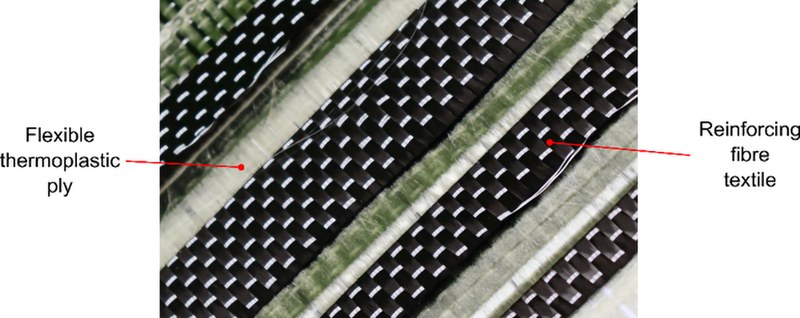
Figure 1: Picture of a partial cutaway of quasi-UD / PEI hybrid textile manufactured at the Faserinstitut Bremen

Technologies

  • Fibre-reinforced plastics
  • Hybrid textiles
  • Press moulding
  • Analytical modelling

Background

Fibre-reinforced thermoplastic composites are materials with excellent mechanical properties ideal for lightweight applications. As of today, their production mainly is based on expensive pre-impregnated materials with which limited part complexity can be attained.

Press moulding of hybrid textile is an alternative process in which semi-complex shapes can be produced. Hybrid textiles have good drapeability and an elevated design freedom, as many parameters can be easily and locally changed. A three-dimensional consolidation model would allow to avoid defect formation and enable process and design optimization. However, such a model is currently lacking.

Goals

The main goal is to develop a three-dimensional consolidation model. In a first step, a “standard” consolidation model is developed and experimentally validated with thorough experiments. A collaboration with the Faserinstitut Bremen (FIBRE) in Germany allows to extent the investigations to high-performance materials: carbon fibres and polyetherimide (PEI). The consolidation model then has to be extended in three dimensions. Finally, demonstrator parts are produced to highlight the potential of this technology, especially for semi-complex shapes.

Results

A novel consolidation model was developed, in which air entrapment, dissolution and diffusion in the molten polymer are considered. A set of experiments was designed to compare the measured impregnation degree against the model predictions and good agreement is found at different pressures and for two different polymers, polypropylene and high-density polyethylene as shown in Figure 2. Further experiments are being currently carried out with the carbon and PEI hybrid textile shown in Figure 1. In the next work steps, the consolidation model will be extended in three dimensions and validated experimentally.
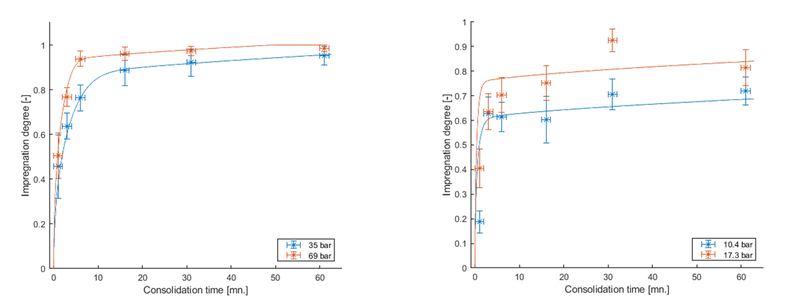
Figure 2: Measured impregnation degree in function of the time along with the predictions of the proposed model with PP as matrix on the left and HDPE on the right.

Publications:

  • Werlen V., Vocke R., Schwanemann P., Michaud V., Brauner C., Dransfeld C., Rytka C. Consolidation of hybrid textiles for aerospace applications. 20th European Conference on Composite Materials ECCM20, Lausanne, CH, 2022.
  • Werlen V., Vocke R., Schwanemann P., Michaud V., Dransfeld C., Rytka C. On the impregnation of hybrid textiles during press moulding and why entrapped air matters. To be submitted to Composite Part A end of 2022.
  • Werlen V., Vocke R., Rytka C., Schwanemann P., Michaud V., Dransfeld C., Brauner C., Herrmann A. S. ConThP: Consolidation of thermoplastic hybrid yarn materials. 5th International Conference and Exhibition on Thermoplastic Composites ITHEC, Bremen, DE, 2020.

Project information

Execution
Institute of Polymer Engineering FHNW
Duration

3 years

Funding

ConThP, Swiss National Science Foundation [200021E / 177210 / 1]

Project team

Vincent Werlen, Richard Vocke, Prof. Dr. Christian Rytka, Prof. Dr. Véronique Michaud, Prof. Dr. Clemens Dransfeld, Dr. Philipp Schwanemann, Prof. Dr. Christian Brauner, Prof. Dr. Axel Herrmann

School of
Engineering and Environment FHNW University of Applied Sciences and Arts Northwestern Switzerland

  • About the School
    • FHNW School of Engineering and Environment
    • Degree Programmes
    • Continuing Education
    • Collaboration in Research and Services
  • Social Media
    • LinkedIn
    • Instagram
    • Facebook
    • TikTok
    • YouTube
  • About FHNW
    • Organisation
    • Schools
    • Locations
    • FHNW Library
    • Media Relations
  • Support
    • IT Support
    • Inside FHNW
    • Webmail
Logo FHNW - 20 Years
Logo Swiss Universities
Logo European University Association
© University of Applied Sciences and Arts Northwestern Switzerland (FHNW)
  • Data Protection
  • Imprint
  • Accessibility
  • DE
  • EN