Skip to main contentSkip to search barSkip to navigationSkip to footer
Logo of the University of Applied Sciences and Arts Northwestern Switzerland
  • DE
  • EN
  • Home
  • Degree programmes
  • Continuing education

Ten Schools One Goal

The FHNW comprises 10 schools with different specializations. Select a school to see its specific courses, study programmes and information.

Applied Psychology

Architecture, Construction and Geomatics

Art and Design

Music

Computer Science

Life Sciences

School of Education

Social Work

Engineering and Environment

Business

  • Research

    • Research fields
    • Projects
  • Updates and insights

    • News and stories
  • Events

  • Media corner

  • About the School of Engineering and Environment

    • People directory
    • Management Board
  • Institutes

    • Institute of Automation
    • Institute of Bioenergy and Resource Efficiency
    • Institute of Business Engineering
    • Institute of Electric Power Systems
    • Institute of Humanities and Social Sciences
    • Institute of Polymer Engineering
    • Institute of Mathematics and Natural Sciences
    • Institute of Polymer Nanotechnology
    • Institute of Optometry
    • Institute of Product and Production Engineering
    • Institute for Sensors and Electronics
    • Institute of Thermal and Fluid Engineering
    • Laboratories of the School of Engineering and Environment
Logo of the University of Applied Sciences and Arts Northwestern Switzerland
  • About the School
    • FHNW School of Engineering and Environment
    • Degree Programmes
    • Continuing Education
    • Collaboration in Research and Services
  • Social Media
    • LinkedIn
    • Instagram
    • Facebook
    • TikTok
    • YouTube
  • About FHNW
    • Organisation
    • Schools
    • Locations
    • FHNW Library
    • Media Relations
  • Support
    • IT Support
    • Inside FHNW
    • Webmail
  • Data Protection
  • Imprint
  • Accessibility
  • Research

    • Research fields
    • Projects
  • Updates and insights

    • News and stories
  • Events

  • Media corner

  • About the School of Engineering and Environment

    • People directory
    • Management Board
  • Institutes

    • Institute of Automation
    • Institute of Bioenergy and Resource Efficiency
    • Institute of Business Engineering
    • Institute of Electric Power Systems
    • Institute of Humanities and Social Sciences
    • Institute of Polymer Engineering
    • Institute of Mathematics and Natural Sciences
    • Institute of Polymer Nanotechnology
    • Institute of Optometry
    • Institute of Product and Production Engineering
    • Institute for Sensors and Electronics
    • Institute of Thermal and Fluid Engineering
    • Laboratories of the School of Engineering and Environment

Type a search term and search continuing education,degree programmes, events, documents and other content.

  • Engineering and Environment
  • Research and services
  • Research
  • Projects
Projects

DUWAS: Sensor warns against volcanic ash, FHNW School of Engineering and Environment

School of Engineering and Environment


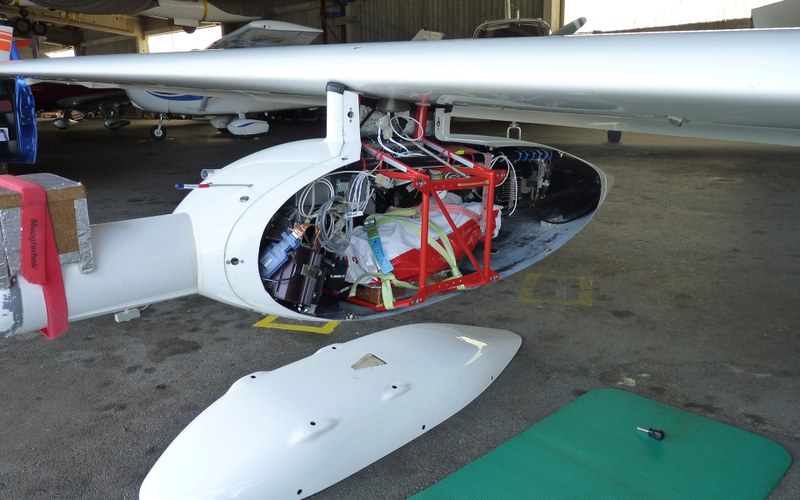
To increase the safety of aviation, the FHNW University of Applied Sciences and Arts Northwestern Switzerland is developing a sensor that detects volcanic ash.
Project details

Technologies

Infrared Sensor, Infrared Laser, Aviation

Objectives

Development of a sensor that can distinguish between volcanic ash particles and  cloud-droplets or ice crystals.

Starting situation

Volcanic ash can damage aircraft’s engines and important sensor systems. The difficulty: an ash cloud is difficult to distinguish from a normal rain cloud, especially if the two types of clouds have mixed. Even conventional sensors cannot distinguish between ash particles and water droplets or ice crystals. Both are between one and 20 micrometres small and scatter visible light equally.

Result

In addition to a conventional sensor, the FHNW research team is focusing on an infrared sensor specially designed for this research project by the Fraunhofer Institute for Applied Solid-state Physics. In the infrared range, water and volcanic ash have different light refraction indices. At a wavelength of 660 nanometres, ash particles and cloud droplets still look the same. At a wavelength of around 2700 nanometres ‒ i.e. in the infrared range ‒  the intended distinction can be made.  In the future, the "Dual Wavelength Volcanic Ash Sensor", or DUWAS, is expected to come into use in commercial flights. But the sensor could potentially be used for other purposes as well, where the distinction between two aerosol particles is important: for example as smoke detector or certain other substances.

Project information

Execution

FHNW Institute for Sensors and Electronics

Duration

2 Years

Funding

Federal Office of Civil Aviation FOCA

Team

Dr. Ernest Weingartner (Lead), Dr. Zsófia Jurányi, Daniel Egli, Prof. Dr. Heinz Burtscher

Contact

Prof. Dr. Ernest Weingartner

Lecturer in Sensor and Aerosol Technology
Phone
+41 56 202 79 18 (Direct)
E-Mail
ernest.weingartner@fhnw.ch

School of
Engineering and Environment FHNW University of Applied Sciences and Arts Northwestern Switzerland

  • About the School
    • FHNW School of Engineering and Environment
    • Degree Programmes
    • Continuing Education
    • Collaboration in Research and Services
  • Social Media
    • LinkedIn
    • Instagram
    • Facebook
    • TikTok
    • YouTube
  • About FHNW
    • Organisation
    • Schools
    • Locations
    • FHNW Library
    • Media Relations
  • Support
    • IT Support
    • Inside FHNW
    • Webmail
Logo FHNW - 20 Years
Logo Swiss Universities
Logo European University Association
© University of Applied Sciences and Arts Northwestern Switzerland (FHNW)
  • Data Protection
  • Imprint
  • Accessibility
  • DE
  • EN