Skip to main contentSkip to search barSkip to navigationSkip to footer
Logo of the University of Applied Sciences and Arts Northwestern Switzerland
  • DE
  • EN
  • Home
  • Degree programmes
  • Continuing education

Ten Schools One Goal

The FHNW comprises 10 schools with different specializations. Select a school to see its specific courses, study programmes and information.

Applied Psychology

Architecture, Construction and Geomatics

Art and Design

Music

Computer Science

Life Sciences

School of Education

Social Work

Engineering and Environment

Business

  • Research

    • Research fields
    • Projects
  • Updates and insights

    • News and stories
  • Events

  • Media corner

  • About the School of Engineering and Environment

    • People directory
    • Management Board
  • Institutes

    • Institute of Automation
    • Institute of Bioenergy and Resource Efficiency
    • Institute of Business Engineering
    • Institute of Electric Power Systems
    • Institute of Humanities and Social Sciences
    • Institute of Polymer Engineering
    • Institute of Mathematics and Natural Sciences
    • Institute of Polymer Nanotechnology
    • Institute of Optometry
    • Institute of Product and Production Engineering
    • Institute for Sensors and Electronics
    • Institute of Thermal and Fluid Engineering
    • Laboratories of the School of Engineering and Environment
Logo of the University of Applied Sciences and Arts Northwestern Switzerland
  • About the School
    • FHNW School of Engineering and Environment
    • Degree Programmes
    • Continuing Education
    • Collaboration in Research and Services
  • Social Media
    • LinkedIn
    • Instagram
    • Facebook
    • TikTok
    • YouTube
  • About FHNW
    • Organisation
    • Schools
    • Locations
    • FHNW Library
    • Media Relations
  • Support
    • IT Support
    • Inside FHNW
    • Webmail
  • Data Protection
  • Imprint
  • Accessibility
  • Research

    • Research fields
    • Projects
  • Updates and insights

    • News and stories
  • Events

  • Media corner

  • About the School of Engineering and Environment

    • People directory
    • Management Board
  • Institutes

    • Institute of Automation
    • Institute of Bioenergy and Resource Efficiency
    • Institute of Business Engineering
    • Institute of Electric Power Systems
    • Institute of Humanities and Social Sciences
    • Institute of Polymer Engineering
    • Institute of Mathematics and Natural Sciences
    • Institute of Polymer Nanotechnology
    • Institute of Optometry
    • Institute of Product and Production Engineering
    • Institute for Sensors and Electronics
    • Institute of Thermal and Fluid Engineering
    • Laboratories of the School of Engineering and Environment

Type a search term and search continuing education,degree programmes, events, documents and other content.

  • Engineering and Environment
  • Research and services
  • Research
  • Projects
Projects

ECPE Joint Research Programme: Reliability comparison of Si IGBTs and SiC MOSFETs for e-mobility applications, FHNW School of Engineering and Environment

School of Engineering and Environment


A new reliability test method that stresses both, transistor and diode is applied to obtain representative reliability data for e-mobility applications. A direct comparison between a two-chip technology such as IGBT/diode and single-chip technology such as MOSFETs with the same package and tested under the same conditions is possible.
Project details

University
School of Engineering and Environment
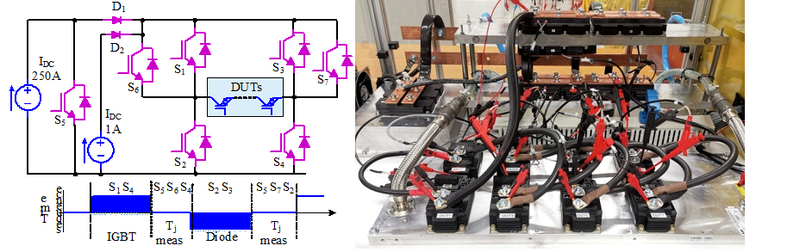
Figure 1: Topology of the bi-directional power cycling test bench and current pattern applied to the DUTs (left). 500-A Bi-directional power cycling setup realized at FHNW (right.)

Background

An Electric Vehicle’s (EV) powertrain operates as inverter when feeding the motor from the battery (accelerating), and as rectifier when recuperating back into the battery (braking). When e.g. a typical 2-level, 3-phase active rectifier/inverter operates in inverter mode, the transistors operate at higher temperatures than the diodes due to a higher average current. In rectifier operation, the diodes carry more current than the transistors and thus experience a higher thermal stress. Single-chip (MOSFETs) and two-chip technologies (IGBT/diode) will result in different load profiles and different junction temperature swings, which play an important role on the device reliability.

Goals

  • E-mobility electrical simulation using realistic mission profiles: single-chip vs. two-chip technologies
  • Validation of bidirectional power cycling test bench
  • Bidirectional power cycling tests by stressing both transistor and diode
  • Reliability evaluation of SiC MOSFETs and Si IGBTs for a e-mobility application

Results

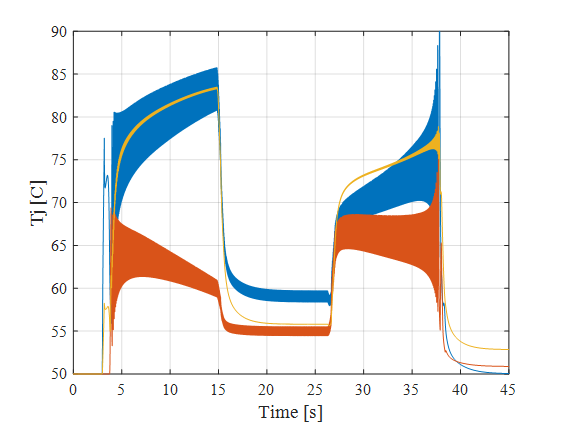
First, a reliability study of power semiconductor devices in an Electric Vehicle application is performed, based on a driving cycle mission profile. A simple mission profile (Fig. 2) with the speed of the car (km/h) is converted into the torque and speed of the motor shaft, which is the input mission profile to an electrical simulation containing the electro-thermal models and datasheet parameters of the power semiconductor devices. As a result, the loading of the transistor/diode can be computed for the two topologies: single-chip (Si IGBT) and two-chip configurations (SiC MOSFET). The thermal behavior for the given mission profile is shown in Fig. 3, where it can be observed that:

  • Two-chip configurations (Si IGBT) have two thermal stresses: (i) motor frequency variations and (ii) mission profile variations.
  • Single-chip configurations (SiC MOSFET) have only one thermal stress: mission profile variations.
  • In this case, the SiC MOSFET is less thermally stressed than the Si IGBT.
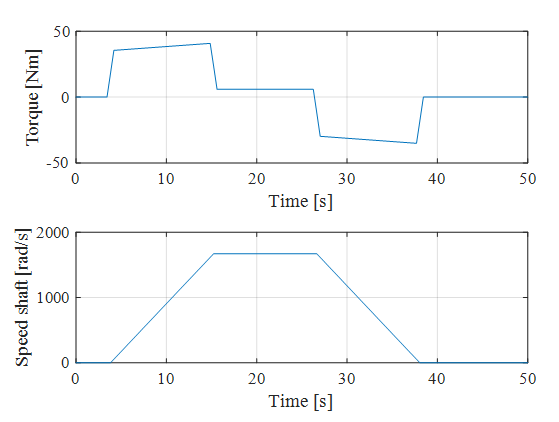
Figure 2: Simple driving cycle mission profile for an Electrical Vehicle application.
Figure 3:Thermal loading of Si IGBT/diode (blue curve is IGBT and orange curve is diode) and SiC MOSFETs (yellow curve) for the mission profile in Figure 2 in an Electric Vehicle application. Specifications: heatsink temperature = 50⁰C, switching frequency of Si IGBTs is 15 kHz, switching frequency of SiC MOSFETs is 25 kHz

Project information

Client

ECPE GmbH

Project lead and execution: 

Institut für Elektrische Energietechnik FHNW

Duration

2 years

Funding ggency (sponsor):

ECPE - European Center for Power Electronics

Project team

Dr. Paula Diaz Reigosa, Prof. Dr. Nicola Schulz, Michael Ramseier

School of
Engineering and Environment FHNW University of Applied Sciences and Arts Northwestern Switzerland

  • About the School
    • FHNW School of Engineering and Environment
    • Degree Programmes
    • Continuing Education
    • Collaboration in Research and Services
  • Social Media
    • LinkedIn
    • Instagram
    • Facebook
    • TikTok
    • YouTube
  • About FHNW
    • Organisation
    • Schools
    • Locations
    • FHNW Library
    • Media Relations
  • Support
    • IT Support
    • Inside FHNW
    • Webmail
Logo FHNW - 20 Years
Logo Swiss Universities
Logo European University Association
© University of Applied Sciences and Arts Northwestern Switzerland (FHNW)
  • Data Protection
  • Imprint
  • Accessibility
  • DE
  • EN