Skip to main contentSkip to search barSkip to navigationSkip to footer
Logo of the University of Applied Sciences and Arts Northwestern Switzerland
  • DE
  • EN
  • Home
  • Degree programmes
  • Continuing education

Ten Schools One Goal

The FHNW comprises 10 schools with different specializations. Select a school to see its specific courses, study programmes and information.

Applied Psychology

Architecture, Construction and Geomatics

Art and Design

Music

Computer Science

Life Sciences

School of Education

Social Work

Engineering and Environment

Business

  • Research

    • Research fields
    • Projects
  • Updates and insights

    • News and stories
  • Events

  • Media corner

  • About the School of Engineering and Environment

    • People directory
    • Management Board
  • Institutes

    • Institute of Automation
    • Institute of Bioenergy and Resource Efficiency
    • Institute of Business Engineering
    • Institute of Electric Power Systems
    • Institute of Humanities and Social Sciences
    • Institute of Polymer Engineering
    • Institute of Mathematics and Natural Sciences
    • Institute of Polymer Nanotechnology
    • Institute of Optometry
    • Institute of Product and Production Engineering
    • Institute for Sensors and Electronics
    • Institute of Thermal and Fluid Engineering
    • Laboratories of the School of Engineering and Environment
Logo of the University of Applied Sciences and Arts Northwestern Switzerland
  • About the School
    • FHNW School of Engineering and Environment
    • Degree Programmes
    • Continuing Education
    • Collaboration in Research and Services
  • Social Media
    • LinkedIn
    • Instagram
    • Facebook
    • TikTok
    • YouTube
  • About FHNW
    • Organisation
    • Schools
    • Locations
    • FHNW Library
    • Media Relations
  • Support
    • IT Support
    • Inside FHNW
    • Webmail
  • Data Protection
  • Imprint
  • Accessibility
  • Research

    • Research fields
    • Projects
  • Updates and insights

    • News and stories
  • Events

  • Media corner

  • About the School of Engineering and Environment

    • People directory
    • Management Board
  • Institutes

    • Institute of Automation
    • Institute of Bioenergy and Resource Efficiency
    • Institute of Business Engineering
    • Institute of Electric Power Systems
    • Institute of Humanities and Social Sciences
    • Institute of Polymer Engineering
    • Institute of Mathematics and Natural Sciences
    • Institute of Polymer Nanotechnology
    • Institute of Optometry
    • Institute of Product and Production Engineering
    • Institute for Sensors and Electronics
    • Institute of Thermal and Fluid Engineering
    • Laboratories of the School of Engineering and Environment

Type a search term and search continuing education,degree programmes, events, documents and other content.

  • Engineering and Environment
  • Research and services
  • Research
  • Projects
Projects

Electrodynamic fragmentation of electronic scrap, FHNW School of Engineering and Environment

School of Engineering and Environment


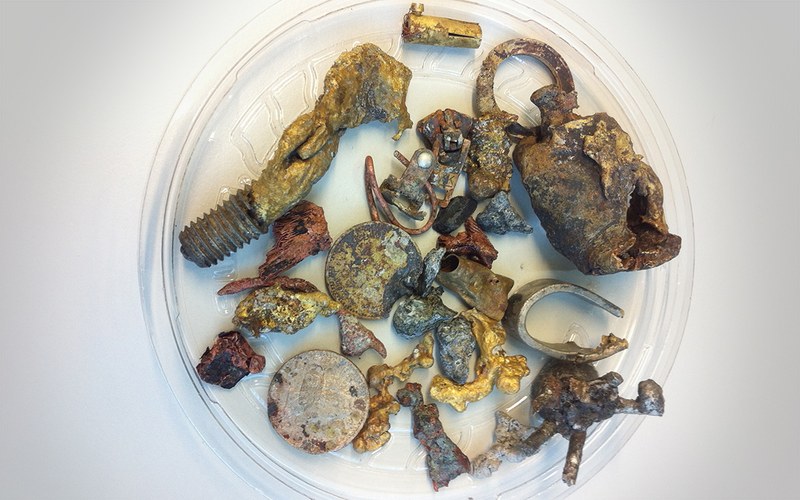
Electronic devices are becoming increasingly complex and compact. This complicates the recycling process – which is why there are plans to introduce new and innovative processes.
Project details

Objectives

Development of an innovative separation method for recycling electronic scrap.

Background

Electronic devices are becoming increasingly complex and compact. As a result, electronic scrap contains a multitude of different components and recyclable materials. Electrical components (printed circuit boards, batteries, displays etc.) are often installed in a plastic enclosure. The aim of a selective separation method is to make the recycling process easier.

Result

In the case of electrodynamic fragmentation (EDF), the material to be separated is immersed in water and positioned between two electrodes; the water acts as an isolator. Applied high voltage (up to 200 kV) is discharged and generates disruptive discharges. In the process, a compression wave (high pressure) and a plasma channel (high temperature) occur. The discharges take place along the edges of the material, whereby the material can be selectively separated.

A test is carried out to determine whether the wet processing of electronic scrap by means of EDF is suitable for identifying desirable recyclable materials in a targeted way. The objective is for recyclable materials to accumulate so that it is easier to recover them. A very wide range of analytical methods are used to verify the effectiveness of EDF for certain types of material.

Project information

Implementation partner

Selfrag AG, Immark AG

Implementation

FHNW Institute of Bioenergy and Resource Efficiency, FHNW Centre for Resource Efficiency

Research partner

Université de Liège 

Duration

three years

Funding

Eco-Innovera

Project team

Prof. Dr. Martin Streicher-Porte, Thomas Keller

School of
Engineering and Environment FHNW University of Applied Sciences and Arts Northwestern Switzerland

  • About the School
    • FHNW School of Engineering and Environment
    • Degree Programmes
    • Continuing Education
    • Collaboration in Research and Services
  • Social Media
    • LinkedIn
    • Instagram
    • Facebook
    • TikTok
    • YouTube
  • About FHNW
    • Organisation
    • Schools
    • Locations
    • FHNW Library
    • Media Relations
  • Support
    • IT Support
    • Inside FHNW
    • Webmail
Logo FHNW - 20 Years
Logo Swiss Universities
Logo European University Association
© University of Applied Sciences and Arts Northwestern Switzerland (FHNW)
  • Data Protection
  • Imprint
  • Accessibility
  • DE
  • EN