Agriculture faces the challenge of controlling weeds efficiently without relying on environmentally harmful pesticides. Particularly in Switzerland, where fields are often small and uneven, existing mechanical weed control equipment reaches its limits. In collaboration with Strebel Maschinen AG, FHNW has developed an innovative solution: an AI-powered hoeing machine that detects weeds in seed rows of varying widths and removes them selectively. This is intended to reduce pesticide use by up to 100%.
Background
Existing hoeing machines have several limitations:
- They operate with fixed row spacings and cannot adapt flexibly to different crops.
- Manually adjusting the hoeing tools is time-consuming and impractical.
- They are designed for flat fields and cannot compensate for sloping terrain.
- Existing image-processing systems are not sufficiently reliable under varying light conditions and at different stages of plant growth.
With growing political and societal demand for pesticide-free agriculture, a highly precise and adaptable solution is required.
Objectives
The project pursues four key objectives:
- AI-powered weed detection: An artificial intelligence (AI)-based image-processing solution analyses the seed rows in real time and distinguishes between weeds and crops.
- Individual hoeing tool control: Each hoeing unit is hydraulically controlled and can flexibly adapt to different row widths (35–75 cm).
- Slope compensation: Mechanical decoupling of lateral forces between the tractor and the hoeing machine ensures that the system operates precisely even on sloping terrain. The cameras detect the positions of the seed rows and compensate for any potential lateral drift of the tractor.
- Safe road transport: The machine can be safely transported on public roads without loss of efficiency or additional effort.
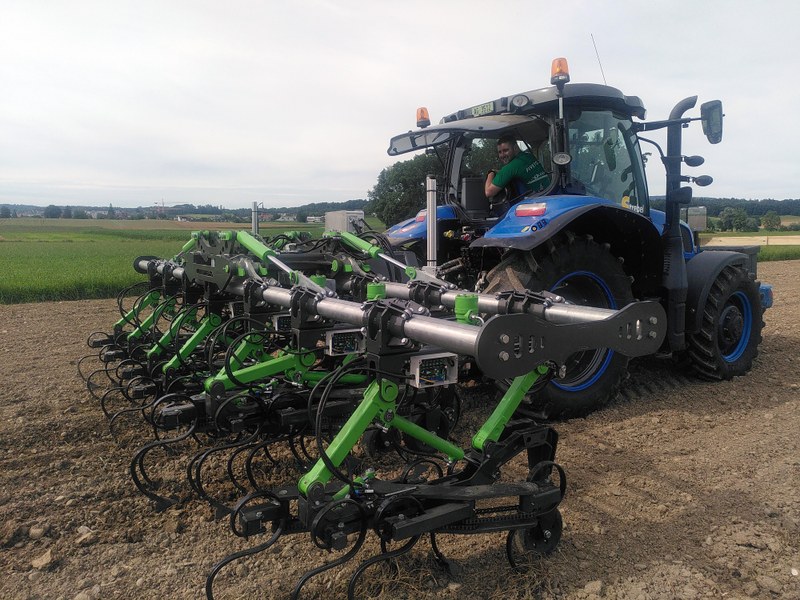
KI-gestütztes Hackgerät im Feld 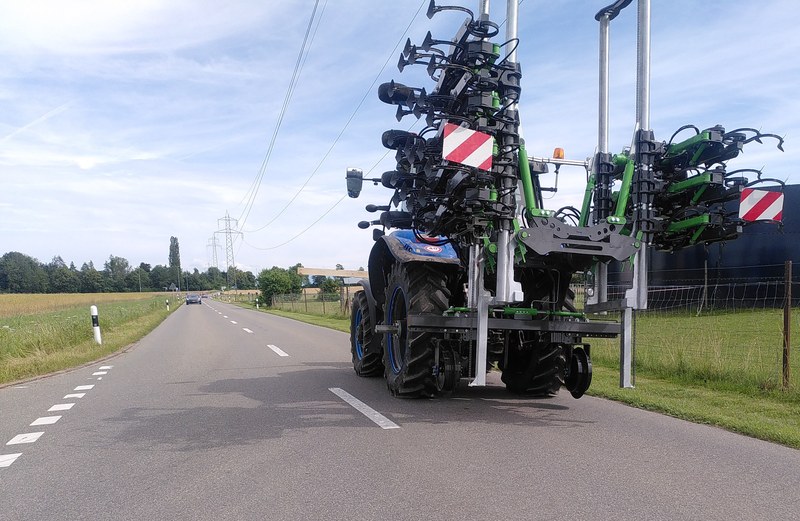
KI-gestütztes Hackgerät auf der Strasse
Results
- Erste Feldtests zeigen, dass das System Unkraut mit einer Genauigkeit von 90 % entfernt, während weniger als 2 % der Nutzpflanzen beschädigt werden.
- Die KI erkennt und verarbeitet Saatreihen mit einer Präzision von ±2,5 cm bei Fahrgeschwindigkeiten von bis zu 10 km/h.
- Im Vergleich zu bisherigen Bildverarbeitungslösungen reagiert das System weniger empfindlich auf Schatten und wechselnde Lichtverhältnisse.
- Das System reduziert den Einsatz chemischer Unkrautvernichter drastisch und verbessert so die Wasserqualität und Bodenökologie.
- Ein neuartiger Klappmechanismus gewährleistet die sichere und einfache Transportierbarkeit des Geräts auf schweizerischen Strassen.
Outlook
In the next steps, the system will be tested under practical field conditions to further validate and optimise the AI-powered detection. The hoeing machine will also be tested for practical use by farmers and prepared for market launch.
The project demonstrates how modern AI technology and sustainable agriculture can be successfully combined to protect the environment while increasing efficiency.
Related Work
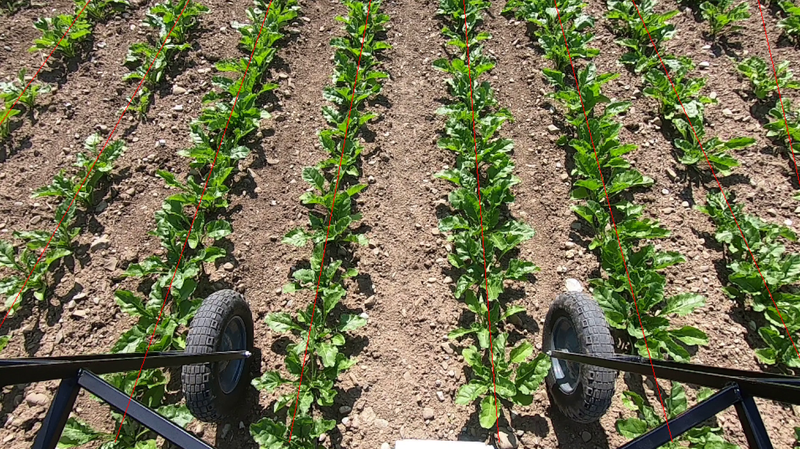
Bildbasierte Saatreihendetektion
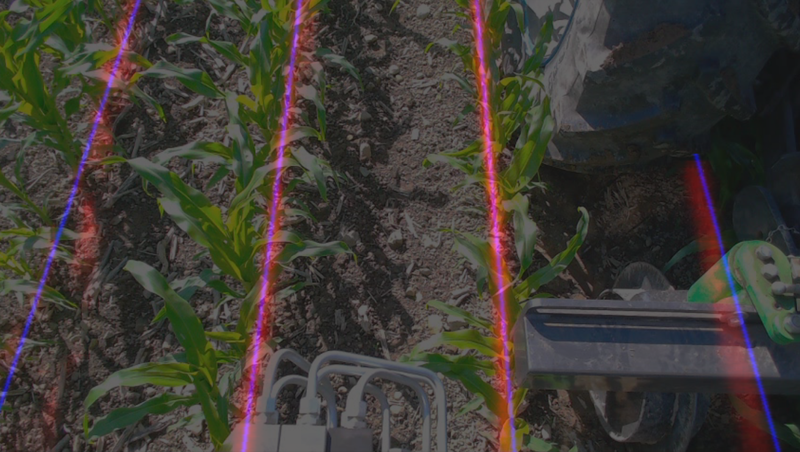
Saatreihendetektion mit neuronalen Netzwerken
Projektdetails
- Type
- Research project
- Research field
- Künstliche Intelligenz in Engineering, Automation
- Topics
- Artificial intelligence and machine learning, Environment and sustainability, Environmental technology and recycling, Technologies and engineering, Mechanical engineering and robotics
- School
- FHNW School of Engineering and Environment / Institute of Automation
- Partners
- Strebel Maschinen AG
- Funding
- Innosuisse
- Duration
- 4 years
- Team
- Prof. Dr. Jürg Keller, Thomas Kuhn