Skip to main contentSkip to search barSkip to navigationSkip to footer
Logo of the University of Applied Sciences and Arts Northwestern Switzerland
  • DE
  • EN
  • Home
  • Degree programmes
  • Continuing education

Ten Schools One Goal

The FHNW comprises 10 schools with different specializations. Select a school to see its specific courses, study programmes and information.

Applied Psychology

Architecture, Construction and Geomatics

Art and Design

Music

Computer Science

Life Sciences

School of Education

Social Work

Engineering and Environment

Business

  • Research

    • Research fields
    • Projects
  • Updates and insights

    • News and stories
  • Events

  • Media corner

  • About the School of Engineering and Environment

    • People directory
    • Management Board
  • Institutes

    • Institute of Automation
    • Institute of Bioenergy and Resource Efficiency
    • Institute of Business Engineering
    • Institute of Electric Power Systems
    • Institute of Humanities and Social Sciences
    • Institute of Polymer Engineering
    • Institute of Mathematics and Natural Sciences
    • Institute of Polymer Nanotechnology
    • Institute of Optometry
    • Institute of Product and Production Engineering
    • Institute for Sensors and Electronics
    • Institute of Thermal and Fluid Engineering
    • Laboratories of the School of Engineering and Environment
Logo of the University of Applied Sciences and Arts Northwestern Switzerland
  • About the School
    • FHNW School of Engineering and Environment
    • Degree Programmes
    • Continuing Education
    • Collaboration in Research and Services
  • Social Media
    • LinkedIn
    • Instagram
    • Facebook
    • TikTok
    • YouTube
  • About FHNW
    • Organisation
    • Schools
    • Locations
    • FHNW Library
    • Media Relations
  • Support
    • IT Support
    • Inside FHNW
    • Webmail
  • Data Protection
  • Imprint
  • Accessibility
  • Research

    • Research fields
    • Projects
  • Updates and insights

    • News and stories
  • Events

  • Media corner

  • About the School of Engineering and Environment

    • People directory
    • Management Board
  • Institutes

    • Institute of Automation
    • Institute of Bioenergy and Resource Efficiency
    • Institute of Business Engineering
    • Institute of Electric Power Systems
    • Institute of Humanities and Social Sciences
    • Institute of Polymer Engineering
    • Institute of Mathematics and Natural Sciences
    • Institute of Polymer Nanotechnology
    • Institute of Optometry
    • Institute of Product and Production Engineering
    • Institute for Sensors and Electronics
    • Institute of Thermal and Fluid Engineering
    • Laboratories of the School of Engineering and Environment

Type a search term and search continuing education,degree programmes, events, documents and other content.

  • Engineering and Environment
  • Research and services
  • Research
  • Projects
Projects

NAEEA+: External Protection Devices" for distributed generation systems, FHNW School of Engineering and Environment

School of Engineering and Environment


Together with leading experts from industry and research, we are shaping the next generation of grid and PV protection to enable a sustainable energy future.
Project details

University
FHNW School of Engineering and Environment / School of Engineering and Environment
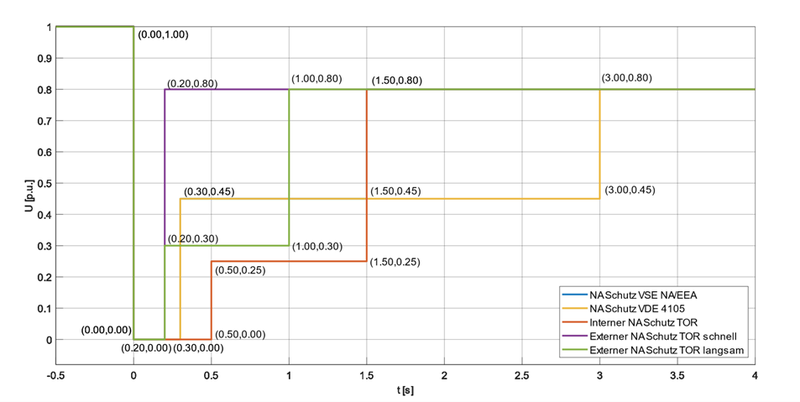
Comparison of the different NA protection parameters for undervoltage protection in the DACH region

Technologies

External Protection Devices

Background

Today, in Switzerland, the distributed generation units must have a wide range of functionality in terms of protection and control functions ("Switzerland country settings"). The industry recommendation of the Association of Swiss Electricity Companies (VSE) also requires that these units with larger than 30 kVA installed capacity must have external protective devices. The Swiss Federal Inspectorate for High Current Installations (ESTI) has elevated this industry recommendation to the status of a directive in Directive 233:0918.

However, this external protective device is controversial and is not implemented by all DSOs. The necessity and correct function of the external protection device are undisputed. It is unclear whether the external protection device currently required for 30-kVA and larger installations is an adequate measure for achieving the protection goals. Furthermore, the external protection device increases the risk that the distributed generation units can no longer correctly fulfil the requirements for grid support functions (especially reactive and active power control as well as FRT).

Goals

  • P+D project for the SFOE with broad support from the industry.
  • The project elaborates on the scientific and practical background for "Grid and PV protection for optimal and safe integration of decentralized power generation plants in the distribution grid".
  • The results flow into the industry document of VSE for the future connection of Swiss PV plants (and other generators) to NE7.
  • FEN leads the consortium of 6 academic partners and about 25 partners from industry and associations.
  • FHNW leads the WP of the review of the legal framework concerning "External Protection Devices" for distributed generation systems

The following key questions are to be answered in a project:

  • Is there a criterion (e.g., a specific connected load) that can be used to assess the risk potential of a distributed generation system for the distribution grid?
  • What are guideline or boundary values for a corresponding criterion (e.g., connected load), above which the DSO should provide additional protective measures?
  • What are the possible causes of errors and damaging events that can occur due to the misconduct of a distributed generation system?
  • What protective measures can be taken to reduce the associated risks to a tolerable level?

Results

  • Identification of fault scenarios for the NA protection investigation
  • Mapping the fault scenarios with realistic distribution grid models
  • Modeling of fault and grid protection
  • Modeling of internal and external NA protection behavior

Project information

Client

Swiss Federal Office of Energy SFOE

Ausführung

FHNW School of Engineering

Projektteam

BFH, FHNW, TU Graz, FGH Mannheim, VSE, Swissolar + ~25 other partners (utilities, associations)

Dauer

09/2022 bis 09/2024

Förderung

Swiss Federal Office of Energy SFOE

Projektleitung

Prof. Dr. Matthias Resch

School of
Engineering and Environment FHNW University of Applied Sciences and Arts Northwestern Switzerland

  • About the School
    • FHNW School of Engineering and Environment
    • Degree Programmes
    • Continuing Education
    • Collaboration in Research and Services
  • Social Media
    • LinkedIn
    • Instagram
    • Facebook
    • TikTok
    • YouTube
  • About FHNW
    • Organisation
    • Schools
    • Locations
    • FHNW Library
    • Media Relations
  • Support
    • IT Support
    • Inside FHNW
    • Webmail
Logo FHNW - 20 Years
Logo Swiss Universities
Logo European University Association
© University of Applied Sciences and Arts Northwestern Switzerland (FHNW)
  • Data Protection
  • Imprint
  • Accessibility
  • DE
  • EN