Skip to main contentSkip to search barSkip to navigationSkip to footer
Logo of the University of Applied Sciences and Arts Northwestern Switzerland
  • DE
  • EN
  • Home
  • Degree programmes
  • Continuing education

Ten Schools One Goal

The FHNW comprises 10 schools with different specializations. Select a school to see its specific courses, study programmes and information.

Applied Psychology

Architecture, Construction and Geomatics

Art and Design

Music

Computer Science

Life Sciences

School of Education

Social Work

Engineering and Environment

Business

  • Research

    • Research fields
    • Projects
  • Updates and insights

    • News and stories
  • Events

  • Media corner

  • About the School of Engineering and Environment

    • People directory
    • Management Board
  • Institutes

    • Institute of Automation
    • Institute of Bioenergy and Resource Efficiency
    • Institute of Business Engineering
    • Institute of Electric Power Systems
    • Institute of Humanities and Social Sciences
    • Institute of Polymer Engineering
    • Institute of Mathematics and Natural Sciences
    • Institute of Polymer Nanotechnology
    • Institute of Optometry
    • Institute of Product and Production Engineering
    • Institute for Sensors and Electronics
    • Institute of Thermal and Fluid Engineering
    • Laboratories of the School of Engineering and Environment
Logo of the University of Applied Sciences and Arts Northwestern Switzerland
  • About the School
    • FHNW School of Engineering and Environment
    • Degree Programmes
    • Continuing Education
    • Collaboration in Research and Services
  • Social Media
    • LinkedIn
    • Instagram
    • Facebook
    • TikTok
    • YouTube
  • About FHNW
    • Organisation
    • Schools
    • Locations
    • FHNW Library
    • Media Relations
  • Support
    • IT Support
    • Inside FHNW
    • Webmail
  • Data Protection
  • Imprint
  • Accessibility
  • Research

    • Research fields
    • Projects
  • Updates and insights

    • News and stories
  • Events

  • Media corner

  • About the School of Engineering and Environment

    • People directory
    • Management Board
  • Institutes

    • Institute of Automation
    • Institute of Bioenergy and Resource Efficiency
    • Institute of Business Engineering
    • Institute of Electric Power Systems
    • Institute of Humanities and Social Sciences
    • Institute of Polymer Engineering
    • Institute of Mathematics and Natural Sciences
    • Institute of Polymer Nanotechnology
    • Institute of Optometry
    • Institute of Product and Production Engineering
    • Institute for Sensors and Electronics
    • Institute of Thermal and Fluid Engineering
    • Laboratories of the School of Engineering and Environment

Type a search term and search continuing education,degree programmes, events, documents and other content.

  • Engineering and Environment
  • Research and services
  • Research
  • Projects
Projects

Periodic technical inspection for diesel soot emissions, FHNW School of Engineering and Environment

School of Engineering and Environment


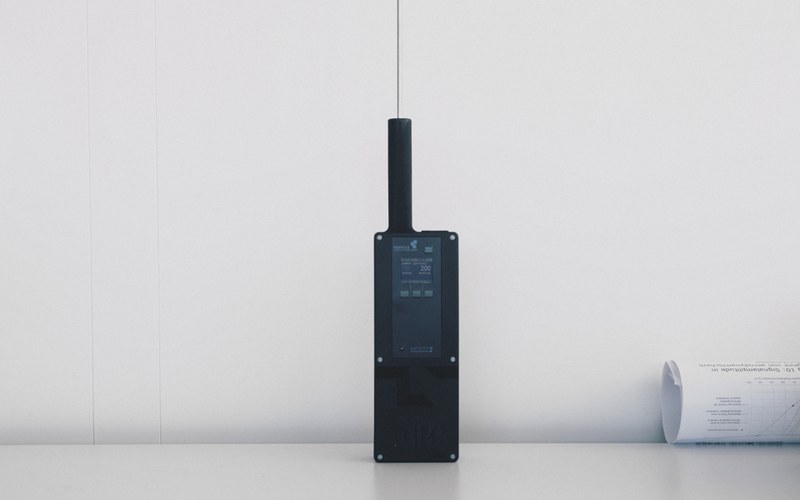
In order to check the exhaust gases of road vehicles regularly, researchers from the FHNW have developed a portable measuring device .

Project details

University
FHNW School of Engineering and Environment / School of Engineering and Environment

Starting situation

With the introduction of particulate filters, particulate emissions from internal combustion engines fell very sharply. A good filter has an efficiency of well over 99%. Often the concentration in the exhaust gas is then lower than in the ambient air. At about the same time, various on-board diagnostic systems were introduced. In the opinion that these would detect a malfunction of the exhaust gas purification systems, the exhaust gas test was abolished.

Meanwhile, it is becoming increasingly clear that while emissions are very low when filters are intact, a small percentage of filters are either defective or have been tampered with, or even removed altogether. Even small defects can increase emissions by orders of magnitude. This leads to a situation where a few engines with very high emissions dominate fleet emissions (Fig. 1).
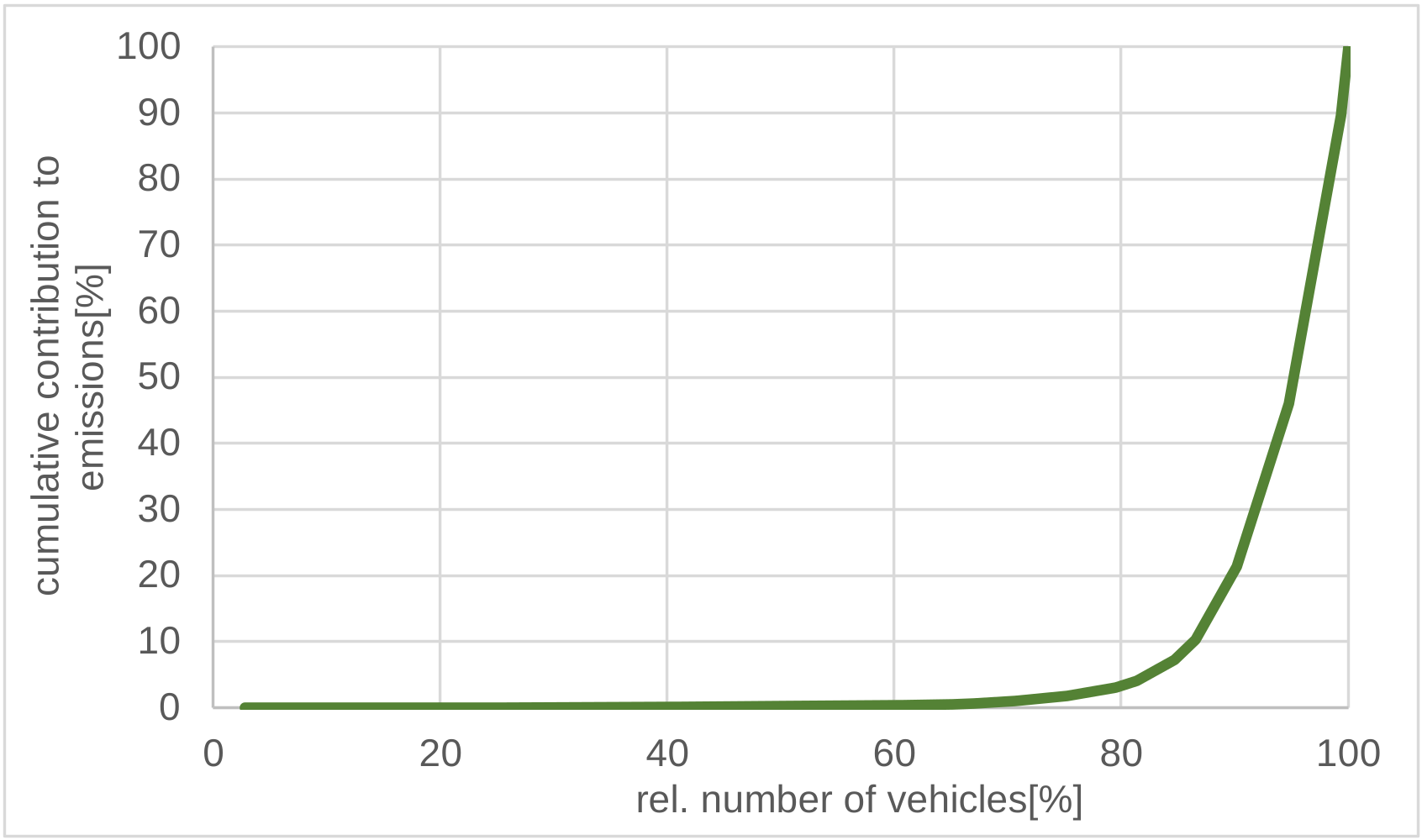
Fig. 1: Cumulative contribution to particulate emissions. 90% of the emissions come from about 10% of the vehicles (Burtscher et al., 2019)

This is true for road vehicles as well as for off-road applications (construction machinery, etc.). This is why periodic emission monitoring needs to be reintroduced. For construction machinery and other off-road engines, this is already the case in Switzerland.

Objectives

In order to carry out the monitoring in practice, suitable measuring instruments with following features are required:

  • Allows easy measurement of particle number concentrations
  • Since the entire sensor is heated, emission measurements can be made without dilution
  • Concentration range up to 5,000,000 particles/cm3.
  • Long maintenance interval as no liquid, no dryer is used and only a few particles are deposited in the instrument
  • Can be used standalone or communicate with PC/tablet via Bluetooth, where the report is also generated for official measurements.
  • Is METAS certified according to regulation SR 941.242 (certificate CH-K4-20002-00)

Results

In a project funded by the Swiss Federal Office for the Environment (BAFU) researches of the FHNW have developed a Handheld Emission Particle Counter (HEPaC). It is based on the Partector 2 of the company naneos, a spin-off of the FHNW.
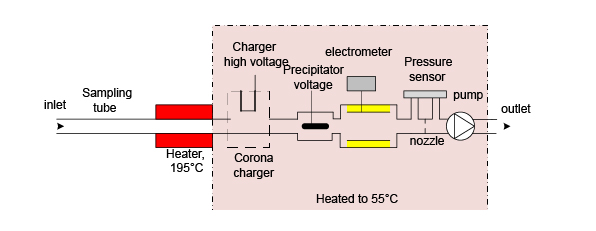
Fig. 2: Configuration of the HEPaC: The exhaust gas is heated to 195°C before it enters the sensor. The particles are then charged by a unipolar diffusion charger, followed by a pulsed separator and the measurement stage where the induced current is measured. More on the function in Fierz et.al, 2014.

The HEPaC can be purchased at naneos, an FHNW spinoff.

The HEPaC can be used for following applications:

  • Emission measurements of combustion engines
  • Official periodic control measurements according to Swiss ordinance SR 941.242 for construction machinery and other off-road engines
  • Fleet emission tests
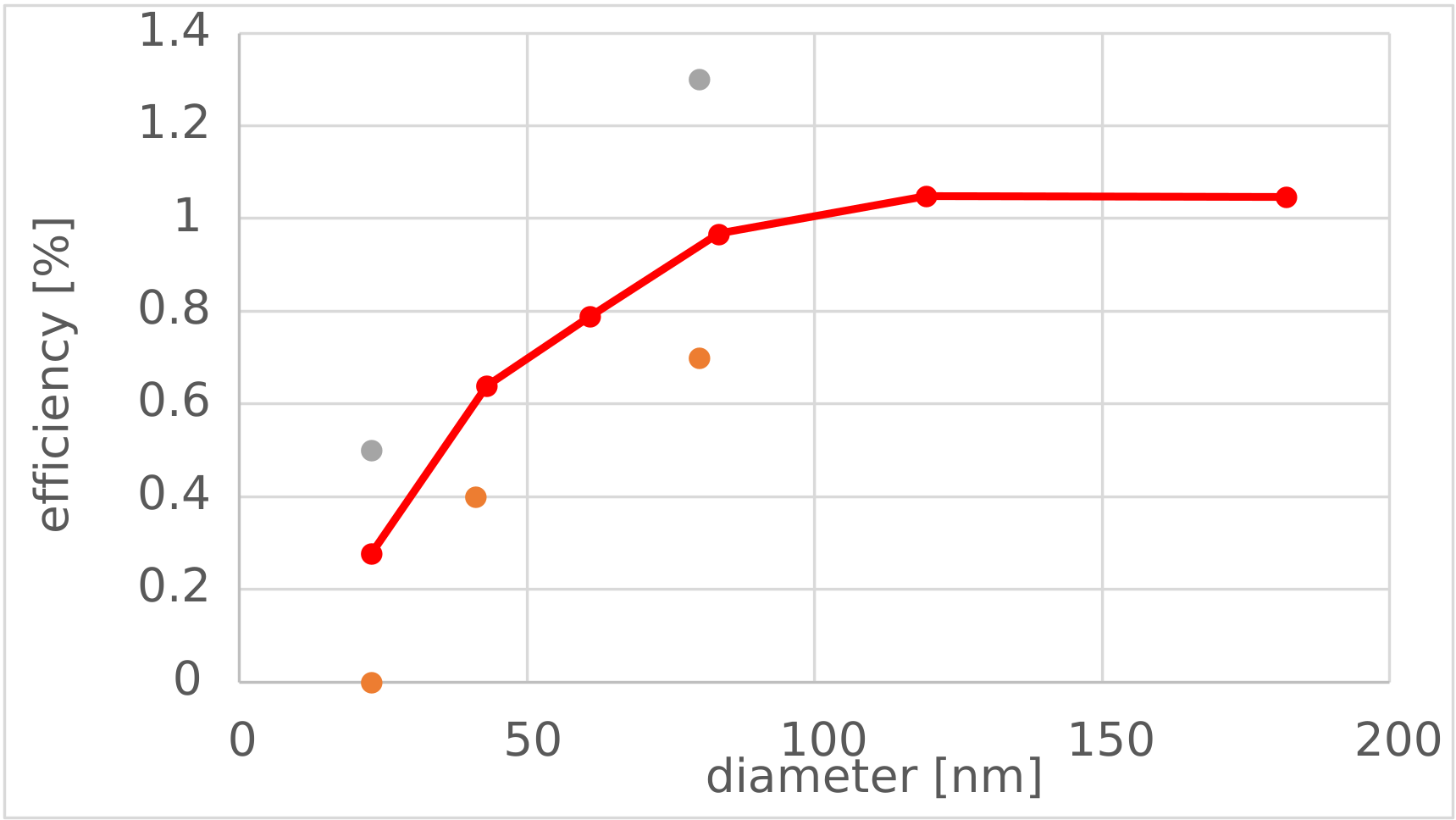
Figure 3: Efficiency as a function of particle size, the orange dots show the minimum efficiency prescribed in the regulation, the gray ones the maximum.

References

  • Burtscher, H. Lutz, Th. und Mayer, A. (2019) A New Periodic Technical Inspection for Particle Emissions of Vehicles. Emission Control Sci. and Technol. 5(3), 279-287.
  • Fierz, M., Meier, D., Steigmeier, P., und Burtscher, H.(2014) Aerosol Measurements by induced currents. Aerosol Sci. and Technol., 48, 350-357.
  • Product flyer
  • METAS certificate

Project Information

Client and funding
Swiss Federal Office for the Environment (BAFU), BAFU Umwelttechnologieförderung, Vertrag UTF 601.1319
Execution
FHNW Institute for Sensors and Electronics, naneos
Duration
2 Years
Project lead
Prof. Dr. Heinz Burtscher

School of
Engineering and Environment FHNW University of Applied Sciences and Arts Northwestern Switzerland

  • About the School
    • FHNW School of Engineering and Environment
    • Degree Programmes
    • Continuing Education
    • Collaboration in Research and Services
  • Social Media
    • LinkedIn
    • Instagram
    • Facebook
    • TikTok
    • YouTube
  • About FHNW
    • Organisation
    • Schools
    • Locations
    • FHNW Library
    • Media Relations
  • Support
    • IT Support
    • Inside FHNW
    • Webmail
Logo FHNW - 20 Years
Logo Swiss Universities
Logo European University Association
© University of Applied Sciences and Arts Northwestern Switzerland (FHNW)
  • Data Protection
  • Imprint
  • Accessibility
  • DE
  • EN