Skip to main contentSkip to search barSkip to navigationSkip to footer
Logo of the University of Applied Sciences and Arts Northwestern Switzerland
  • DE
  • EN
  • Home
  • Degree programmes
  • Continuing education

Ten Schools One Goal

The FHNW comprises 10 schools with different specializations. Select a school to see its specific courses, study programmes and information.

Applied Psychology

Architecture, Construction and Geomatics

Art and Design

Music

Computer Science

Life Sciences

School of Education

Social Work

Engineering and Environment

Business

  • Research

    • Research fields
    • Projects
  • Updates and insights

    • News and stories
  • Events

  • Media corner

  • About the School of Engineering and Environment

    • People directory
    • Management Board
  • Institutes

    • Institute of Automation
    • Institute of Bioenergy and Resource Efficiency
    • Institute of Business Engineering
    • Institute of Electric Power Systems
    • Institute of Humanities and Social Sciences
    • Institute of Polymer Engineering
    • Institute of Mathematics and Natural Sciences
    • Institute of Polymer Nanotechnology
    • Institute of Optometry
    • Institute of Product and Production Engineering
    • Institute for Sensors and Electronics
    • Institute of Thermal and Fluid Engineering
    • Laboratories of the School of Engineering and Environment
Logo of the University of Applied Sciences and Arts Northwestern Switzerland
  • About the School
    • FHNW School of Engineering and Environment
    • Degree Programmes
    • Continuing Education
    • Collaboration in Research and Services
  • Social Media
    • LinkedIn
    • Instagram
    • Facebook
    • TikTok
    • YouTube
  • About FHNW
    • Organisation
    • Schools
    • Locations
    • FHNW Library
    • Media Relations
  • Support
    • IT Support
    • Inside FHNW
    • Webmail
  • Data Protection
  • Imprint
  • Accessibility
  • Research

    • Research fields
    • Projects
  • Updates and insights

    • News and stories
  • Events

  • Media corner

  • About the School of Engineering and Environment

    • People directory
    • Management Board
  • Institutes

    • Institute of Automation
    • Institute of Bioenergy and Resource Efficiency
    • Institute of Business Engineering
    • Institute of Electric Power Systems
    • Institute of Humanities and Social Sciences
    • Institute of Polymer Engineering
    • Institute of Mathematics and Natural Sciences
    • Institute of Polymer Nanotechnology
    • Institute of Optometry
    • Institute of Product and Production Engineering
    • Institute for Sensors and Electronics
    • Institute of Thermal and Fluid Engineering
    • Laboratories of the School of Engineering and Environment

Type a search term and search continuing education,degree programmes, events, documents and other content.

  • Engineering and Environment
  • Research and services
  • Research
  • Projects
Projects

QHAPS – Simulation of Satellite-Based Quantum Communication Using Stratospheric Balloons, FHNW School of Engineering and Environment

School of Engineering and Environment


Future-proof communication systems increasingly rely on quantum communication – for example, through optical links between satellites and ground stations. To test this technology under realistic conditions, FHNW, in collaboration with GA-Synopta, is developing a balloon-based platform that simulates near-Earth orbit conditions. Stratospheric balloons (High-Altitude Platforms, HAPS) offer a unique and cost-efficient alternative to satellite missions.
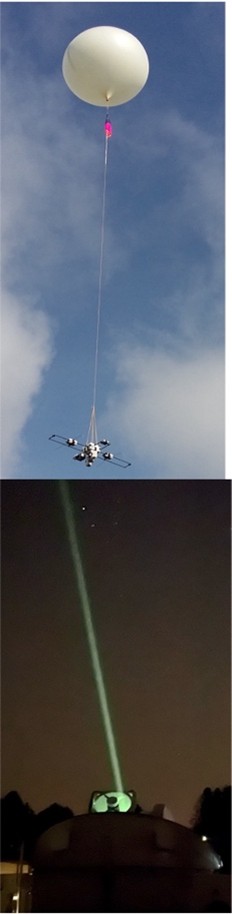
ballonstart_fhnw.jpg

Background

In earlier projects, FHNW successfully demonstrated optical communication using balloon platforms. Building on this experience, an advanced HAPS platform is now being deployed, combining precise gimbal tracking with MEMS mirrors. At altitudes above 30 km – where more than 99% of the atmosphere lies below the platform – the effects of atmospheric turbulence on optical quantum channels can be studied under near-realistic downlink conditions.

Objectives

The goal is to measure the scintillation index at a wavelength of 637 nm under various geographical and meteorological conditions, and to determine the structure parameter Cn² using the Obukhov-Kolmogorov turbulence model. The results will serve as a basis for model-based extrapolation to wavelengths relevant for quantum communication (850 nm, 1550 nm). The impact of location-specific factors will be systematically investigated using mobile optical ground stations at multiple sites in Switzerland.

Expected Outcomes

The project will deliver validated models describing atmospheric effects on optical quantum links. It will also produce high-quality datasets that can be used for the development of adaptive optics and robust quantum key distribution (QKD) protocols. In parallel, a closed control loop between the balloon platform and the ground station will be established, enabling real-time tracking in a realistic environment.

Outlook

QHAPS provides a unique research platform for the terrestrial simulation of satellite communication – flexible, scalable, and significantly more cost-effective than orbital tests. The results will strengthen Switzerland's position in the field of secure quantum communication and directly contribute to the implementation of the Swiss Quantum Initiative (SQI).

Project Information

Client

GA-Synopta

Execution

Institute for Sensors and Electronics

Duration

1,5 Jahre

Funding

Swiss Quantum Initiative (SQI)

Team

Prof. Dr. Christoph Wildfeuer (Project Lead), Alain Lavoyer, Timeo Jauslin

School of
Engineering and Environment FHNW University of Applied Sciences and Arts Northwestern Switzerland

  • About the School
    • FHNW School of Engineering and Environment
    • Degree Programmes
    • Continuing Education
    • Collaboration in Research and Services
  • Social Media
    • LinkedIn
    • Instagram
    • Facebook
    • TikTok
    • YouTube
  • About FHNW
    • Organisation
    • Schools
    • Locations
    • FHNW Library
    • Media Relations
  • Support
    • IT Support
    • Inside FHNW
    • Webmail
Logo FHNW - 20 Years
Logo Swiss Universities
Logo European University Association
© University of Applied Sciences and Arts Northwestern Switzerland (FHNW)
  • Data Protection
  • Imprint
  • Accessibility
  • DE
  • EN