Skip to main contentSkip to search barSkip to navigationSkip to footer
Logo of the University of Applied Sciences and Arts Northwestern Switzerland
  • DE
  • EN
  • Home
  • Degree programmes
  • Continuing education

Ten Schools One Goal

The FHNW comprises 10 schools with different specializations. Select a school to see its specific courses, study programmes and information.

Applied Psychology

Architecture, Construction and Geomatics

Art and Design

Music

Computer Science

Life Sciences

School of Education

Social Work

Engineering and Environment

Business

  • Research

    • Research fields
    • Projects
  • Updates and insights

    • News and stories
  • Events

  • Media corner

  • About the School of Engineering and Environment

    • People directory
    • Management Board
  • Institutes

    • Institute of Automation
    • Institute of Bioenergy and Resource Efficiency
    • Institute of Business Engineering
    • Institute of Electric Power Systems
    • Institute of Humanities and Social Sciences
    • Institute of Polymer Engineering
    • Institute of Mathematics and Natural Sciences
    • Institute of Polymer Nanotechnology
    • Institute of Optometry
    • Institute of Product and Production Engineering
    • Institute for Sensors and Electronics
    • Institute of Thermal and Fluid Engineering
    • Laboratories of the School of Engineering and Environment
Logo of the University of Applied Sciences and Arts Northwestern Switzerland
  • About the School
    • FHNW School of Engineering and Environment
    • Degree Programmes
    • Continuing Education
    • Collaboration in Research and Services
  • Social Media
    • LinkedIn
    • Instagram
    • Facebook
    • TikTok
    • YouTube
  • About FHNW
    • Organisation
    • Schools
    • Locations
    • FHNW Library
    • Media Relations
  • Support
    • IT Support
    • Inside FHNW
    • Webmail
  • Data Protection
  • Imprint
  • Accessibility
  • Research

    • Research fields
    • Projects
  • Updates and insights

    • News and stories
  • Events

  • Media corner

  • About the School of Engineering and Environment

    • People directory
    • Management Board
  • Institutes

    • Institute of Automation
    • Institute of Bioenergy and Resource Efficiency
    • Institute of Business Engineering
    • Institute of Electric Power Systems
    • Institute of Humanities and Social Sciences
    • Institute of Polymer Engineering
    • Institute of Mathematics and Natural Sciences
    • Institute of Polymer Nanotechnology
    • Institute of Optometry
    • Institute of Product and Production Engineering
    • Institute for Sensors and Electronics
    • Institute of Thermal and Fluid Engineering
    • Laboratories of the School of Engineering and Environment

Type a search term and search continuing education,degree programmes, events, documents and other content.

  • Engineering and Environment
  • Research and services
  • Research
  • Projects
Projects

SAPE – a modular printing system, FHNW School of Engineering and Environment

School of Engineering and Environment


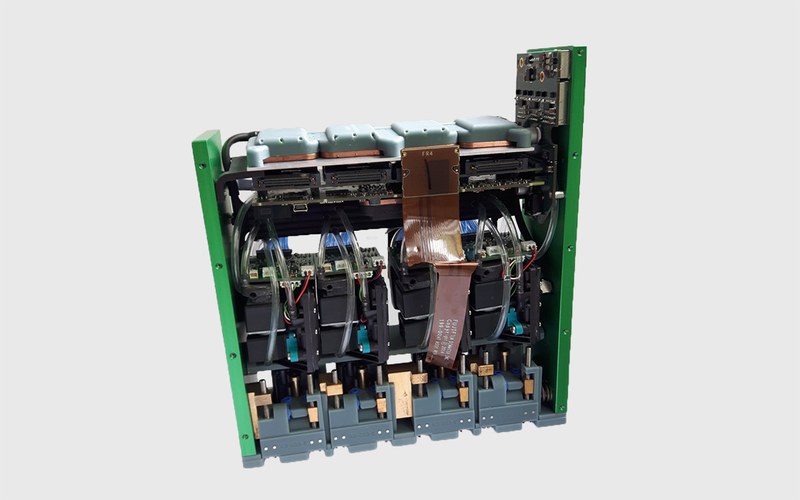
The modular printing system SAPE raises the benchmark in terms of printing speed and quality.

Project details
Objectives

This project had two primary objectives: firstly the aim was to significantly reduce the waiting time between the print order and the start of printing. Secondly, a light, compact printing unit was to be developed which was to be modular in structure.

Background

Radex AG manufacturers makes industrial printing machines for label and textile printing. Image data has to be rendered prior to printing. The image material is processed for each print head. The images are cut in strips to the width of the print heads and their position is shifted as necessary. The colours are also separated according to the ink colours available for printing. The pixels required for printing are then read out of the processed image data and re-sorted for each specific print head, after which they are loaded onto the print head.

Result

In order to reduce the waiting time that elapses between the print order and actual printing (up to several hours in the case of very large images), much of the computational burden was transferred from the computer (host/server) to a field programmable gate array (FPGA) and parallelised. This not only accelerated image processing but also enabled miniaturisation of the electronics. In conjunction with new production techniques such as 3D printing and bionic design, this contributes to creating a compact and lightweight print module. The weight of the print module was reduced by more than 2/3 as compared to similar units on the market, while at the same time, performance was increased by a factor of two in terms of printing quality and speed.

In addition to developing the digital circuit for data transfer to the print heads in the FPGA, the project also involved the development of an analogue fire-pulse circuit to control the print jets. Furthermore, an algorithm was developed to optimise positioning of the medium as a FPGA. Both tasks were carried out at the FHNW Institute of Microelectronics. A subproject involving the analysis and optimisation of fluidics processing was also carried out at the Institute of Thermal and Fluid Engineering. Staff at Radex carried out the mechanical work required to make the print module as well as developing the circuit boards and all software solutions.

Information

Client

Radex AG

Execution

FHNW Institute for Sensors and Electronics, FHNW Institute of Thermo- and Fluidengineering

Research sponsor

Innosuisse (Kommission für Technologie und Innovation KTI)

School of
Engineering and Environment FHNW University of Applied Sciences and Arts Northwestern Switzerland

  • About the School
    • FHNW School of Engineering and Environment
    • Degree Programmes
    • Continuing Education
    • Collaboration in Research and Services
  • Social Media
    • LinkedIn
    • Instagram
    • Facebook
    • TikTok
    • YouTube
  • About FHNW
    • Organisation
    • Schools
    • Locations
    • FHNW Library
    • Media Relations
  • Support
    • IT Support
    • Inside FHNW
    • Webmail
Logo FHNW - 20 Years
Logo Swiss Universities
Logo European University Association
© University of Applied Sciences and Arts Northwestern Switzerland (FHNW)
  • Data Protection
  • Imprint
  • Accessibility
  • DE
  • EN