Experimental and numerical analysis of drapability in flax fiber-based textiles
Technologies
- Flax fibers
- Sustainable composites
- Draping
Background
In composite materials, flax fiber-reinforced plastics have gained significant attention due to their exceptional density-specific mechanical properties, sustainability, and versatile design possibilities. These materials hold great promise for applications in the automotive industry, particularly in interior components. However, when processing flax fiber-reinforced plastics into complex geometries, issues such as wrinkles, bulges, and fiber misalignment, collectively known as drapability defects, can arise. Depending on their size and frequency, these defects can result in the entire component's rejection. Unlike continuous fiber-reinforced textiles, flax-based semi-finished products consist of discontinuous staple fibers, typically ranging from 5 to 80 mm in length. The slip between these fibers along their length significantly affects the drapability of these textiles.
Objectives
In this funded project supported by the Innosuisse, we examine various textile products from BCOMP to assess their drapability. Additionally, we employ simulation methods based on kinematic and numerical models to predict deformations and potential drapability defects.
One of the primary drapability modes under consideration is shear. The maximum shear angle is the critical threshold for the onset of wrinkle formation. The kinematic simulation employs a purely geometric algorithm to calculate this shear angle but does not consider material parameters like bending and shear stiffness. The advantage of this simulation lies in its speed and simplicity.
On the other hand, numerical finite element simulations, based on implicit methods like Aniform or explicit methods like LS-Dyna and Pam-Form, offer a more comprehensive but computationally intensive approach, requiring textile-specific input parameters.
This study determined the shear stiffness of selected textile semi-finished products using a Bias-Extension Test, a Picture-Frame Shear Frame test, and a bending stiffness measurement. The Picture-Frame Shear Frame test is advantageous as it ensures nearly uniform shear angles across the textile and allows for easy measurement using optical methods. However, when textile materials are clamped at an angle, localized tension can affect results. The Bias-Extension Test, on the other hand, eliminates tension in the fiber direction offers a more straightforward and cost-effective setup.
Results
Testing Methods and Textiles
Comparing the various flax-based textiles shown in the figure, differing in weave pattern, yarn density, and coloring, the Bias-Extension Test provides more precise results as it eliminates tension in the fiber direction, which could otherwise skew the results. The plain weave exhibits the highest shear stiffness among these textiles, while the 4x4 twill weave displays the lowest. This is attributed to the number of crimp points in the textiles, with more crimp points resulting in higher shear stiffness. Notably, the shear frame test results for these textiles exhibit different behavior compared to continuous fiber-based textiles.

The drapability of textiles depends significantly on the ratio between shear and bending stiffness. Both deformation mechanisms are required to drape a double-curved geometry. This study aims to identify the optimal ratio that reduces drapability defects such as wrinkles and bulges. Three test geometries – a hemisphere, a double dome, and a tetrahedron – were analysed experimentally and through kinematic (Ansys) and numerical (Aniform) simulations.
Drape simulation using Aniform
The kinematic simulation can calculate shear angles and provide meaningful results under specific conditions, such as when the draping process starts from a clearly defined seed point. When draping begins from a line, as in the case of the double dome, the kinematic simulation only provides meaningful values when the textile direction is parallel to this starting line (seed line). The major advantage of the kinematic simulation is its very fast calculation time, typically ranging from 10 to 60 seconds. When dealing with complex geometries, it is advisable to conduct a numerical simulation, which can visualize different draping phenomena and defects. However, textile-specific input parameters, including shear stiffness and bending stiffness, are essential for numerical simulations.
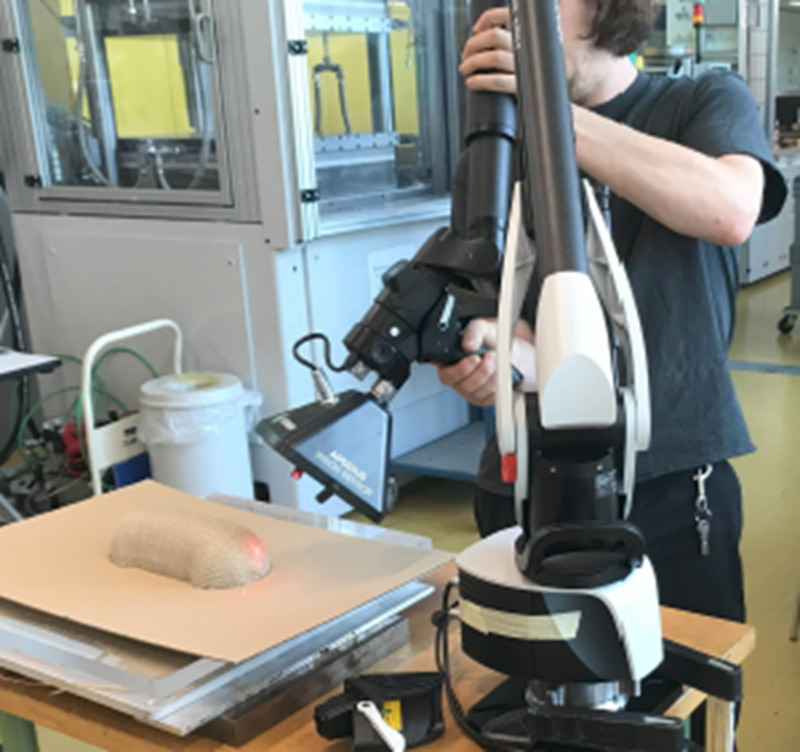
To validate the simulations, experiments were performed, and shear angles and drapability phenomena were compared.
It was observed that the 4x4 twill weave textile exhibited the best drapability for the hemisphere and double dome geometries, with no wrinkles or bulges. However, for the tetrahedral geometry, which features flat surfaces, the low bending stiffness of the 4x4 textile resulted in larger bulges compared to the 2x2 twill textiles. Additionally, some rovings at the tip of the tetrahedron slipped compared to the 2x2 twill textiles, which have more crimp points, minimizing bulge size and preventing fiber misalignment. In summary, fewer crimp points appear to be optimal for a doubly curved surface, while for use on flat surfaces, there is a higher risk of larger bulges.

The numerical simulation can predict shear angles and drapability defects for various geometries and textile directions, whereas the kinematic simulation is limited in this regard due to its algorithm and neglect of textile properties.
Project details
- Type
- Research project
- Research field
- Materials
- School
- FHNW School of Engineering and Environment / Institute of Polymer Engineering
- Partners
- Funding
- Duration
- 18 months
- Team
- Lucian Zweifel, Markus Grob, Michael Spälti, Erich Kramer, Yara Khalaf, Christian Brauner
Contact

Prof. Dr. Christian Brauner
- Phone
- +41 56 202 74 75 (Direct)