Sensors measure air quality, traffic volumes and noise levels, providing cities with valuable real-time data for the present and the future. Yet however advanced this infrastructure may be, it has always faced a problem: many of these small devices rely on disposable batteries or complex wiring. This creates costs, increases maintenance requirements and ultimately generates addi-tional electronic waste.
This is where the trinational research project EMPOWER#IoT comes in. The project is developing energy-autonomous sensors powered by innovative solar cells. The Institute for Ecopreneurship at the FHNW School of Life Sciences (HLS) is investigating what happens to these technologies at the end of their useful life.
Solar power where conventional panels reach their limits
When we think of photovoltaics, we usually picture large silicon panels on rooftops. But small sensors installed on building façades, beneath bridges or even indoors require different solutions, as lighting conditions in these locations are often far from ideal.
EMPOWER#IoT therefore focuses on thin-film photovoltaics, particularly organic photovoltaics (OPV) and perovskite solar cells. OPV cells use carbon-based materials to generate electricity, while the special crystal structure of perovskites enables them to capture and convert light particularly efficiently. Unlike conventional silicon panels, both technologies can be manufactured to be extremely thin, lightweight and flexible.
The idea is for the solar cells to power the sensors during the day while simultaneously charging a small battery for use at night. This allows smaller batteries to be used and reduces the frequency of replacements. At the same time, electrical engineering specialists are developing new data transmission protocols. The aim is to create sensor nodes that consume as little energy as possible while reliably collecting and transmitting data.
The circular economy starts with material development
However, new energy technologies are not automatically sustainable. What matters is which materials they need, how long they can be used and what happens to them afterwards. This is where the Institute for Ecopreneurship comes in. While the universities of Strasbourg and Freiburg are working on the production and further development of thin-film solar cells, HLS researchers are investigating how these cells can be recycled. In particular, they are looking at the key question of how to selectively separate and recover valuable, scarce raw materials such as the silver and indium in thin-film solar cells.
For Markus Lenz, Head of the Applied Circular Economy Research Group and Lecturer at the Institute for Ecopreneurship at HLS, and his team, recycling means more than simply disposing of products as cleanly as possible. Wherever possible, materials should be recovered as raw materials and returned to the circular economy.
“We want to find out which components we can recover as reusable materials and whether returning them to the circular economy makes sense from both an environmental and an economic perspective.”
The Novartis Pavillon as a research subject
The Novartis Pavillon in Basel provides a particularly striking example. Its semi-transparent façade combines LED elements displaying changing patterns of light and images with integrated organic photovoltaic solar cells; these generate the electricity needed to power the displays.
For the HLS researchers, the façade also provides a real-world opportunity to investigate how such innovative materials could eventually be recycled.
Can valuable components such as silver or indium be recovered with reasonable effort, rather than being lost as electronic waste when the panels reach the end of their useful life?
And what exactly do the modules contain?
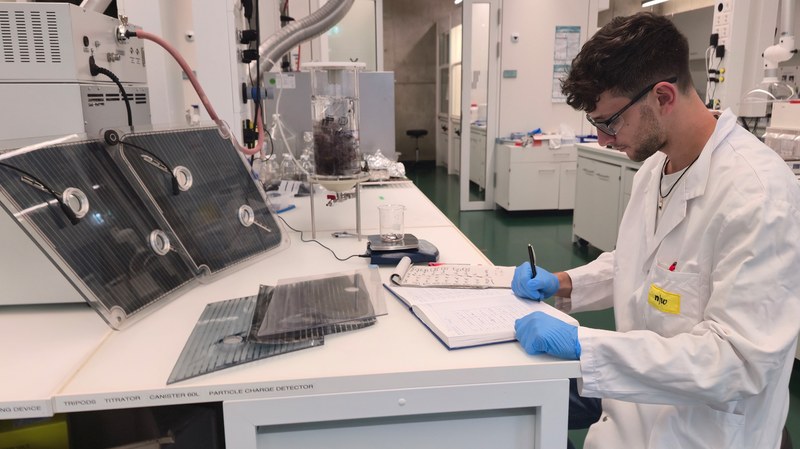
The team is currently creating an inventory of the types and quantities of materials in the photovoltaic façade, as the essential basis for the next stages of the research.
Recycling must also be economically viable
The fact that a material can technically be recovered is not enough. A recycling process must retrieve as many valuable materials as possible whilst being economically viable and delivering a positive environmental balance in the real world.
Researchers therefore examine the entire life cycle. How much energy does recycling require? What emissions are generated during collection, transport, sorting and processing? And how does this compare with the environmental impact of extracting and processing the same raw materials from scratch?
This comparison can be particularly important for metals such as silver and indium, whose mining and primary production have a significant environmental impact. Recycling can therefore be environmentally beneficial even if the process itself requires energy and chemicals, provided that the overall environmental impact avoided is greater than the impact generated.
Recovering valuable materials selectively
One technology that could be used for this purpose is a membrane-based process known as nanofiltration.
When recycling thin-film solar cells, HLS researchers first dissolve the valuable substances. The resulting liquid is then passed under pressure through a selective membrane.
“In simple terms, the membrane acts as an extremely fine filter. It retains certain dissolved substances more strongly than others, depending on factors such as their size and electrical charge. This allows individual elements to be concentrated and subsequently recovered,” explains Sebastian Hedwig, Research Associate in Applied Circular Economy at the HLS Institute for Ecopreneurship.
In this way, EMPOWER#IoT brings together two challenges that are closely linked in sustainable technology development: enabling new, sustainable applications while considering from the outset how materials used today can be recovered and reused tomorrow.
From the first material inventory to a functioning circular economy
The research is still at an early stage in several areas. The material composition of the autonomous sensors needs to be determined more precisely, suitable separation and recycling processes must be developed, and their environmental and economic performance compared with existing methods.
By the time the project concludes in 2028, researchers expect to have a clearer understanding of which raw materials can be recovered, which processes are most efficient and under what conditions an innovative solar technology can become a truly circular solution.
The findings will reveal which approaches hold the greatest promise and where further innovation is still needed.
Project

Empower#IoT
- Institute
- Institute for Ecopreneurship
- Research field
- Applied circular economy
Contact

Dr. Markus Lenz
- Phone
- +41 61 228 56 86
- markus.lenz@fhnw.ch