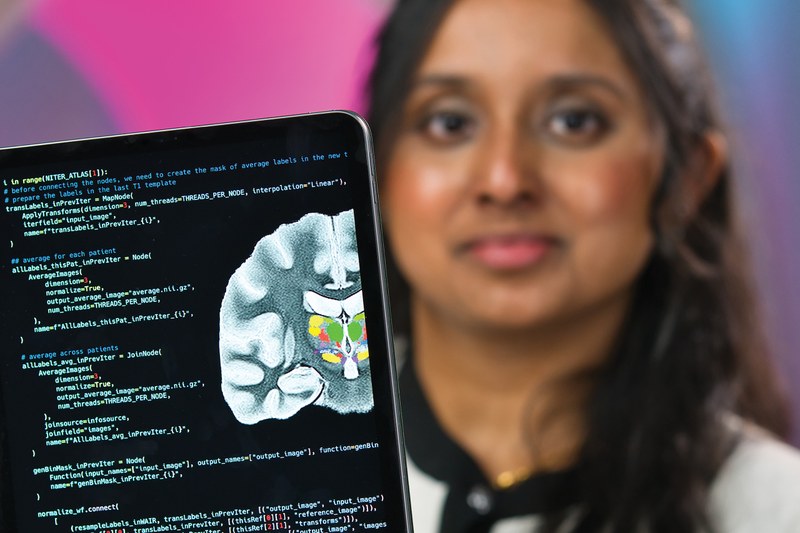
What you will learn
- Data literacy: Collect, structure and evaluate data – from lab results to big data
- Programming & automation: Python or R and the use of digital tools in the lab
- Modelling & simulation: Virtually map and understand complex biological systems
- Digital health & bioinformatics: Explore interfaces between IT, medicine and wider life science fields
- Laboratory 4.0: Work in networked, automated laboratory environments
Bachelor of Science in Life Sciences
Digitalisation plays a central role in the BSc in Life Sciences: from the first semesters you will work in labs and on projects using digital tools, data systems and automated processes. You will learn how modern technologies are changing biological, chemical and environmental science, and how to use data to develop new solutions.
In modules such as Bioinformatics & Biological Databases, Introduction to Programming, Databases and Data Modelling and Methods of Artificial Intelligence, you will build up specific digital skills. In most fields of study you can also do a cross-disciplinary qualification in digitalisation: in-depth preparation for data-driven and technology-supported methods.
This will equip you to think experimentally, digitally and across disciplines - an increasingly sought-after capability in life sciences research and industry.
Master of Science in Life Sciences, specialising in Data Science
In the MSc in Life Sciences you will learn how digitalisation is becoming a key skill in the field: you will learn to understand and structure data and convert it into value-adding processes – from experimental and process data to automation, visualisation and data-driven decision-making. This is your path into an industry in which biological, chemical and pharmaceutical problems are increasingly being solved with digital tools.
For those who want to go one step further, the Data Science specialisation offers in-depth training in modern data science methods: you will learn programming, algorithms, database design and deep learning techniques. Elective modules allow you to focus on genomics, proteomics or laboratory automation, for example, while building key skills in data visualisation, multivariate data modelling and data handling ethics.
Master of Science in Medical Informatics
The MSc in Medical Informatics applies digital technologies and artificial intelligence to healthcare, focusing on the latest information technologies for the medical and pharmaceutical industries. Students acquire IT knowledge and methods, and deepen their skills in biomedical data analysis, the application of artificial intelligence, visualisation technologies, big data handling and the related economic implications.
Contact
FHNW School of Life Sciences
FHNW University of Applied Sciences and Arts Northwestern Switzerland
School of Life Sciences
Hofackerstrasse 30
CH - 4132 Muttenz