Lukas Erni is studying for a Bachelor’s degree in Business Information Technology at the FHNW School of Business and works as a customer care agent alongside his studies. In this interview, he talks about his passion for data science, key moments during his studies, and how his degree has helped him develop both professionally and personally.
Could you tell us a bit about yourself, your degree at the FHNW, your job (if you work part-time) and your day-to-day tasks?
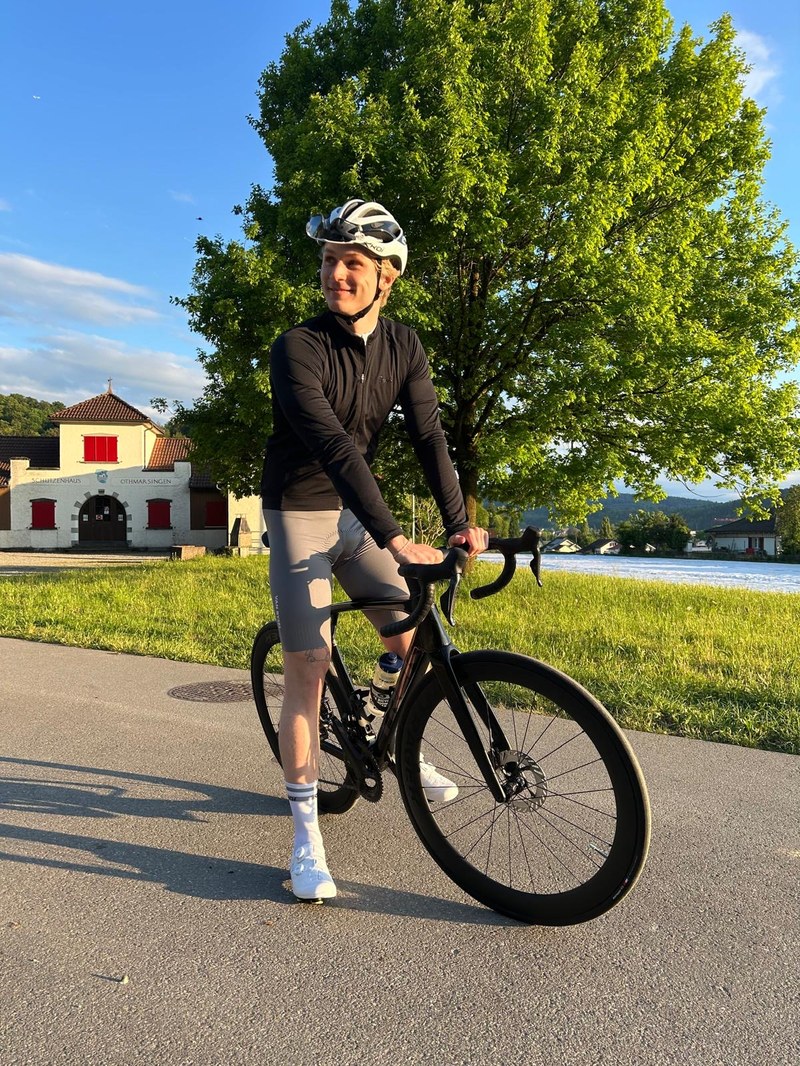
My name is Lukas Erni. I’m 22 years old, currently studying Business Information Technology (BIT) in my fourth semester, and I work part-time as a Customer Care Agent at Festo AG. My daily tasks include processing enquiries and orders, helping customers with any issues they have with the online shop, and ensuring that customer master data is accurate. I really enjoy the constant contact with customers, whether by email, over the phone or in person, and it plays a big part in my day-to-day life. In my spare time, I love playing sport, watching films and spending time with friends.
Why did you decide to study at the FHNW back then?
The FHNW, based in Brugg-Windisch, is extremely easy to get to. The convenient timetable (Thursdays and Fridays from 8.00 am to 5.00 pm) and the option to study in English, as well as to do so whilst working, are all reasons why I ultimately chose to study at the FHNW. What’s more, at that point I wasn’t quite sure whether I wanted to study something technical or business-related. The BIT programme was the perfect combination.
Which specialisation will you choose, and why?
As I’m only in my fourth semester, I haven’t yet made a final decision on a specialisation. However, I’m fairly certain I’ll be moving in the direction of ‘Business Analytics and Data Science’. Not only does that sound fancy, but in my opinion it’s a field with huge potential and a bright future. Analysing huge amounts of data and identifying patterns can bring enormous benefits. By integrating artificial intelligence and machine learning, I’ll also stay on top of how to make the most of cutting-edge technologies.
·Was there a project or module that you particularly remember or are especially looking forward to, and why?
I never thought I’d say this, but I really enjoyed the ‘Business Mathematics 2’ module. The course was very flexible in its structure. There were no live lessons, just a 120-page document covering all the theory and a short motivational video for each of the five sub-topics. For each sub-topic, there was a document containing exercises and case studies, which was assessed. There was no traditional final exam.
At first, I was very sceptical when our lecturer introduced the course (I’d never read 120 pages of maths theory, would I?!). It turned out, however, that the case studies finally allowed me to make the connection between maths and real-world applications. For example, I analysed how the projection of a 3D world onto a 2D screen works in video games, or how a chess computer evaluates different positions.


When you think back on your time at the university so far, how has it changed you, both academically and personally? Was there a particular moment or project that had a significant impact on you?
My degree has made me someone who is eager to learn. The wide range of subjects has allowed me to discover many interests that I hadn’t found particularly exciting before (think maths or programming). However, the high degree of independence required during my studies has also helped me develop a great deal personally. The assessment year was particularly intense, as you were required to pass all your modules. During that time, I sometimes really had to pull myself together to stay on track.
·What specific skills or experience have you already gained from your degree, or do you hope to develop further?
During my degree, I’ve already managed to develop my technical skills, such as programming, quite well, and I can say that I understand the basics. However, I hope to acquire even more knowledge during my further studies, or rather in my specialisation.
Have there been any highlights during your time at university so far? Moments you’re particularly proud of, that have impressed you or made a difference?
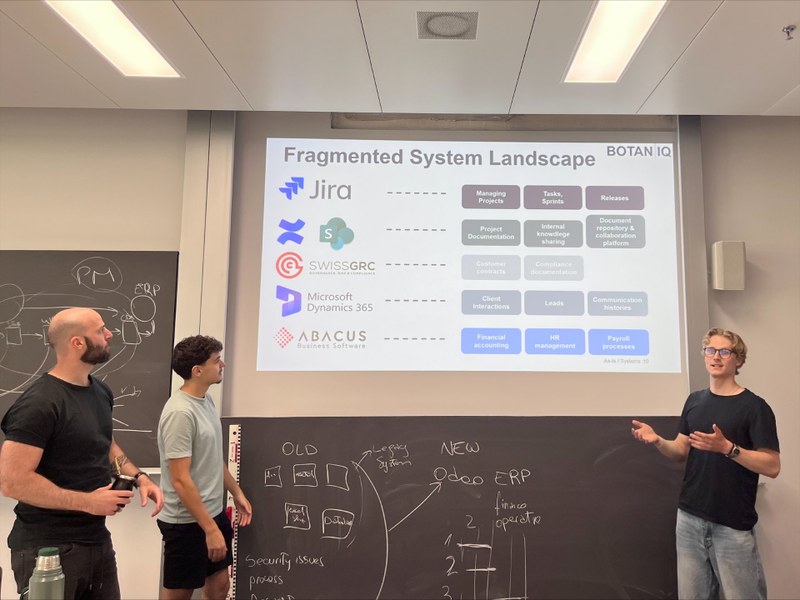
The moment I’ve been most proud of so far in my studies was when, as part of the Enterprise Systems module, we gave a presentation demonstrating the integration of an ERP (Enterprise Resource Planning) system in a real company. The feedback from the lecturer and my fellow students was very positive, and I was really proud of myself and my team. Throughout your studies, you get to share many such successes, and it really keeps you motivated to maintain high standards and go the extra mile.
Which topics or issues are you currently particularly interested in with regard to your studies? And why do you think they are relevant to the future of the economy and society?
Naturally, like many others, I find myself wondering how artificial intelligence will affect our world. I use it for practically every module and it helps me enormously. However, this raises the question of the extent to which it might also restrict us as future workers and as a society. These days, tools like Claude Code allow you to programme entire websites in seconds. But would I entrust such a website with my personal data? Personally, I would approach this with caution.
What are your expectations for life after graduation? Has your degree so far influenced your future prospects in any way?
Through my degree, I naturally hope to get off to a good start in the world of work and to find a job that really interests me, suits me and challenges me. My degree has made me realise that I’d like to do something more technical, such as a role as a data or business analyst. I’m not ruling out doing a Master’s degree at a later stage either. However, my priority is to gain as much work experience as possible after I graduate.
What advice would you give to current and prospective students?
I would advise current students to attend as many face-to-face (or online) classes as possible. That way, you stay on top of things and find the study period a lot easier. It also helps you build valuable relationships with your fellow students and lecturers.
My advice to prospective students is not to overthink things and just get started. Whether it’s Business Administration, International Management or Business Information Technology, studying helps you discover your true interests and allows you to explore them in depth. Or, at worst, you can always change your mind.
Bachelor of Science Business Information Technology
Contact

Prof. Dr. Michael Pülz
- Phone
- +41 61 279 18 42
- michael.puelz@fhnw.ch