You develop smart digital solutions and use cutting-edge tools to optimise business processes. With your IT skills and business know-how, you help companies become more efficient, agile, and future-ready. The Business Information Technology degree programme at FHNW offers a unique blend of business and IT.
Factsheet
- Degree
- Bachelor of Science FHNW in Business Information Technology
- Study mode
- Full-time and Part-time/work-study
- Learning environment
- Onsite
- ECTS points
- 180
- Next start
- 14.9.2026
- Duration
- 3 to 4 years
- Language
- English
- Place
- Basel, Brugg-Windisch
- Staying abroad
- Possible
- Application fee
- CHF 200
- Semester fee
- CHF 750 for residents of Switzerland (for details, see fees)
At a glance
- Interdisciplinary knowledge: You are equipped to act as a bridge between business processes and IT solutions.
- Practice-oriented: Practical assignments, projects, and case studies prepare you specifically for your professional career.
- Individual specialisation: Choose from various focus areas and prepare for your desired career path.
- Focus on digital innovation: Special emphasis on current topics such as artificial intelligence and cybersecurity.
Why study this?
As a business IT specialist, you are the digital expert in the business world. In your role as an intermediary between business administration and IT, you are one of the game changers who makes companies more efficient and competitive. Whether it is smart software, data analysis, artificial intelligence (AI) or cool digital tools – you are at the forefront when it comes to optimising processes, managing projects, and developing innovative solutions. In short: you shape the digital world of tomorrow!
What do you do as a business IT specialist?
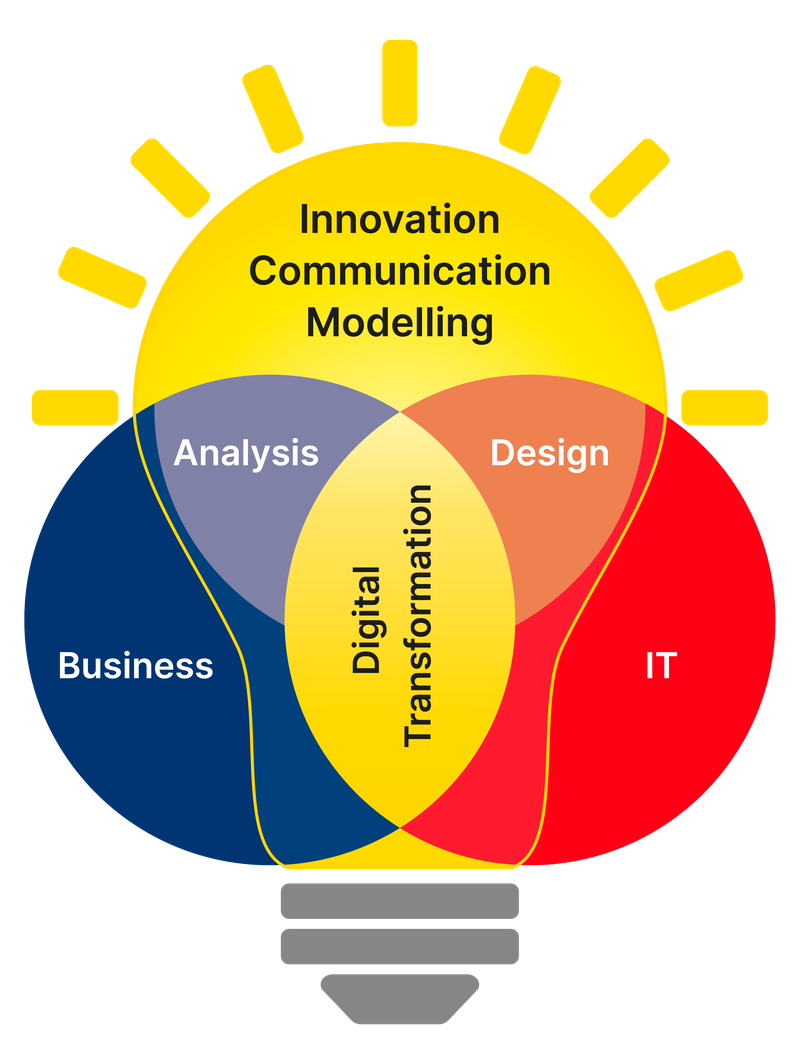
Bridge the gap between IT and the business departments
In your projects, you communicate with the people involved and recognise their challenges, expectations, and needs. You understand the language of business as well as that of IT and mediate between the two worlds. After your studies, you will be able to master complex business challenges with innovative IT solutions.
Help shaping the digital future
Thanks to your interdisciplinary knowledge, you will find and design suitable, innovative IT solutions and take on an advisory role. You optimise processes, analyse and structure data with the help of artificial intelligence, develop effective strategies or new business models. In this way, you help companies to succeed.
You know what a computer scientist is talking about
You know the possibilities and limitations of IT systems, how they are structured and how they work. You are actively involved in the implementation of projects, whether in project management, software development, quality assurance or other functions.
Get to the bottom of things
You analyse situations, regulations, and processes in order to understand them. This allows you to uncover weaknesses and create a basis for decisions. After analysing the current situation, you determine the requirements for your projects, record them in a structured manner and define the target status.
You know what the business is talking about
You know the correlations in the business world as well as the success criteria of processes and organisations. You lead projects and/or teams, act in line with the company strategy and always ensure the best cost-benefit ratio.
Convince across the board
You are able to critically evaluate and analyse actions, ventures, and contracts. You are convincing in workshops and meetings, document professionally and assess data and facts correctly.
Career prospects
As a business IT specialist, you have the choice between many exciting job profiles in a wide range of industries. During your studies, you will find out which areas interest you the most and what best suits your particular strengths. This will allow you to decide later on whether you would prefer a technical job, plunge into the analytical world or work in management.
Typical examples of job profiles:
IT consultant
As an IT consultant, you advise customers on finding solutions, assess the feasibility of different approaches and support the implementation of IT projects.
Requirements Engineer
As a requirements engineer, you determine the requirements of various stakeholders. You mediate between customers, developers and project teams and ensure that everyone has the same expectations about the implementation.
(IT) Project Manager
As a project manager, you ensure that IT projects satisfy the client, are implemented on time, meet the required quality standards, and stay within budget.
Data Scientist
As a data scientist, you ensure a solid database, develop new algorithms to find correlations and create forecasting models.
Cyber Security Consultant
As a Cyber Security Consultant, you shape the IT security of companies, identify risks, define measures, and assess their effectiveness.
(Junior) Developer
As a (Junior) Developer, you have the necessary skills to use software development tools in a company and to work productively on projects.
Structure and programme contents
Study content
Your studies will provide you with the ideal mix of knowledge from business administration, computer science and business information technology. You will immerse yourself in the world of business administration, learn how companies work and make decisions. At the same time, you will acquire in-depth IT knowledge, from programming to databases, machine learning and cybersecurity.
Business information technology brings together both disciplines (computer science and business): you will learn to understand the needs and expectations of different groups and develop digital solutions to transform business processes and drive companies forward – and everything in English, the language of IT and global business.
Practice orientation
Here at the FHNW University of Applied Sciences and Arts Northwestern Switzerland, you will gain real insights into the professional world as part of your studies. Whether in a practical project, during your bachelor’s thesis or in project-based modules, you will directly experience the challenges that companies have to overcome.
You use your knowledge to develop practical solutions – always at the forefront of the latest technologies, be it to optimise processes, support companies in their choice of business software or contribute your ideas on topics such as cloud computing and data management.
During your studies, you will experience how you can apply your knowledge into practice with various real-life projects in actual companies. And after a successful project you might even secure a job in that organisation.
Study structure
Full-time (Basel only)
Would you like to concentrate fully on your studies? Then the full-time course is exactly right for you. You will graduate in just three years (6 semesters).
- Instruction days: Monday to Friday (one day off per week)
- Scope: 30 ECTS per semester
- Full-time module overview (PDF)
Part-time (Basel and Brugg-Windisch)
Would you like to work while studying, or do you have other responsibilities such as caring for a loved one? Then part-time studying is ideal. This allows you to complete your studies in four years (8 semesters). With a 50% workload in a field related to your studies, you can also have your work credited up to a maximum of 18 ECTS through short papers (job reflections).
- Teaching days (Basel): Monday afternoon/evening and Wednesday afternoon/evening, exceptional Saturday morning (some modules online)
- Teaching days (Brugg-Windisch): Thursday, Friday
- Time windows (PDF)
- Scope: 21-24 ECTS per semester
- Part-time module overview (PDF)
Structure and modules
The degree programme consists of the assessment stage, which you must complete in the first year of study, and the main study. In the main study programme, you have the opportunity to choose certain modules individually and put together your study portfolio flexibly. The individual modules are assigned to a module group. To complete your studies, you need a minimum number of ECTS points per module group.
Module group | ECTS | Notes |
|---|---|---|
Foundations | 24 | 3 ECTS can be substituted* |
Business Administration | 21 | 3 ECTS can be substituted* |
Business Information Technology | 33 | 6 ECTS can be substituted* |
Information Technology | 28 | 6 ECTS can be substituted* |
Student Work | 27 | |
Specialisation* | 36 | |
Electives* | 12 |
*A total of 66 ECTS can be chosen individually. This corresponds to around one-third of your studies.
Specialisations
In the second half of your studies, you can choose from several specialisations that are tailored to current trends and jobs on the market. Depending on your interests and career plans, you can put together your own study portfolio and turn your studies into your own personal programme.
International
The FHNW School of Business offers numerous opportunities to gain international experience – from semesters abroad and double degrees to summer/winter schools, as well as virtual exchange formats and international projects. These opportunities will help you to develop professionally and personally, and will also prepare you for an international career.

Gain international experience during your studies
Requirements and admission
Direct Admission
With the following qualifications you are directly admitted to the programme (valid for Switzerland):
- Professional Baccalaureate, commercial or technical
- Commercial School (with Professional Baccalaureate)
Admission only with practical experience
With the following qualifications, you need at least one year of commercial work experience. The work experience must include a predominantly commercial or technical activity and have taken place after the completion of upper secondary education.
- Other Professional Baccalaureate
- General Baccalaureate (1)
- International Baccalaureate (2)
- Specialised Middle School Baccalaureate
- German University of Applied Sciences Entry Diploma entitling studies in all federal states of Germany (minimum grade 2.5)
- Higher Vocational School
(1) Baccalaureate certificates obtained outside Switzerland are accepted if granted access to Swiss universities without examination.
(2) Accepted, if in final diploma 32 out of 42 points achieved (without bonus points) as well as 6 subjects from the IB group list. At least 3 subjects have to be at Higher Level (one of these being a mathematics or natural sciences subject).
Individual admission procedure
We will consider the admission procedure individually with the following degrees:
- Degree from a higher vocational school in the fields of business, technology, or business information technology (number of creditable ECTS is checked individually, max. non-English 60 ECTS)
- Foreign Certificate on request (1)
- Federal PET Diplomas (entrance exam)
- Transfer from Universities and Universities of Applied Sciences (determination of equivalence)
(1) or international students: The entrance examinations are held in English. Subjects: English, Business Studies, Accounting, Mathematics. Registration Deadline: End of January.
Language certificate
You do not need to submit a language certificate for the BSc in Business Information Technology. However, for successful studies we recommend that you have already reached the level of at least B2 according to the Common European Framework of Reference for Languages (CEFR) in all language skills before starting your studies.
Organisational matters
Fees and Grants
Tuition fees qualify for attendance of any Bachelor course within FHNW, independent of the particular enrolment at a faculty.
Registration fee (1) | once | CHF 200 |
Personal course fee (2) | per semester | CHF 750* |
Copying and materials | per semester | CHF 100 |
Teaching materials, books, projects | per year | ca. CHF 1000 |
Diploma fee | once | CHF 300 |
(1) A separate registration fee has to be paid for each programme you register for.
(2) Applies to:
- Students whose civil law residence is in Switzerland or the Principality of Liechtenstein at the start of their studies
- as well as Swiss citizens living abroad
- or foreign students with civil law residence in a Swiss canton who hold a residence permit not issued for the purpose of studying.
For other students, please contact the admissions office.
*Personal course fee for EU or EFTA citizens: CHF 1 000.00 per semester
*Personal course fee for Non-European citizens: CHF 5 700.00 per semester
The determination of the semester fee requires the complete and correct completion of the Student Personal Data Form, which is sent to students before the start of their studies. The Student Personal Data Form including additional documents must be signed and submitted before the start of the studies.
Registration and deadlines
1. Registration
Start of studies in September: We recommend early registration by April 30. Depending on your previous education, the following documents must be enclosed with the application:
- University entrance qualification incl. transcript of records (vocational baccalaureate certificate, baccalaureate certificate, etc.)
- Federal diploma of higher education
- Residence permit (if available)
- Certificate of Exmatriculation (if available)
2. Timetable
You will receive your timetable for the first semester in July.
3. Introduction week
Mandatory introduction days will be held in week 37, just before your first semester begins. Exact dates will be provided in August.
4. Autumn semester (from week 38)
- Duration: 14 weeks (from mid-September to End of December)
- Block week: week 45 (from the 2nd year of study)
- Examinations: Early January to the beginning of February
5. Spring semester (from week 8)
- Duration: 15 weeks (mid-February to the beginning of June)
- Block week: week 16 (from the 2nd year of study)
- Examinations: Mid-June to early July

Compensation for disadvantages
Students with disabilities and chronic illnesses can apply for compensation for disadvantages.
The aim of compensation for disadvantages is to eliminate or reduce the disadvantages resulting from disabilities and chronic illnesses during studies by means of suitable measures. The term refers to the adaptation of the conditions under which learning and/or examinations take place, but not a modification of the learning objectives or a waiver of subjects. Compensation for disadvantages can be applied both in the admission procedure and in the degree programme.
Military and Civil Service
The FHNW will help you coordinate your studies and compulsory military service in the best possible way. You can find all the information on training credits, credit transfer options, postponements and advice centers under the following link.
Study locations
Life at University
Advising and information events
Info-Events
Loading...
Contact

Pauline Suárez Espinoza
- Phone
- +41 61 279 17 46
- pauline.suarez@fhnw.ch
Sandra Koller
- Phone
- +41 56 202 72 74
- sandra.koller@fhnw.ch

Prof. Dr. Michael Pülz
- Phone
- +41 61 279 18 42
- michael.puelz@fhnw.ch
FAQs
Do I need any previous knowledge of business or IT?
No. Our students have a wide variety of educational backgrounds. That is why we impart knowledge step by step during your studies and do not require any prior knowledge of business or IT.
If you already have some knowledge, you will make faster progress and can invest the time you have gained in subjects that are new to you.
What level of English do I need?
You do not need to submit a language certificate for the BSc in Business Information Technology. However, for successful studies we recommend that you have already reached the level of at least B2 according to the Common European Framework of Reference for Languages (CEFR) in all language skills before starting your studies.
Do I need to know how to program already?
Previous programming knowledge is not necessary.
The lessons are designed in a way that no previous programming experience is required. However, interest in analytical thinking and problem solving is expected. If you would still like to get a taste of it, you can find numerous introductory videos on YouTube. The first programming language you will learn is called “Python”.
What are assessment modules?
Assessment modules are compulsory modules in the first semester. You must pass them to be able to enter the second year and thus the main course of study.
Can I also attend classes online?
The FHNW is fundamentally a face-to-face university. Participation in face-to-face teaching is therefore expected. However, individual teaching units may take place online.
What are ECTS?
The number of credits indicates how much study work is expected.
One ECTS (European Credit Transfer System) represents approximately 30 hours of student work for an average student. A 3 ECTS module therefore corresponds to about 90 hours of study work.
Examples of student workload
- Contact lessons: only net time (45' per lesson) credited
- Guided self-study
- Autonomous self-study
Do I need a laptop for my studies?
Yes. To study, you will need a laptop or tablet with a keyboard, integrated camera and microphone. You must be able to download software. Further information can be found here: Mandatory Notebook Requirement for Students at the School of Business.
The Neptun project offers high-quality laptops at a very good price-performance ratio, which are specially tailored to the requirements of university studies.
Registration
Bachelor of Science Business Information TechnologySeptember 2026
- Date
- 14.9.2026
- Duration
- 3 to 4 years
- Place
- Basel or Brugg-Windisch
- Application start
- 3.11.2025