Toni Jehle’s career began in engineering: after many years there, he moved into Marketing and later returned to a leadership role. Today, he is Head of Department for the Solutions Portfolio at a global leader in measurement technology, where he leads an international team. He completed his Dual Degree MBA alongside a full-time role – an experience that has had a lasting impact on his path from engineer to business.
Autorin - Alice Lydia Frey
In this interview, Toni explains why the Dual Degree MBA suited him as an engineer, what surprised him most during the programme and what it meant for his career.
From Engineering to Marketing
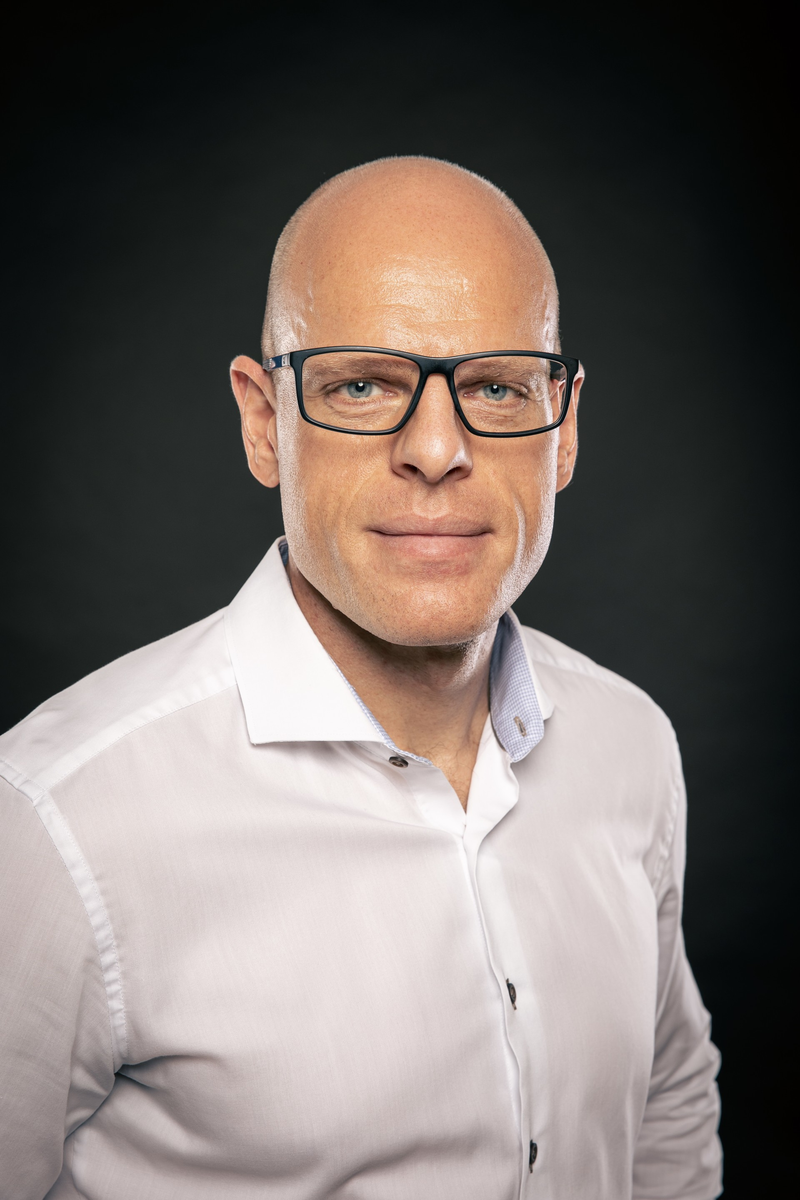
Toni began the Dual Degree MBA shortly after an important career move within his company. He had spent years in engineering, where he also held leadership responsibilities. In 2020, he moved to a subsidiary specialising in flow-measurement technology and took on a new role as Product Owner in Marketing, this time without direct leadership responsibility. For him, it was the right moment to complement his technical expertise with a broader business perspective.
The idea of an MBA came up quickly in a conversation with his manager at the time. “I had a technical background, but I also wanted to learn more about the business side,” he says. The initial idea quickly became a joint decision: his manager supported the plan, and the company was fully behind it from the outset.
Why the Dual Degree MBA?
The Dual Degree MBA fit Toni on several levels. He works in an international company, his team is international, and English is the daily working language. An English-language, internationally oriented MBA was therefore a natural fit for his professional environment.
The schedule was another decisive factor. “The Dual Degree MBA was one of the very few programmes with classes almost exclusively on Saturdays,” he recalls. Other programmes he had looked at usually ran on Friday and Saturday or on weekday evenings. That would have meant reducing his working hours. Thanks to the weekend format, he was able to maintain his full-time workload.
Two degrees from two institutions was not his main reason for choosing the programme. He had also considered pure online MBAs from abroad and was ultimately glad to have chosen a programme with in-person teaching. Over the course of his studies, he increasingly came to appreciate the opportunity to earn two degrees. “It is quite unique that you are enrolled at two universities and come away from one programme with two degrees.”
A Community That Lasts
What surprised Toni most about the MBA programme was the sense of community that developed among the students. “We really formed a strong community, and it has stayed with us to some extent to this day.” He is still in regular contact with several of his fellow students.
The international mix of participants and lecturers also shaped his experience. The lecturers came from different countries and taught with genuine enthusiasm. Some went well beyond what was expected of them. “You could call them on a Saturday evening and still get a response. That was not something to be taken for granted.”
A Career Step Soon After Graduation
The MBA quickly translated into a concrete career opportunity for Toni. Less than a year after graduating, in 2023, the opportunity arose to take on a department head role. He applied and got the position.
Today, he is responsible for the Solutions Portfolio. With his team, he analyses markets and customer needs and translates them into business plans and strategic initiatives. Taking on a leadership role, however, was not the primary goal when he started the MBA. “Developing further was the goal. Whether it would specifically mean a leadership role was not the main point,” he says.
The fact that an MBA in his company supports both the leadership and specialist-expert tracks makes the qualification valuable in both directions.
Greater Confidence Through the Challenge
The MBA also had a lasting impact on Toni personally. Above all, it strengthened his self-confidence. “Taking on the challenge of studying again was not something I took for granted. Proving to myself that I could still do it, and seeing it through, was a real achievement.”
The Thesis: Applied Directly to the Day Job
Toni’s thesis, “Data Driven Digital Services for OEM Customers in the Food and Beverage Industry,” was closely tied to his work as Product Owner. He deliberately chose a topic that allowed his studies and professional work to complement each other. For this, he interviewed customers of his company, exploring their needs and the direction in which their businesses were developing. “It was not theoretical, it was practically relevant.”
The direct connection to his professional practice not only made the thesis more relevant but also helped him manage his day-to-day work during this phase.
Study, Work and Family
A full-time job alongside the MBA was demanding. Work took place during the week, while studying filled the weekends. The more challenging part was family life, Toni says: weekends were no longer free, and his family had to make some sacrifices while he was studying.
Discipline and a clearly structured weekly routine were therefore essential. Sport remained his way of maintaining balance. It had been his outlet before the MBA and continues to be so today.
Who the Programme is For?
Toni would recommend the Dual Degree MBA to anyone interested in leadership and international business who is looking for a part-time programme combining in-person teaching, an English-language environment and a weekend format. Being awarded two degrees, in his view, is a valuable additional benefit, further reinforcing the programme’s international orientation.
His conclusion captures his development perfectly: “I see my MBA experience as a bridge between the technical background I brought with me and the more entrepreneurial thinking I have today. It is the step that paved the way for the rest of my career.”
The Programme at a Glance
The Dual Degree MBA (MBA FHNW Cross-Cultural Leadership / Edinburgh Business School) is a joint programme of the FHNW School of Business and Edinburgh Business School (Heriot-Watt University). The English-language programme comprises 100 ECTS credits and focuses on cross-cultural leadership. It is designed to run alongside a job, with workshops mainly on Saturdays, and usually takes two to three years. The workshops take place in Basel, with study starts in March, September and December. Graduates earn two recognised MBA degrees: one from the FHNW and one from Edinburgh Business School (Heriot-Watt University).
Master of Business Administration (MBA) FHNW
Contact
Dr. Laila Kabous
- Phone
- +41 61 279 17 36 (Direct)
- laila.kabous@fhnw.ch