Ganesh Kumar Murugesan spent twenty years as an engineering manager. Then he did an MBA, and today he shapes how his company industrialises products worldwide.
Author - Alice Lydia Frey
For more than twenty years, Ganesh Kumar Murugesan worked as an engineering manager in industrial manufacturing, first in India, then in Germany. Today he directs the global industrialisation of Endress+Hauser, a measurement technology company. The Dual Degree MBA (MBA FHNW Cross-Cultural Leadership / Edinburgh Business School) gave him the tools to move from technical to strategic leadership.
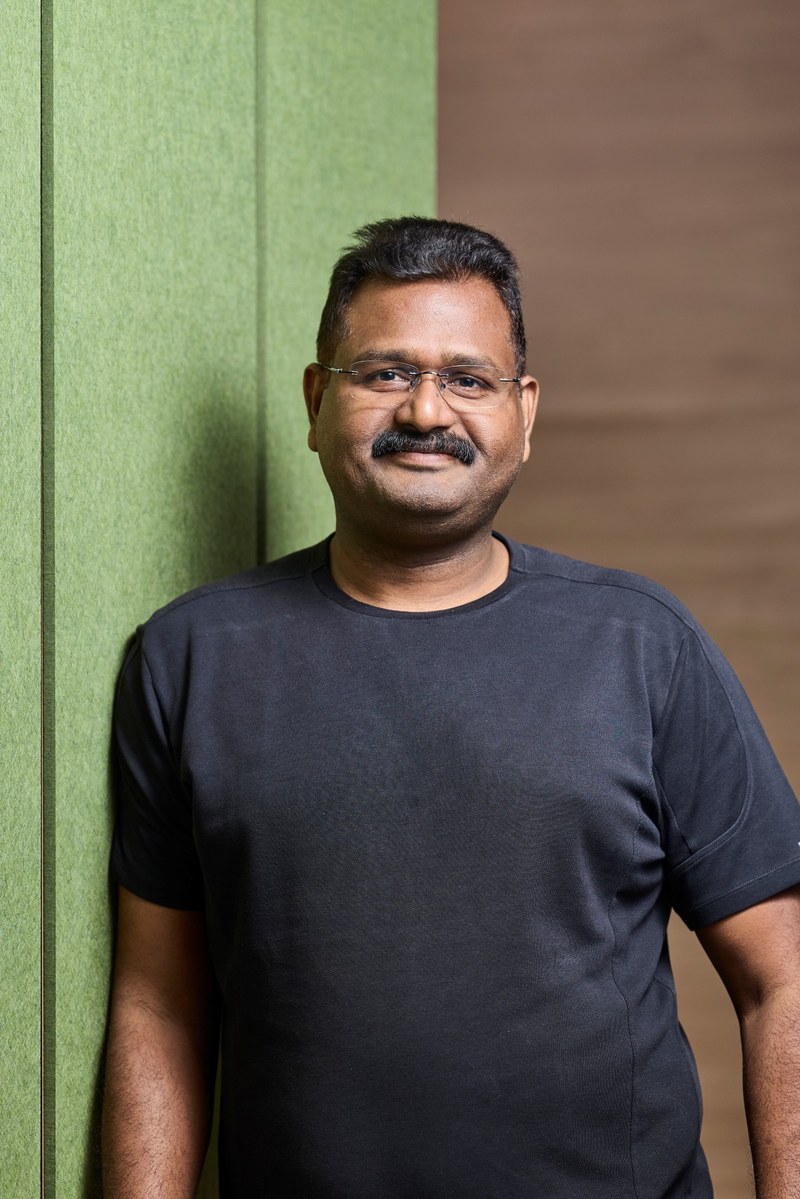
From engineer to global industrialisation manager
Ganesh trained in India as an electronics and telecommunications engineer. He began his career in manufacturing, first in the automotive sector, then in the production of measuring instruments. In 2008 he joined Endress+Hauser. He spent fourteen years at the company in India, where he served as Assistant Director of Engineering and Facility Management. After many years in one place, he wanted a change and a chance to bring his experience to other locations. That opportunity came with a move to the headquarters of Endress+Hauser SE+Co. KG in Maulburg, Germany, around twenty kilometres from Basel.
Since 2022, he has been Global Industrialization and Technology Transfer Manager there. He sets up new products and production lines at the company’s plants in India, China, Brazil and the USA.
The search for the right MBA
After two decades working at a technical and operational level, he wanted to deepen his understanding of strategy, finance, leadership and organisational development. Finding the right programme was not easy. Most MBA options in the region were taught in German, and an English-language programme would have meant long journeys to Austria, Stuttgart, Munich or Zurich. Then he came across the Dual Degree MBA at FHNW.
Language was the first deciding factor. Next came the two partner institutions, FHNW and Edinburgh Business School (Heriot-Watt University), and the on-site teaching. “I prefer learning through direct exchange rather than online on my own,” he says. The Cross-Cultural Leadership focus mattered too, and he saw a real advantage in it for his global role. Practical reasons sealed the decision: the school is close to his home, so he could attend the Saturday workshops without a long journey, and the price was right.
A class like a small world
What surprised him most at the start was the makeup of the class. People from many countries and with very different backgrounds sat side by side: finance specialists, researchers, engineers like himself, and peers from sales and from HR.
This became one of the greatest benefits of the programme for him. Through direct exchange he got to know other cultures, as well as the perspectives of other industries and countries.
The on-site teaching also helped him build a network that supported him during his studies and beyond. He found the lecturers open and supportive, including with questions outside class. With some fellow students he met regularly in study groups after the weekend workshops.
A new understanding of leadership
Because he studied alongside his job, he could put what he learned into practice straight away. What stayed with him most were cross-cultural leadership, people management and organisational development. Before the MBA, he says, he had developed his leadership skills organically, over years and through observation: “You learn by doing.” The MBA added something new: tested theories and concrete tools for managing change or handling conflict. “The MBA is like your tool.”
Working across several countries showed him how much leadership depends on context. What works in one team does not automatically work in another. He learned to communicate more clearly, in a more structured and detailed way. Before moving ahead, he now makes sure a plan also works for the people who have to carry it out. “The most important thing is to understand people,” he says.
The master’s thesis as a turning point
He wrote his master’s thesis within his own company. Together with his division head, he developed a topic on global industrialisation: how it works today and which success factors will matter in future, with particular attention to cross-cultural leadership. The school accepted the proposal.
It was a demanding phase. Alongside his job, he stepped in to take over the projects of a colleague who fell sick, and he travelled a great deal. Even so, he conducted 19 interviews across five countries, with people ranging from managing directors to engineers. The effort paid off: the thesis gave him a detailed, cross-site picture of what makes global industrialisation succeed, and he now draws on those insights in his daily work.
Who the MBA is worth it for
Global industrialisation, he says, is like building a small organisation. You introduce a new product at different locations, which covers everything from costing and investment appraisal to working with people from very different cultures, from North America to China.
He would recommend the programme without hesitation, with one note: the entire MBA is taught in English, so strong language skills are essential. Anyone who wants to develop broadly as a leader is in the right place, he says. He particularly values the exchange with people from many industries and countries, the on-site teaching and the award of two degrees.
From technical manager to strategic organisational development
Looking back, he sums it up: “I’ve grown from a technical and operational manager into someone who shapes strategic organisational development.” The MBA strengthened his understanding of strategy, finance and leadership and gave him the tools to put it into practice.
The Programme at a Glance
The Dual Degree MBA (MBA FHNW Cross-Cultural Leadership / Edinburgh Business School) is a joint programme of the FHNW School of Business and Edinburgh Business School (Heriot-Watt University). The English-language programme comprises 100 ECTS credits and focuses on cross-cultural leadership. It is designed to run alongside a job, with workshops mainly on Saturdays, and usually takes two to three years. The workshops take place in Basel and can partly be attended remotely, with study starts in March, September and December. Graduates earn two recognised MBA degrees: one from the FHNW and one from Edinburgh Business School (Heriot-Watt University).

MBA FHNW Cross-Cultural Leadership / Edinburgh Business School
Contact

Dr. Laila Kabous
- Phone
- +41 61 279 17 36 (Direct)
- laila.kabous@fhnw.ch