AI for IMPACTS informs a legislative proposal on responsible AI use in Healthcare.
An open-access framework developed by Christine Jacob and an interdisciplinary research team has helped inform a proposed U.S. bill on the independent evaluation of artificial intelligence systems used by the Veterans Health Administration. In this interview, the FHNW researcher explains how the connection emerged, why responsible AI evaluation must extend beyond technical performance, and what comes next.

Christine, what is the AI for IMPACTS framework?
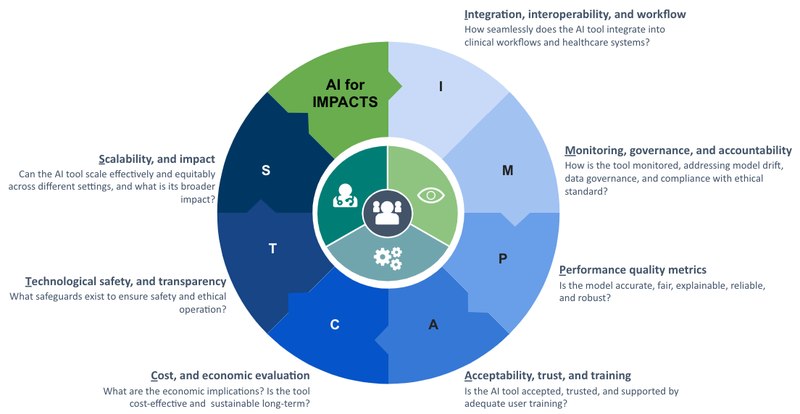
AI for IMPACTS is a research-based framework for evaluating the long-term, real-world effects of AI-powered tools used by clinicians. It grew out of a systematic review of 44 studies and brings together 28 assessment criteria within seven areas: integration and workflow; monitoring and governance; performance and quality; acceptability, trust and training; economic evaluation; technological safety and transparency; and scalability and impact.
The central idea is that we should not evaluate an AI system as an isolated piece of software. We also need to understand how it interacts with clinical workflows, healthcare professionals, patients, organisational structures and the wider healthcare system.
What problem was the framework designed to address?
Many existing approaches understandably concentrate on technical performance, such as accuracy, sensitivity or specificity. These measures are essential, but they do not tell us whether an AI tool can be integrated safely into a particular hospital, whether clinicians can use and understand it, who remains accountable for its outputs, or whether it creates meaningful value over time.
A system may perform well in a controlled study and still struggle in practice because it disrupts workflows, requires infrastructure that is not available, produces results that clinicians do not trust or creates new organisational burdens. AI for IMPACTS was developed to bring these technical, human and organisational questions together.
How did the contact with the U.S. House Committee on Veterans’ Affairs arise?
In July, I received an unexpected email from Reggie Darby, a professional staff member with the Subcommittee on Oversight and Investigations of the U.S. House Committee on Veterans’ Affairs. His work includes oversight of artificial intelligence, health information technology and technology modernisation within the Department of Veterans Affairs.
Mr Darby explained that, after examining a number of AI governance and evaluation frameworks, the sociotechnical perspective of our work had stood out because it addressed the realities of implementing AI in a large and complex healthcare system. He also informed me that U.S. Representative Greg Murphy, M.D., was preparing a legislative proposal that had drawn on our team’s work. That was both exciting and deeply encouraging.
What did you learn about how the framework had been used?
Mr Darby described the framework as a practical way of thinking about AI in complex healthcare environments and said that it had helped bridge the gap between strong research and actionable policy. He also explained how its sociotechnical approach complemented Representative Murphy's approach to responsible AI in healthcare.
It is important, however, to describe the connection precisely. While the framework helped inform the proposal, was used as a reference during its development, or contributed to the thinking behind it, I would not claim that our framework alone produced the legislation.
What does the proposed bill seek to do?
The bill titled the Responsible Artificial Intelligence for Veterans Act of 2026, was introduced in the House of Representatives on 22 July 2026 and referred to the House Committee on Veterans’ Affairs. It remains a proposed bill and has not yet been enacted.
The bill would direct the Secretary of Veterans Affairs to seek an agreement with a federally funded research and development centre to independently evaluate at least five AI systems used, piloted or being developed for clinical use within the Veterans Health Administration. Priority would be given to systems deployed at scale or presenting elevated clinical, operational or patient-safety risks.
The proposed evaluation extends well beyond model accuracy. It includes integration and operational readiness, governance and accountability, model performance, safety and human oversight, veteran-centred design and adoption, costs and resource use, transparency and documentation, and real-world scalability and impact. It also proposes reporting, corrective-action and follow-up requirements.
Why is this an important example of knowledge transfer?
It shows that academic research can move into practical settings in ways that are not always predictable. The framework was published as an open-access article under a Creative Commons licence. That meant that policymakers, regulators, healthcare organisations and researchers could read it and build on it without encountering a subscription barrier.
Open access does not guarantee policy impact, but it removes an important obstacle. In this case, research developed in a European academic context became relevant to a policy discussion concerning one of the world’s largest integrated healthcare systems. That is a powerful example of how accessible research can contribute to international knowledge exchange.
Why must responsible AI evaluation consider more than safety and technical performance?
Responsible evaluation should not be understood as an attempt to slow innovation. Its purpose is to help innovation create meaningful value without compromising patients, healthcare professionals or healthcare systems.
Technical safety is one part of that responsibility, but it is not the whole picture. We also need to ask whether the technology fits the clinical workflow, whether staff receive suitable training, whether different patient groups benefit equitably, whether responsibility is clear, whether performance can be monitored over time and whether the organisation has the resources to sustain the system.

What did you discuss during your meeting with Mr Darby?
We discussed how the research has evolved since the original publication, our ongoing international Delphi process and the challenge of translating implementation science into workable AI oversight. The exchange was valuable because it brought together two different perspectives: the research perspective, which asks what evidence is needed, and the policy perspective, which asks how that evidence can be translated into structures that are practical and accountable.
I also shared that our Delphi panel includes 46 experts from 25 countries and eight stakeholder groups. Their contribution is essential because the framework cannot be refined from one disciplinary or national perspective alone. Mr Darby expressed his hope that the exchange could develop into an ongoing dialogue between researchers and policymakers.
What role has FHNW played in this work?
The research was developed through my work at FHNW and in collaboration with an interdisciplinary author team from FHNW and partner institutions, including ETH Zurich, and University of Bern. The published framework is therefore not the achievement of one individual. It reflects the work of researchers with expertise spanning medicine, information systems, biomedical engineering and implementation science.
The current Delphi study expands that collaborative foundation even further by involving experts from different countries and stakeholder communities. For me, that collective dimension is central to the story. Universities create impact not only by publishing research, but also by making knowledge accessible, creating connections across disciplines and supporting its translation into settings where decisions are made.
What happens next for AI for IMPACTS?
The publication established the evidence-based foundation, but it was never intended to be the final word. The next phase is using the Delphi process to refine, validate and prioritise the criteria through international and multidisciplinary expert consensus.
We are also working towards practical and accessible assessment resources that healthcare organisations can eventually use to examine clinician-facing AI tools in their own settings. These resources are still under development. AI for IMPACTS should therefore not yet be described as a completed standard, validated audit instrument or finished hospital toolkit.
The longer-term ambition is to combine the expert-consensus work with testing in real healthcare environments. That will help us understand not only whether the criteria are scientifically sound, but also whether they can support decisions about adoption, monitoring, scaling and, where necessary, discontinuation.
The next stage of AI for IMPACTS will combine international expert consensus with practical development. The Delphi panel is refining and prioritising the assessment criteria, while the research team is working towards accessible tools that can later be tested in real-world healthcare settings. The aim is to help organisations make context-sensitive decisions about which AI tools to adopt, how to monitor them and whether they deliver lasting clinical and organisational value
What is a Delphi process? A Delphi process is a structured method used to build expert agreement on complex topics where evidence may be limited, uncertain, or open to different interpretations. It is often used in medicine and healthcare to develop recommendations, guidelines, or assessment criteria. Experts review and rate proposed statements over several rounds, receiving an anonymised summary of the group’s responses after each round. This helps clarify areas of agreement, identify remaining differences, and refine the final recommendations. |
Contact
Dr. Christine Jacob
- Phone
- +41 56 202 74 64
- christine.jacob@fhnw.ch