David Henzmann trained as a forester, founded an advertising agency at 20 and now runs a holding company with more than 40 employees. In the MBA at FHNW, he wanted to back up what he had taught himself with sound theory. It was there that he also found the people for his board of directors.
A company as a hobby
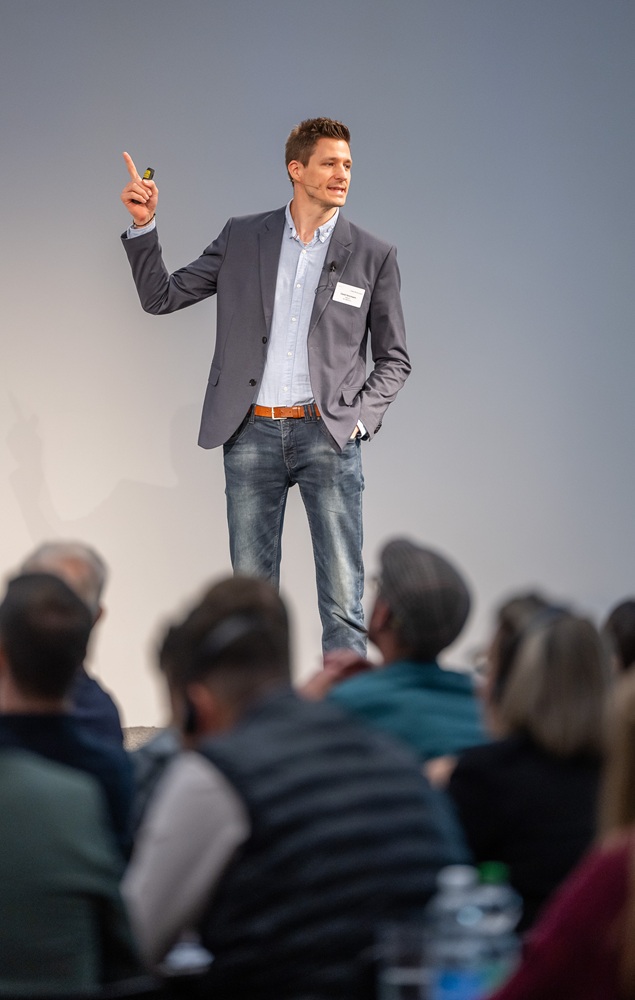
After his apprenticeship as a forester, David Henzmann founded an advertising agency at 20 and ran it on the side for two years, as a hobby. What drew him in was the business side, bookkeeping and all. In the end he quit his job and went all in on his own company.
Until around 2019 the team stayed at five. Then he wanted to scale up, with more than one company. He set up a second one, converted both into public limited companies (AG) and brought them under Henzmann Holding AG. Today the group generates roughly thirty times its revenue from back then and employs more than 40 people.
Where does a forester start?
He read a lot, watched videos and followed what other companies were doing on LinkedIn. Eventually he wanted to know whether his way of running companies could be improved. But where to start? A commercial school was not enough for him. The tip came from his partner, who had studied at FHNW herself.
Through admission on the basis of his record, his military background, several CAS programmes and extensive leadership training were recognised. He had expected to be one of the oldest in the class and found himself on the younger side instead. Some classmates were over 50.
Corporate finance at the right time
Just as the programme began, he was bringing investors into one of his subsidiaries in a first funding round. At the time, he researched the issue price, placing the shares and valuation methods online himself. Then, in the module, a lecturer who had been through an exit himself spoke from his own experience. David Henzmann benefited directly and approached the second round very differently.
His company was present throughout the programme. In almost every module he was able to write a paper about it, and in group work it often served as the case study. In employment law he knew almost every topic from his own business, such as protected periods or employees calling in sick during their notice period. Unlike most of his classmates, who worked for large companies, he faced these issues directly as an employer.
Business ethics has stayed with him too. In his paper he asked who bears responsibility for mass layoffs: the CEO, the board or the shareholders. He found his lecturers highly competent, and in class the time often flew by: one moment it was twenty past eight, the next time he looked at the clock it was twenty to twelve.
A board drawn from his own class
The biggest highlight of the programme now sits on the board of his holding. David Henzmann watched the class and saw over time who was really strong. He wanted people who were better than himself. He approached the first person on gut feeling. The two of them then each wrote down who might be suitable, and anyone on both lists was asked. That is how three people came together.
Two years on, all of them are still fully committed and help decide what happens with the sub-sidiaries. He has also brought in one of his lecturers as a coach for their strategy days. “I made use of every opportunity.”
Two days of wellness for the mind
A funding round, setting up the holding, buying a company, the birth of his child: all of it hap-pened during the MBA, and he kept working as usual. Even so, the programme was a refresh-ing change from a daily life that, with your own companies, is a constant up and down.
Classes took place on Fridays and Saturdays. David Henzmann lives 45 minutes’ walk from the university and decided to make that walk for the full three years. On the way in, he left the week behind; on the way back, he went over the two days once more.
He misses those days now. His partner had his back throughout. Learning and writing came easily to him, and he even tutored others in his class.
Why Generation Z changes jobs
For his master’s thesis he chose a problem from his own business: retaining Generation Z em-ployees in small and medium-sized ICT companies. In his companies, people stay two and a half to three years on average. In the literature he found employers complaining about young people changing jobs too quickly as early as around 1930. For him, what matters is less the generation than the stage of life after training, when people are working out where they want to go. According to his survey, work-life balance and working from home do little to keep young employees with a company. What counts is perspective. He was able to apply much of this directly.
Together with his supervisor, he has since published an article in KMU-Magazin. For many, he says, the thesis is a burden. He celebrated it, because he wrote it for himself and his company.
What a degree brings
Why a degree when you own the company? For David Henzmann, the value lies in the content and the contacts. Still, the MBA gets noticed: he was offered a board seat, partly because of the programme. He declined to focus on his own companies. For him, a diploma above all shows a certain commitment. On a board in particular, he says, an MBA is worth a great deal, because it lets you assess the full range of a decision.
On campus and fully focused
He chose the German-language programme because he did not want to complete the whole programme in English. FHNW was close by, and many of his employees studied there. Online would never be an option for him, if only because of focus. In his view, some things only work on campus anyway.
Alongside his companies, he serves in a leadership role with the Baden Fire Departement and the civil defense organization. People often ask him how he manages it all. His answer: focus. On his computer he never has more than one or two browser windows open. ”If you really want to succeed, you can’t multitask.”
Who the MBA is for
He recommends the MBA to anyone who wants to join the management of a company with around five to ten people or more, whether their own or as an employee. The same goes for people in large companies aiming for executive management or a board seat. His advice: study on campus, close the laptop and stay fully focused. “I’m only human, like everyone else,” he says. With the computer open, your inbox soon beckons. But whether you read an email during the lesson or at lunchtime makes no difference. Put in a single sentence:
Master of Business Administration (MBA) FHNW
Contact

Dr. Beat Birkenmeier
- Phone
- +41 56 202 81 94 (Direct)
- beat.birkenmeier@fhnw.ch
Prof. Dr. Mahmoud Al-Kilani
- Phone
- +41 56 202 81 04
- mahmoud.alkilani@fhnw.ch