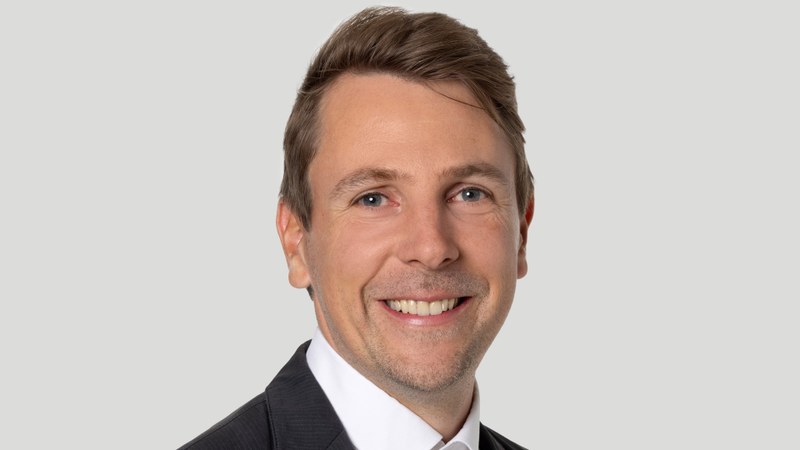
Tim Kröncke, lecturer for the ‘Investments’ module on the Master of Science in Finance programme at the FHNW and co-initiator of the programme, provides an insight into the new Master’s programme at the FHNW School of Business. He explains what students can expect, what makes the new MSc in Finance unique, and who the programme is – or isn’t – suitable for.
What do you teach, and what fascinates you about your subject area?
I teach the Investments module in the first semester. In addition, I set up the MSc in Finance together with Ivan Köhle and coordinate the curriculum and our academic partnerships.
My fascination stems from my banking apprenticeship at SEB in Germany. After leaving school, I wanted to understand what actually drives financial markets – and, above all, how to build a decent portfolio amidst all the noise. What can one realistically expect, and what is mere illusion? This question has stayed with me ever since: through my undergraduate studies, my PhD, my professorships in Basel and Neuchâtel, and right up to the present day at the FHNW.
I have never lost touch with the practical side of things. I used to work for a multi-family office in Basel and continue to support the firm in my role as an academic adviser. At Vontobel Bank in Zurich, too, I was able to bridge the gap between academia and practice as a member of the Academic Advisory Council. I am curious – but I also enjoy actually putting things into practice. It is this combination of both that I bring to my teaching.
What makes the MSc in Finance at the FHNW different?
We deliberately take a broad approach. Until now, Swiss universities of applied sciences have only offered highly specialised courses: either Banking & Finance or Financial Management. We offer training in both. Internationally, this is the norm for leading programmes, and there is a simple reason for this: otherwise, those starting out in their careers are at the mercy of the cycles of a single sector.
On top of that, there is the final project – which, in our case, is not a Master’s thesis but the Equity Research Challenge. Working in teams, students analyse a Swiss company, visit its premises, speak to the management and defend their valuation in front of a jury of industry professionals.
And we have the infrastructure to support this. Through the Financial Data Lab, our students have access to S&P Capital IQ, directly on their own devices. A Bloomberg terminal on campus will be added in a few weeks’ time. The aim is clear: graduates from our programme will be able to analyse financial data independently and present the results convincingly.
Finally, I’d like to mention something that many would dismiss as a minor detail: we’re moving into the new Dreispitz Campus. The new building on Dornacherstrasse will be our home from the autumn semester of 2026. However, it is not the size that matters, but the concept. The campus has been systematically designed around exchange, collaboration and coaching – alongside traditional lecture theatres, there will be spaces for new forms of teaching and learning, which interlink with meeting and event areas. There is no other campus in Switzerland quite like it in this respect. A Master’s in Finance thrives on people working together, analysing, presenting and discussing. This building has been designed precisely for that purpose.
How is the degree programme structured?
The first semester lays the foundations, and the curriculum is the same for everyone: Investments, Financial Markets and Institutions, Financial Accounting, Corporate Finance, Applied Statistical Data Analysis. There are no optional modules. This is deliberate – without this shared foundation, it is not possible to explore the subject in depth later on.
From the second semester onwards, the programme becomes significantly more varied. The core modules continue – Derivatives & Financial Risk Management, Financial Analysis & Valuation, Fixed Income, Finance Ethics – but alongside these, the range of electives opens up and the nature of the teaching changes. In the elective module Applied Portfolio Management, for example, Chief Investment Officers from Switzerland teach using real-life case studies. These are not guest lectures, but lessons delivered by people who have made the very decisions they are discussing themselves. In addition, there are laboratory modules such as Python for Finance.
The third semester focuses on practical application. The main focus is on the Equity Research Challenge, supplemented by Alternative Investments and elective modules such as M&A: Dealmaking or AI Tools for Finance.
In short: Semester 1 lays the foundations, Semester 2 builds on these and opens the door to practical application, whilst Semester 3 puts the knowledge into practice.
What skills do students acquire on your course?
In Investments, a typical week follows this pattern: we start with a problem. Next comes the scientific concept that addresses this problem. Then the application – evidence-based, using Colab, Claude, Excel or similar tools. And finally, there is an assessment of the options and a recommendation for a decision. The problem is solved.
That may sound simple, but it is precisely the skill in question: identifying what a problem actually is, recognising and assessing the options for action, finding the best available solution and putting it into practice.
What do students need to bring with them?
A solid quantitative foundation – we focus on analysis. Openness and strong communication skills, because without investors’ trust, even the best analysis is worthless. Curiosity. And a willingness to explore the bigger picture rather than looking for ready-made solutions.
The most common mistake I see is memorising concepts for the exam. Knowledge alone is of limited value these days – it can almost always be accessed via AI, wherever you are. What counts is an understanding of the underlying relationships and interactions. Only then can you identify problems before they become apparent and evaluate solutions, rather than blindly adopting them.
AI is transforming the financial sector. Is an MSc in Finance still the right investment?
Yes, but the answer to the question of why has shifted.
We actively integrate AI as a tool. It’s amazing what can be achieved with it in such a short space of time. For us, this is a real benefit: time that used to be spent on routine tasks is now available for critical analysis and thinking. That is precisely where the value of a skilled professional lies.
However, this also has some inconvenient consequences, and we are open about them. Take-home assignments are hardly a measure of competence any more. That is why we rely on written closed-book examinations – they are absolutely essential for actually assessing what someone is capable of. Anyone who passes our exams really does have the skills. That is the value of a degree in a world where knowledge is accessible at any time.
How relevant to real-world practice is the degree programme really?
I don’t just teach about portfolio construction; I was responsible for it in my role as CIO. This experience shapes which questions I consider relevant and which I do not.
Specifically, we incorporate practical experience in three ways: the Equity Research Challenge, in which students must prove themselves to a jury of industry professionals; the Financial Data Lab, which uses the same databases as those employed in the industry; and a planned project that means a great deal to me personally: the Dreispitz Financial Literacy Lab, centred around our MSc students. They are to pass on their knowledge to young people and adults, off-campus, in local community centres and at clubs. Anyone who can explain complex financial topics to a sixteen-year-old has truly understood them.
Who is this Master’s programme not suitable for?
For anyone expecting stock tips. Of course, we analyse specific companies – in the Equity Research Challenge, the focus is on a single Swiss company over a period of weeks. But we do so in a scientifically sound and evidence-based manner. The outcome is not a gut feeling, but a valuation that must be justified and defended before a panel of judges. If you’re looking for quick opinions, you’ve come to the wrong place. If you want to learn how to reach a well-founded judgement, you’ve come to the right place.
And for anyone who thinks a Master’s degree is just a certificate you pick up on the side. Here, we analyse, discuss and make decisions. You have to be willing to engage with that, and you have to put in the effort.
What advice would you give to prospective students?
Ask yourself this about every concept: What problem does this actually solve? If you do this consistently, you’ll learn differently – and retain what you’ve learnt. If I’m just studying for an exam, it’s very likely that I’ll have forgotten what I’ve learnt shortly after the exam.
And: Get in touch early. We’ve allocated 75 places for the first cohort. It’s been fully booked since the end of May, for a start date in September 2026.
What do you like doing in your spare time?
I’m the coach of an Under-10 football team. At the weekend, I go out with my boys to score goals.
It’s astonishing how much of what works there also works in university. We almost always play in small groups – not because it’s more comfortable, but because each child then has to recognise connections for themselves and make lots of decisions during the game. That’s the hardest thing you can learn. The children pick up techniques and tricks at home or in the school playground anyway – through practical experience, in other words.
It’s the same for students: these days, they can acquire knowledge from anywhere. The only thing they learn here is how to identify the problem they’re facing and how to make a decision.