Skip to main contentSkip to search barSkip to navigationSkip to footer
Logo of the University of Applied Sciences and Arts Northwestern Switzerland
  • EN
  • Home
  • Degree programmes
  • Continuing education

Ten Schools One Goal

The FHNW comprises 10 schools with different specializations. Select a school to see its specific courses, study programmes and information.

Applied Psychology

Architecture, Construction and Geomatics

Art and Design

Business

Computer Science

Engineering and Environment

Life Sciences

Music

School of Education

Social Work

  • Research

    • Research fields
    • Projects
  • Updates and insights

    • News and stories
  • Events

  • Media corner

  • About the School of Engineering and Environment

    • People directory
    • Management Board
  • Institutes

    • Institute of Automation
    • Institute of Bioenergy and Resource Efficiency
    • Institute of Business Engineering
    • Institute of Electric Power Systems
    • Institute of Humanities and Social Sciences
    • Institute of Polymer Engineering
    • Institute of Mathematics and Natural Sciences
    • Institute of Polymer Nanotechnology
    • Institute of Optometry
    • Institute of Product and Production Engineering
    • Institute for Sensors and Electronics
    • Institute of Thermal and Fluid Engineering
    • Laboratories of the School of Engineering and Environment
Logo of the University of Applied Sciences and Arts Northwestern Switzerland
  • About the School
    • FHNW School of Engineering and Environment
    • Degree Programmes
    • Continuing Education
    • Collaboration in Research and Services
  • Social Media
    • LinkedIn
    • Instagram
    • Facebook
    • TikTok
    • YouTube
  • About FHNW
    • Organisation
    • Schools
    • Locations
    • FHNW Library
    • Media Relations
  • Support
    • IT Support
    • Inside FHNW
    • Webmail
  • Data Protection
  • Imprint
  • Accessibility
  • Research

    • Research fields
    • Projects
  • Updates and insights

    • News and stories
  • Events

  • Media corner

  • About the School of Engineering and Environment

    • People directory
    • Management Board
  • Institutes

    • Institute of Automation
    • Institute of Bioenergy and Resource Efficiency
    • Institute of Business Engineering
    • Institute of Electric Power Systems
    • Institute of Humanities and Social Sciences
    • Institute of Polymer Engineering
    • Institute of Mathematics and Natural Sciences
    • Institute of Polymer Nanotechnology
    • Institute of Optometry
    • Institute of Product and Production Engineering
    • Institute for Sensors and Electronics
    • Institute of Thermal and Fluid Engineering
    • Laboratories of the School of Engineering and Environment

Type a search term and search continuing education,degree programmes, events, documents and other content.

  • Engineering and Environment
  • About us
  • Institutes
  • Research Projects
Research Projects

Cleaning of contaminated air from nanoparticles and viruses, FHNW School of Engineering and Environment

School of Engineering and Environment


Viruses have sizes of 0.03 – 0.3 µm and therefore behave similarly to nanoparticles from com-bustion (soot), which we can remove with our particle filters with an efficiency of > 99 %. This project aims to test the suitability of these filters for use as “virus removers” to keep the air in hotspots such as public transport (vehicle cabins) largely free of nanoparticles and viruses.

Project details

University
FHNW School of Engineering and Environment / School of Engineering and Environment, lnstitute for Sensors and Electronics
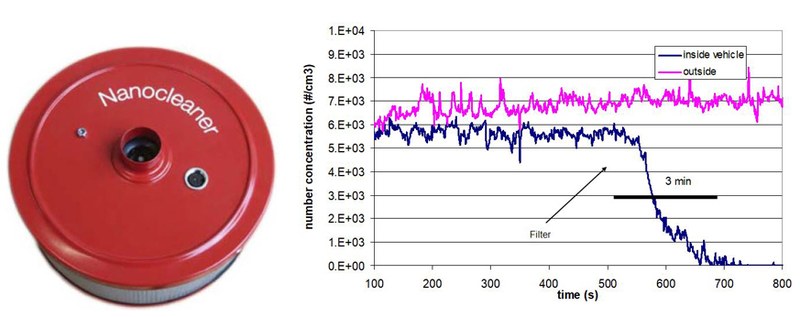
The ‘Nanocleaner’ filter system (left picture) was developed to clean the air inside vehicles. The vehicle's ventilation system is switched to recirculation mode and about 10 % of the air circulated by the system is fed through the filter from outside. After a few minutes, the air in the cabin is nearly particle-free (right picture).

Initial situation

The concentration of soot particles in vehicle cabins can be very high. To allow a reduction, a filter system named 'Nanocleaner' was developed with the aim to clean the air entering the cabin from outside. The target of this study is to develop a stand-alone filter system based on this cabin filter in collaboration with NanocleanAir GmbH and Swiss NanoAnalytics at the Adolphe Merkle Institute of the University of Fribourg. The aim is not only to filter nanoparticles consisting of soot, metal oxides or minerals but also to retain viruses, bacteria and germs. Since the viruses mainly do not come from outside, the room air itself must be filtered.

There are multiple applications possible: Filtration of vehicle cabins (especially of public transport such as buses, trains and airplanes), medical treatment rooms, shops, hairdressing salons etc. Another large market is in the veterinary sector, where air pollution by microorganisms and the associated health risks from viruses, bacteria and fungal spores are playing an increasing role.

Objectives

  • The main scientific objective is to determine the degree of virus filtration and mainly answer the question whether there is a sufficiently reliable correlation between the separa-tion of solid particles in the given filtration medium and the separation of viruses. These tests are initially performed with bacteriophages.
  • The second scientific objective is to investigate the influence of air humidity, the aqueous coating of the viruses and the water introduced into the filter.
  • Subsequent questions to be addressed in the continuation and deepening of the investigation are whether the viruses stored in the filter substrate denature "by themselves" in a sufficiently short time or which methods could be used to shorten this time of residual activity. In this context, the question of the disposal of the filter materials after usage also arises.
  • Whether the test results with the bacteriophages are valid for all viruses, especially for SARS viruses, must also be guaranteed. A suitable test procedure has to be clearly de-fined, even if the associated tests themselves are not carried out in

In a first step, a test setup will be built to be able to work with combustion particles and bacteriophages. In a later phase, active viruses can be brought into the aerosol phase by using a nebulizer. The aerosol concentration and size distribution in front and behind the filter is then measured and compared.
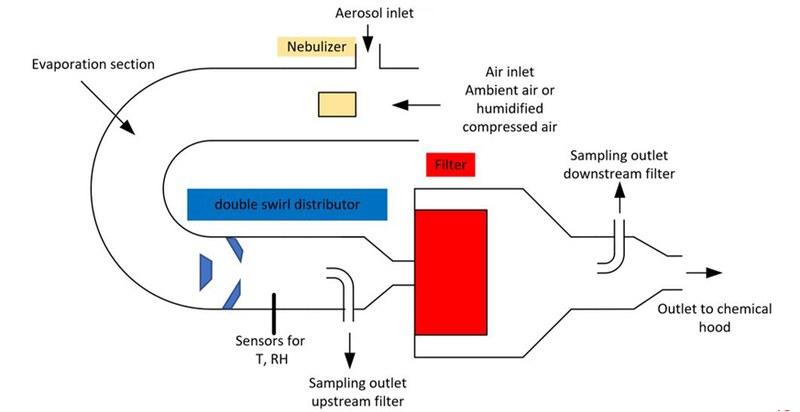
Envisaged filter test setup.

Project information

Execution

FHNW Institute for Sensors and Electronics

Duration

6 Months

Funding

Federal Office for the Environment FOEN, NanoCleanAir GmbH, Swiss Lung Foundation

Partner

NanoCleanAir GmbH, Swiss NanoAnalytics (Adolphe Merkle Institut der Universität Fribourg), Swiss Lung Foundation


School of
Engineering and Environment FHNW University of Applied Sciences and Arts Northwestern Switzerland

  • About the School
    • FHNW School of Engineering and Environment
    • Degree Programmes
    • Continuing Education
    • Collaboration in Research and Services
  • Social Media
    • LinkedIn
    • Instagram
    • Facebook
    • TikTok
    • YouTube
  • About FHNW
    • Organisation
    • Schools
    • Locations
    • FHNW Library
    • Media Relations
  • Support
    • IT Support
    • Inside FHNW
    • Webmail
Logo FHNW - 20 Years
Logo Swiss Universities
Logo European University Association
© University of Applied Sciences and Arts Northwestern Switzerland (FHNW)
  • Data Protection
  • Imprint
  • Accessibility
  • EN