Skip to main contentSkip to search barSkip to navigationSkip to footer
Logo of the University of Applied Sciences and Arts Northwestern Switzerland
  • EN
  • Home
  • Degree programmes
  • Continuing education

Ten Schools One Goal

The FHNW comprises 10 schools with different specializations. Select a school to see its specific courses, study programmes and information.

Applied Psychology

Architecture, Construction and Geomatics

Art and Design

Music

Computer Science

Life Sciences

School of Education

Social Work

Engineering and Environment

Business

  • Research

    • Research fields
    • Projects
  • Updates and insights

    • News and stories
  • Events

  • Media corner

  • About the School of Engineering and Environment

    • People directory
    • Management Board
  • Institutes

    • Institute of Automation
    • Institute of Bioenergy and Resource Efficiency
    • Institute of Business Engineering
    • Institute of Electric Power Systems
    • Institute of Humanities and Social Sciences
    • Institute of Polymer Engineering
    • Institute of Mathematics and Natural Sciences
    • Institute of Polymer Nanotechnology
    • Institute of Optometry
    • Institute of Product and Production Engineering
    • Institute for Sensors and Electronics
    • Institute of Thermal and Fluid Engineering
    • Laboratories of the School of Engineering and Environment
Logo of the University of Applied Sciences and Arts Northwestern Switzerland
  • About the School
    • FHNW School of Engineering and Environment
    • Degree Programmes
    • Continuing Education
    • Collaboration in Research and Services
  • Social Media
    • LinkedIn
    • Instagram
    • Facebook
    • TikTok
    • YouTube
  • About FHNW
    • Organisation
    • Schools
    • Locations
    • FHNW Library
    • Media Relations
  • Support
    • IT Support
    • Inside FHNW
    • Webmail
  • Data Protection
  • Imprint
  • Accessibility
  • Research

    • Research fields
    • Projects
  • Updates and insights

    • News and stories
  • Events

  • Media corner

  • About the School of Engineering and Environment

    • People directory
    • Management Board
  • Institutes

    • Institute of Automation
    • Institute of Bioenergy and Resource Efficiency
    • Institute of Business Engineering
    • Institute of Electric Power Systems
    • Institute of Humanities and Social Sciences
    • Institute of Polymer Engineering
    • Institute of Mathematics and Natural Sciences
    • Institute of Polymer Nanotechnology
    • Institute of Optometry
    • Institute of Product and Production Engineering
    • Institute for Sensors and Electronics
    • Institute of Thermal and Fluid Engineering
    • Laboratories of the School of Engineering and Environment

Type a search term and search continuing education,degree programmes, events, documents and other content.

  • Engineering and Environment
  • Degree programmes
  • Study offerings
  • All degree programmes
  • BSc Electrical and Information Technology
BSc Electrical and Information Technology

A Tesla-ancestor needs new batteries, FHNW School of Engineering and Environment

School of Engineering and Environment


Two students repair a 100 years old electric car. They update the battery-system and restore the car's driving functionality.
topbild-bachelor-elektrotechnik-informationstechnik-ht-fhnw.jpg

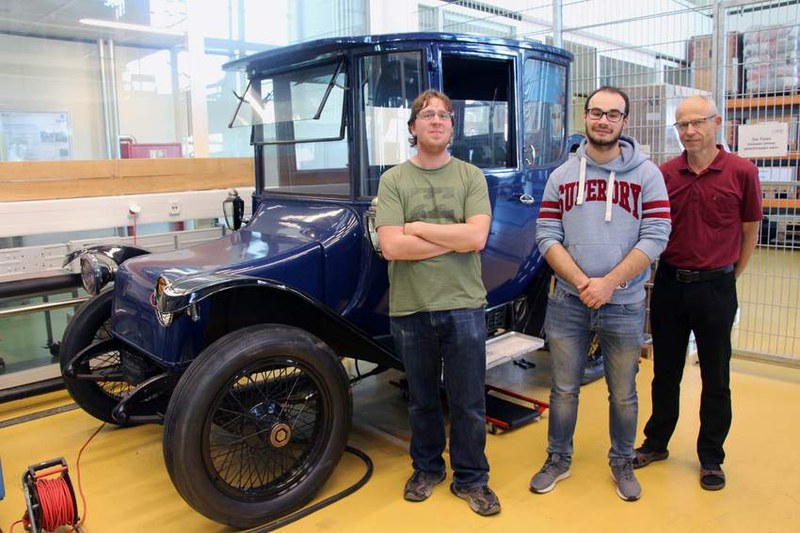
Electric cars aren’t an invention of the 21st century. Back in 1900, a lot of cars did use electric energy, even more than gasoline. A proof of this statement is the DETROIT ELECTRIC CAR built in 1918 and recently bought by a car collector that lives in the surrounding area. Two students at the Institute for Electric Power Systems did both, build up a new modern battery and restore the car’s driving functionality.

The drive

The car benefits of it’s four poles commutated series-wound motor, because it has a lot of torque at low speed, which reduces after acceleration. To provide different levels of power, two identical batteries are used in the car. They can be connected in series or parallel in order to deliver high voltage or high current. An additional feature are the two excitation windings, which also allows the driver to use field- weakening. A big advantage of this circuit is that only at very low speed power is dissipated in resistors. It is also interesting that the approach to control an engine by it’s voltage and it’s excitation is quite the same as today, even with different types of machines.

The batteries

Two identical batteries work as energy storage element of the car. In contrast to the motor and the level switch the battery includes modern technology. The two lithium-ion batteries - which are build up in two metal encasements - can be removed easily from the car to restore its original condition. The main goal of using used batteries of an accident vehicle is not to improve the range of the car, but use the batteries for a second time instead of disposing them.

To achieve almost the same rated voltage as with the original batteries, a total number of twelve cells is connected in series, with two in parallel for higher charge. Both batteries also include a fuse and a diode to avoid compensating currents when switching from series to parallel connection of the batteries. A battery-management-system provides the security functions of the battery, monitors the state of charge and controls the balancing of the cells.

Work done by the students

  • Determine the electrical and mechanical functionality
  • Drawing of the schemas for both, drive and lights
  • Figuring out a concept for the batteries with the given cells
  • Assembly of the batteries with a battery-management-system
  • Check and - if necessary - repair of the whole electrical installation
  • Comprehensive test drives

Project details

  • Students: Marc Müller, Yanick Frei
  • BSc Electrical and Information Technology degree programme
  • Coach: Professor Dr. Felix Jenny

School of
Engineering and Environment FHNW University of Applied Sciences and Arts Northwestern Switzerland

  • About the School
    • FHNW School of Engineering and Environment
    • Degree Programmes
    • Continuing Education
    • Collaboration in Research and Services
  • Social Media
    • LinkedIn
    • Instagram
    • Facebook
    • TikTok
    • YouTube
  • About FHNW
    • Organisation
    • Schools
    • Locations
    • FHNW Library
    • Media Relations
  • Support
    • IT Support
    • Inside FHNW
    • Webmail
Logo FHNW - 20 Years
Logo Swiss Universities
Logo European University Association
© University of Applied Sciences and Arts Northwestern Switzerland (FHNW)
  • Data Protection
  • Imprint
  • Accessibility
  • EN