Skip to main contentSkip to search barSkip to navigationSkip to footer
Logo of the University of Applied Sciences and Arts Northwestern Switzerland
  • EN
  • Home
  • Degree programmes
  • Continuing education

Ten Schools One Goal

The FHNW comprises 10 schools with different specializations. Select a school to see its specific courses, study programmes and information.

Applied Psychology

Architecture, Construction and Geomatics

Art and Design

Music

Computer Science

Life Sciences

School of Education

Social Work

Engineering and Environment

Business

  • Research

    • Research fields
    • Projects
  • Updates and insights

    • News and stories
  • Events

  • Media corner

  • About the School of Engineering and Environment

    • People directory
    • Management Board
  • Institutes

    • Institute of Automation
    • Institute of Bioenergy and Resource Efficiency
    • Institute of Business Engineering
    • Institute of Electric Power Systems
    • Institute of Humanities and Social Sciences
    • Institute of Polymer Engineering
    • Institute of Mathematics and Natural Sciences
    • Institute of Polymer Nanotechnology
    • Institute of Optometry
    • Institute of Product and Production Engineering
    • Institute for Sensors and Electronics
    • Institute of Thermal and Fluid Engineering
    • Laboratories of the School of Engineering and Environment
Logo of the University of Applied Sciences and Arts Northwestern Switzerland
  • About the School
    • FHNW School of Engineering and Environment
    • Degree Programmes
    • Continuing Education
    • Collaboration in Research and Services
  • Social Media
    • LinkedIn
    • Instagram
    • Facebook
    • TikTok
    • YouTube
  • About FHNW
    • Organisation
    • Schools
    • Locations
    • FHNW Library
    • Media Relations
  • Support
    • IT Support
    • Inside FHNW
    • Webmail
  • Data Protection
  • Imprint
  • Accessibility
  • Research

    • Research fields
    • Projects
  • Updates and insights

    • News and stories
  • Events

  • Media corner

  • About the School of Engineering and Environment

    • People directory
    • Management Board
  • Institutes

    • Institute of Automation
    • Institute of Bioenergy and Resource Efficiency
    • Institute of Business Engineering
    • Institute of Electric Power Systems
    • Institute of Humanities and Social Sciences
    • Institute of Polymer Engineering
    • Institute of Mathematics and Natural Sciences
    • Institute of Polymer Nanotechnology
    • Institute of Optometry
    • Institute of Product and Production Engineering
    • Institute for Sensors and Electronics
    • Institute of Thermal and Fluid Engineering
    • Laboratories of the School of Engineering and Environment

Type a search term and search continuing education,degree programmes, events, documents and other content.

  • Engineering and Environment
  • Degree programmes
  • Study offerings
  • All degree programmes
  • BSc Electrical and Information Technology
BSc Electrical and Information Technology

Electric Power Systems and Drives, FHNW School of Engineering and Environment

School of Engineering and Environment


Electric power systems, electric drives, and power electronics are key elements of electrical energy supply and mobility. Engineers are sought after and required to meet the challenges of the energy and mobility revolution with new, innovative and efficient solutions.
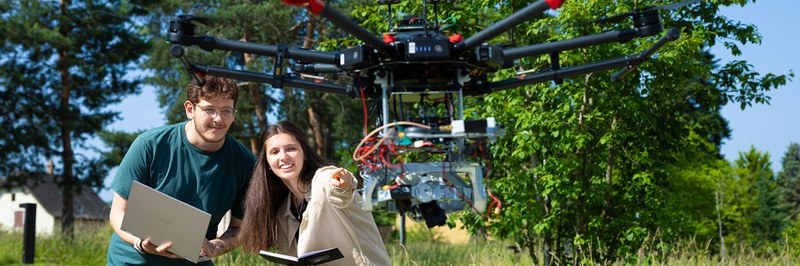
topbild-bachelor-elektrotechnik-informationstechnik-ht-fhnw.jpg

The specialisation profile "Electric Power Systems and Drives" is part of the Bachelor of Science in Electrical Engineering and Information Technology degree programme.

"Having completed vocational training as an electrician, the specialization in power systems and drives builds on my previous knowledge and matches my interests perfectly. Energy technology is taught in a practical way to small groups in class and laboratory work. This maximizes our learning gains so that when we graduate, we are ready for the challenges of the job market."
Marc Studer, Student

Electrical power systems are in a transition phase. After laying the foundation for a highly reliable and cost-effective power supply in the last century, the task now is to make the entire system more efficient and sustainable. Power generation from wind and solar energy entails a transformation of the grid. On the one hand, local distribution grids must be prepared to connect small power plants and storage facilities; on the other hand, large transport corridors must be built across Europe to transport and distribute wind and solar power to the load centers. Decarbonization, i.e., the replacement of fossil fuels, leads to new requirements of the electricity grid. For example, approximately 20,000 heat pumps are installed in Switzerland every year. In addition, nearly 35,000 electric and plug-in hybrid vehicles charged from the power grid were added in 2020.

The application range of electric drives and power electronics is growing. Ever higher energy efficiencies and intelligence is required from end user devices. Electric drives can often only meet these demanding requirements with modern power electronics, advanced control algorithms, innovative measurement and sensor technology, and digitalization. Such power electronic systems are found in most of the devices we use in everyday life, for example in the chargers of our smartphones, tablets and laptops, or LED lights.

In addition to classroom teaching, training in the field of power systems and drives includes up-to-the-minute laboratory experiments and attractive student projects with industry partners. After your studies, you will have sought-after skills and you will be well prepared to make your contribution as an engineer to the energy supply of today and tomorrow. Are you ready for this exciting challenge?

VBZ-linie-83-abb-eit-ht.jpg
Zurich public transport trolley bus with modern drive and energy storage system from ABB (Photo: ABB).

School of
Engineering and Environment FHNW University of Applied Sciences and Arts Northwestern Switzerland

  • About the School
    • FHNW School of Engineering and Environment
    • Degree Programmes
    • Continuing Education
    • Collaboration in Research and Services
  • Social Media
    • LinkedIn
    • Instagram
    • Facebook
    • TikTok
    • YouTube
  • About FHNW
    • Organisation
    • Schools
    • Locations
    • FHNW Library
    • Media Relations
  • Support
    • IT Support
    • Inside FHNW
    • Webmail
Logo FHNW - 20 Years
Logo Swiss Universities
Logo European University Association
© University of Applied Sciences and Arts Northwestern Switzerland (FHNW)
  • Data Protection
  • Imprint
  • Accessibility
  • EN