Skip to main contentSkip to search barSkip to navigationSkip to footer
Logo of the University of Applied Sciences and Arts Northwestern Switzerland
  • EN
  • Home
  • Degree programmes
  • Continuing education

Ten Schools One Goal

The FHNW comprises 10 schools with different specializations. Select a school to see its specific courses, study programmes and information.

Applied Psychology

Architecture, Construction and Geomatics

Art and Design

Music

Computer Science

Life Sciences

School of Education

Social Work

Engineering and Environment

Business

  • Research

    • Research fields
    • Projects
  • Updates and insights

    • News and stories
  • Events

  • Media corner

  • About the School of Engineering and Environment

    • People directory
    • Management Board
  • Institutes

    • Institute of Automation
    • Institute of Bioenergy and Resource Efficiency
    • Institute of Business Engineering
    • Institute of Electric Power Systems
    • Institute of Humanities and Social Sciences
    • Institute of Polymer Engineering
    • Institute of Mathematics and Natural Sciences
    • Institute of Polymer Nanotechnology
    • Institute of Optometry
    • Institute of Product and Production Engineering
    • Institute for Sensors and Electronics
    • Institute of Thermal and Fluid Engineering
    • Laboratories of the School of Engineering and Environment
Logo of the University of Applied Sciences and Arts Northwestern Switzerland
  • About the School
    • FHNW School of Engineering and Environment
    • Degree Programmes
    • Continuing Education
    • Collaboration in Research and Services
  • Social Media
    • LinkedIn
    • Instagram
    • Facebook
    • TikTok
    • YouTube
  • About FHNW
    • Organisation
    • Schools
    • Locations
    • FHNW Library
    • Media Relations
  • Support
    • IT Support
    • Inside FHNW
    • Webmail
  • Data Protection
  • Imprint
  • Accessibility
  • Research

    • Research fields
    • Projects
  • Updates and insights

    • News and stories
  • Events

  • Media corner

  • About the School of Engineering and Environment

    • People directory
    • Management Board
  • Institutes

    • Institute of Automation
    • Institute of Bioenergy and Resource Efficiency
    • Institute of Business Engineering
    • Institute of Electric Power Systems
    • Institute of Humanities and Social Sciences
    • Institute of Polymer Engineering
    • Institute of Mathematics and Natural Sciences
    • Institute of Polymer Nanotechnology
    • Institute of Optometry
    • Institute of Product and Production Engineering
    • Institute for Sensors and Electronics
    • Institute of Thermal and Fluid Engineering
    • Laboratories of the School of Engineering and Environment

Type a search term and search continuing education,degree programmes, events, documents and other content.

  • Engineering and Environment
  • Research and services
  • Collaboration
  • services
services

Eye Movement and Usability Lab FHNW, FHNW School of Engineering and Environment

School of Engineering and Environment


Versatile eye-tracking systems for research and interaction studies as well as usability tests.
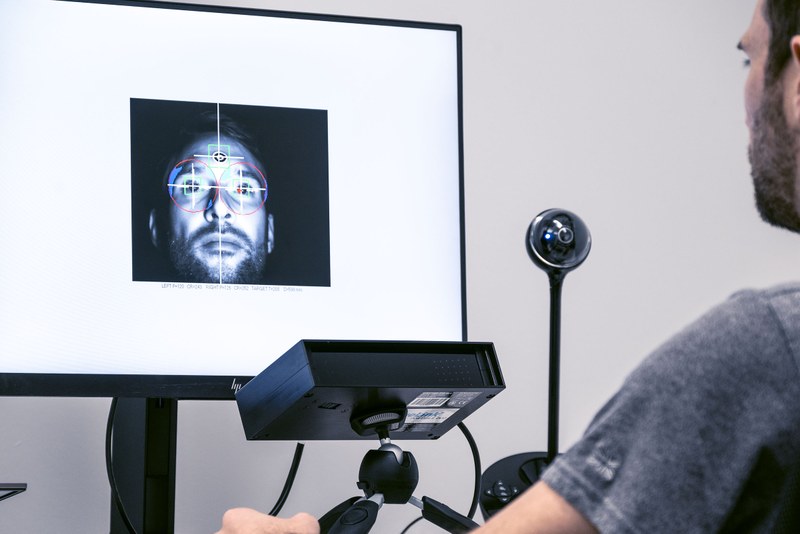
eyemovement-usability_iit-imvs_ht_fhnw.jpg

Our Offer

We offer a comprehensive range of high-precision eye-tracking systems and software solutions suitable for cognitive experiments, human-computer interaction studies and usability testing, including portable options for on-site data collection.

Get in touch with us

For more information or to discuss a collaboration, please contact Thekla Müller.

Infrastructure

Remote-controlled eye tracker: EyeLink 1000 Plus

Eye tracker with a refresh rate of up to 2,000 Hz. High-resolution eye tracker for cognitive experiments, human-computer interaction studies (e.g. gaze-adaptive displays) and usability studies. The mobile carrying case enables data acquisition on site.

Eye tracker: EyeLink Portable Duo

It supports a refresh rate of up to 2,000 Hz when used with head stabilisation and 1000 Hz in a remote environment (the head can be moved freely). The high-resolution eye tracker is suitable for cognitive experiments, human-computer interaction studies (e.g. gaze-adaptive displays) and usability studies. The EyeLink Portable Duo is, as the name suggests, a portable system. It is installed in our usability lab, but can be easily disassembled and transported with a mobile carrying case to collect data on site.

Hardware included:

  • Soft and hard carrying cases
  • Lightweight host laptop
  • Portable Duo camera (centrepiece of the eye tracker)
  • Laptop and tripod mounts
  • Lightweight headrest
  • Reaction device (e.g. for recording reaction time)

Some specifications:

  • Sampling rate: up to 2000hz
  • Average accuracy: Up to 0.15°
  • Resolution of saccade events: 0.05° microsaccades
  • Spatial resolution: 0.01°
  • Pupil size resolution: 0.1% of the diameter
  • Compatibility with spectacles: Excellent
  • Online event analysis: FixaKons / Saccade / Blink / FixaKon Updatee

Further specifications

Software solutions

Our software solutions:

  • SR Research WebLink (1x lifetime licence) is a screen recording software solution that allows EyeLink users to record eye movements while participants view and interact with websites, computer software, live events (e.g. puppetry tasks), game consoles, tablets, mobile phones and other dynamic media such as videos and PDF documents. It is ideal for usability tests, HCI research and many other scenarios.
  • With the SR Research Experiment Builder (1x lifetime licence), users can create anything from simple experiments where each trial shows a static text or image and then waits for a response from the participant, to sophisticated experiments where complex gaze-dependent event sequences can be planned with excellent temporal precision. Frequently used by psychologists and neuroscientists
  • The EyeLink Data Viewer (1x lifetime licence) is a tool that allows users to view, filter and generate output reports from EDF data files recorded with EyeLink eye trackers. The EyeLink Data Viewer is used to analyse your data recorded with the EyeLink Portable Duo.
Remote-controlled eye tracker: Tobii X1 Light eye tracker

Lightweight eye tracker with 30 Hz resolution. Fully functional, suitable e.g. for web usability studies, but also useful for cognitive experiments and studies on human-computer interaction (e.g. gaze-adaptive displays) if the precision requirements are not too high.
Software: Tobii Studio

Augmented (virtual, augmented, mixed) reality XRd devices with built-in eye trackers (available in the media lab or at the FHNW campus)

Apple Vision Pro

It is not yet possible to access eye-tracking data. It is possible to highlight objects when the user looks at them. However, this is managed by an Apple framework, so we have no control over what happens.

Hololens 2

The HoloLens 2 has integrated eye tracking, which can be used to visualise gaze and interactions with objects. It is also possible to collect eye tracking data, e.g. which object is looked at and for how long. Other eye-tracking data requires programming or the use of ARETT. Four examples are available for student projects.

Specification of eye tracking

  • Real-time tracking with 2 IR cameras
HTC Vive Pro Eye

The HTC Vive Pro Eye is an enhanced regular HTC Vive Pro version with precise eye tracking from Tobii.

EyeTracking specification:

  • Gaze data output (binocular): 120Hz
  • Accuracy: 0.5°-1.1°
  • Calibrations: 5-point
  • Trackable field of view: 110°

Possible data output:

  • Time stamp
  • Viewing direction
  • Pupil position
  • Pupil size
  • Openness of the eyes

Programming interface: HTC SRanipal SDK
SDK engine compatibility: Unity, Unreal

Meta Quest Pro

The sampling rate is about 72 Hz. Eye tracking is used to make your avatar's eye contact and facial expressions look more natural during virtual interaction with other users and to improve the image quality within the area you are looking at in VR. Eye tracking can also be used as an input, meaning you can interact with virtual content depending on where you are looking. Eye tracking is not used to identify you. Eye tracking estimates the direction your eyes are looking and the images of your eyes never leave your headset and are deleted after processing.

Eye tracking studies with webcam and smartphone

Eye tracking is also possible with ordinary cameras, albeit less stable, and we have experience in conducting eye tracking studies with some commercially available devices and webcams. If you have any questions, please feel free to contact us.

Calibration of the EyeLink eye tracker. Enables the recording of eye movements, blink rate and pupil changes. Supports the optimisation of the user-friendliness of applications.
A mobile eye-tracking setup makes it easy to carry out remote experiments.

The MediaLab belongs to the following institutes
Loading

School of
Engineering and Environment FHNW University of Applied Sciences and Arts Northwestern Switzerland

  • About the School
    • FHNW School of Engineering and Environment
    • Degree Programmes
    • Continuing Education
    • Collaboration in Research and Services
  • Social Media
    • LinkedIn
    • Instagram
    • Facebook
    • TikTok
    • YouTube
  • About FHNW
    • Organisation
    • Schools
    • Locations
    • FHNW Library
    • Media Relations
  • Support
    • IT Support
    • Inside FHNW
    • Webmail
Logo FHNW - 20 Years
Logo Swiss Universities
Logo European University Association
© University of Applied Sciences and Arts Northwestern Switzerland (FHNW)
  • Data Protection
  • Imprint
  • Accessibility
  • EN