Skip to main contentSkip to search barSkip to navigationSkip to footer
Logo of the University of Applied Sciences and Arts Northwestern Switzerland
  • DE
  • EN
  • Home
  • Degree programmes
  • Continuing education

Ten Schools One Goal

The FHNW comprises 10 schools with different specializations. Select a school to see its specific courses, study programmes and information.

Applied Psychology

Architecture, Construction and Geomatics

Art and Design

Business

Computer Science

Engineering and Environment

Life Sciences

Music

School of Education

Social Work

  • Research

    • Research fields
    • Projects
  • Updates and insights

    • News and stories
  • Events

  • Media corner

  • About the School of Engineering and Environment

    • People directory
    • Management Board
  • Institutes

    • Institute of Automation
    • Institute of Bioenergy and Resource Efficiency
    • Institute of Business Engineering
    • Institute of Electric Power Systems
    • Institute of Humanities and Social Sciences
    • Institute of Polymer Engineering
    • Institute of Mathematics and Natural Sciences
    • Institute of Polymer Nanotechnology
    • Institute of Optometry
    • Institute of Product and Production Engineering
    • Institute for Sensors and Electronics
    • Institute of Thermal and Fluid Engineering
    • Laboratories of the School of Engineering and Environment
Logo of the University of Applied Sciences and Arts Northwestern Switzerland
  • About the School
    • FHNW School of Engineering and Environment
    • Degree Programmes
    • Continuing Education
    • Collaboration in Research and Services
  • Social Media
    • LinkedIn
    • Instagram
    • Facebook
    • TikTok
    • YouTube
  • About FHNW
    • Organisation
    • Schools
    • Locations
    • FHNW Library
    • Media Relations
  • Support
    • IT Support
    • Inside FHNW
    • Webmail
  • Data Protection
  • Imprint
  • Accessibility
  • Research

    • Research fields
    • Projects
  • Updates and insights

    • News and stories
  • Events

  • Media corner

  • About the School of Engineering and Environment

    • People directory
    • Management Board
  • Institutes

    • Institute of Automation
    • Institute of Bioenergy and Resource Efficiency
    • Institute of Business Engineering
    • Institute of Electric Power Systems
    • Institute of Humanities and Social Sciences
    • Institute of Polymer Engineering
    • Institute of Mathematics and Natural Sciences
    • Institute of Polymer Nanotechnology
    • Institute of Optometry
    • Institute of Product and Production Engineering
    • Institute for Sensors and Electronics
    • Institute of Thermal and Fluid Engineering
    • Laboratories of the School of Engineering and Environment

Type a search term and search continuing education,degree programmes, events, documents and other content.

  • Engineering and Environment
  • Research and services
  • Research
  • Research fields
  • Electrical engineering
Electrical engineering

Communication Technology, FHNW School of Engineering and Environment

School of Engineering and Environment


elektrotechnik_forschung-feld.jpeg

We develop communication systems from the channel model to the finished system. We conduct research and development for quantum-safe network protocols for both wired and wireless connections.

Competencies

Transmission Technologies
Internet of Things
High-Frequency Technology
Cryptography

Tools

  • MATLAB, Simulink, Python, C/C++, Java, CST Microwave Studio
  • HF-Messtechnik Labor
  • PCB Design und Entwicklung
  • 3D-Druck

Collaboration

  • Innovation projects with industry (e.g. Innosuisse, SNF-Bridge, StiftungFHNW)
  • Service contracts
  • Preliminary studies, feasibility studies
  • Student projects
  • Cooperations with universities and research centers (ETHZ, Uni Genf, Uni Bern, PSI, CSEM, Centre of Quantum Technologies, National University of Singapore)

Selected Projects
QDrone – Simulation of Free-Space Quantum Communication Using Drones

Free-space optical communication (FSOC) is considered a key enabling technology for future quantum communication networks. To better understand the physical foundations of this technology, the FHNW, in collaboration with GA-Synopta, is developing a mobile drone platform that investigates atmospheric disturbances in the context of quantum communication – cost-efficient, flexible, and practice-oriented.

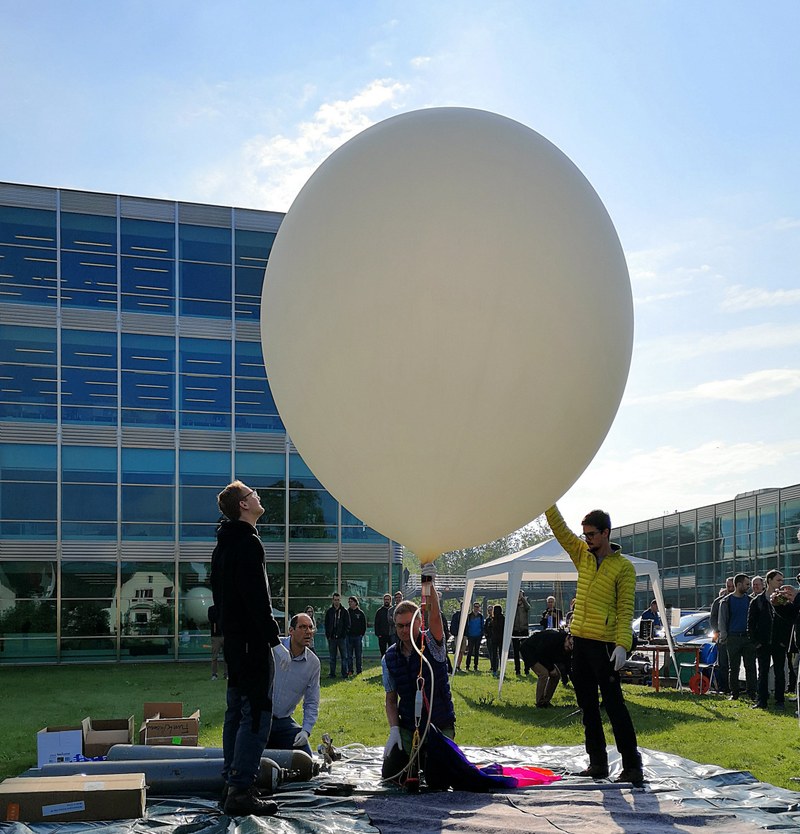
QHAPS – Simulation of Satellite-Based Quantum Communication Using Stratospheric Balloons

Future-proof communication systems increasingly rely on quantum communication – for example, through optical links between satellites and ground stations. To test this technology under realistic conditions, FHNW, in collaboration with GA-Synopta, is developing a balloon-based platform that simulates near-Earth orbit conditions. Stratospheric balloons (High-Altitude Platforms, HAPS) offer a unique and cost-efficient alternative to satellite missions.

Contact

Prof. Dr. Stefan Gorenflo

Lecturer for Signal Processing
Phone
+41 56 202 87 24
E-Mail
stefan.gorenflo@fhnw.ch

Prof. Dominique Kunz

Lecturer for Embedded Systems
Phone
+41 56 202 79 75
E-Mail
dominique.kunz@fhnw.ch

Prof. Dr. Miklós Lenner

Lecturer in Measurement- and Sensing Technologies
Phone
+41 56 202 76 96 (Direct)
E-Mail
miklos.lenner@fhnw.ch

Prof. Dr. Christoph Wildfeuer

Lecturer for Sensor Technology, Head of the Quantum Technologies working group
Phone
+41 56 202 86 46
E-Mail
christoph.wildfeuer@fhnw.ch

School of
Engineering and Environment FHNW University of Applied Sciences and Arts Northwestern Switzerland

  • About the School
    • FHNW School of Engineering and Environment
    • Degree Programmes
    • Continuing Education
    • Collaboration in Research and Services
  • Social Media
    • LinkedIn
    • Instagram
    • Facebook
    • TikTok
    • YouTube
  • About FHNW
    • Organisation
    • Schools
    • Locations
    • FHNW Library
    • Media Relations
  • Support
    • IT Support
    • Inside FHNW
    • Webmail
Logo FHNW - 20 Years
Logo Swiss Universities
Logo European University Association
© University of Applied Sciences and Arts Northwestern Switzerland (FHNW)
  • Data Protection
  • Imprint
  • Accessibility
  • DE
  • EN