Skip to main contentSkip to search barSkip to navigationSkip to footer
Logo of the University of Applied Sciences and Arts Northwestern Switzerland
  • DE
  • EN
  • Home
  • Degree programmes
  • Continuing education

Ten Schools One Goal

The FHNW comprises 10 schools with different specializations. Select a school to see its specific courses, study programmes and information.

Applied Psychology

Architecture, Construction and Geomatics

Art and Design

Music

Computer Science

Life Sciences

School of Education

Social Work

Engineering and Environment

Business

  • Research

    • Research fields
    • Projects
  • Updates and insights

    • News and stories
  • Events

  • Media corner

  • About the School of Engineering and Environment

    • People directory
    • Management Board
  • Institutes

    • Institute of Automation
    • Institute of Bioenergy and Resource Efficiency
    • Institute of Business Engineering
    • Institute of Electric Power Systems
    • Institute of Humanities and Social Sciences
    • Institute of Polymer Engineering
    • Institute of Mathematics and Natural Sciences
    • Institute of Polymer Nanotechnology
    • Institute of Optometry
    • Institute of Product and Production Engineering
    • Institute for Sensors and Electronics
    • Institute of Thermal and Fluid Engineering
    • Laboratories of the School of Engineering and Environment
Logo of the University of Applied Sciences and Arts Northwestern Switzerland
  • About the School
    • FHNW School of Engineering and Environment
    • Degree Programmes
    • Continuing Education
    • Collaboration in Research and Services
  • Social Media
    • LinkedIn
    • Instagram
    • Facebook
    • TikTok
    • YouTube
  • About FHNW
    • Organisation
    • Schools
    • Locations
    • FHNW Library
    • Media Relations
  • Support
    • IT Support
    • Inside FHNW
    • Webmail
  • Data Protection
  • Imprint
  • Accessibility
  • Research

    • Research fields
    • Projects
  • Updates and insights

    • News and stories
  • Events

  • Media corner

  • About the School of Engineering and Environment

    • People directory
    • Management Board
  • Institutes

    • Institute of Automation
    • Institute of Bioenergy and Resource Efficiency
    • Institute of Business Engineering
    • Institute of Electric Power Systems
    • Institute of Humanities and Social Sciences
    • Institute of Polymer Engineering
    • Institute of Mathematics and Natural Sciences
    • Institute of Polymer Nanotechnology
    • Institute of Optometry
    • Institute of Product and Production Engineering
    • Institute for Sensors and Electronics
    • Institute of Thermal and Fluid Engineering
    • Laboratories of the School of Engineering and Environment

Type a search term and search continuing education,degree programmes, events, documents and other content.

  • Engineering and Environment
  • Research and services
  • Research
  • Projects
Projects

DustEar: Detection of single, micrometer sized aerosol particles by acoustic impaction, FHNW School of Engineering and Environment

School of Engineering and Environment


The FHNW Institute for Sensors and Electronics has developed a new measurement technology that detects aerosol particles by their impaction on a piezo transducer and allows therefore single particle mass characterization.

Project details

University
FHNW School of Engineering and Environment / School of Engineering and Environment, lnstitute for Sensors and Electronics

Technologies

  • Acoustic Detection Method
  • Piezo Transducer
  • Impactor
  • Single Particle Mass Characterization

Objectives

Development of a new sensor based on acoustic impaction to detect the mass of single aerosol particles directly, without artefacts and with a simple and robust measurement setup.

Background

Human health is affected by exposure to high or long-term aerosol concentrations. Due to their small size, aerosol particles can reach our lungs via the respiratory tract and enter the bloodstream, where they can cause serious diseases. Therefore, limit values for aerosol mass concentrations are specified by the WHO and need to be monitored. Due to the heterogeneity of aerosol concentrations and their complex interactions with the environment, long-term measurements of air pollution require both high spatial and temporal resolution to provide reliable information on variations or trends.

Results
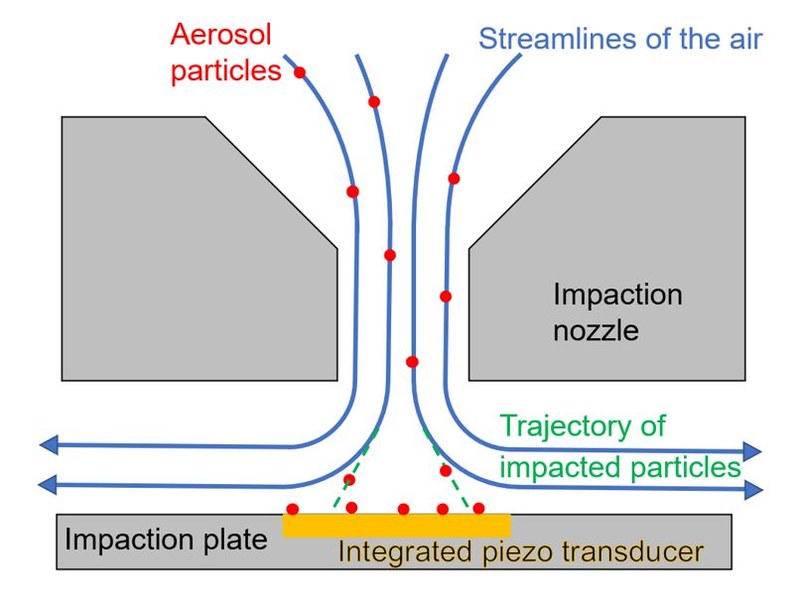
Our measurement principle uses a mechanical impactor setup with a nozzle that accelerates the particles before they impact. A piezo transducer is mounted on the impaction plate, which detects the momentum transfer of each impacted particle as a characteristic signal pulse whose amplitude is proportional to the particle mass.

Customer-designed microphones, an optimized mechanical and electrical setup and software code for a precise data evaluation were developed in this project. Microphones and acceleration nozzles were specially designed in collaboration with CSEM SA and FEMTOPrint SA. Our measurement principle is very robust against noise caused by vibrations or the air flow and at the same time sensitive enough to detect impacting particles down to a mass of a few picograms or a diameter of a few micrometers. The setup can also be used at reduced pressure, which further improves the lower detection limit.
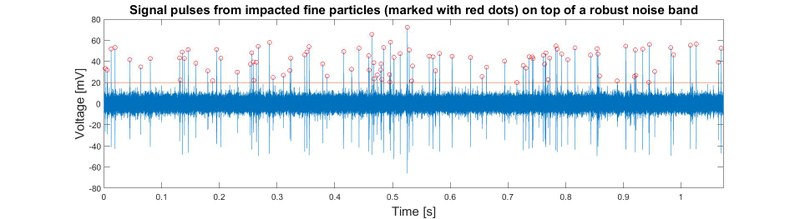
Signal pulses from impacted fine particles

In a next step the goal of the project is to further develop and miniaturize this promising and unique measurement technique.

References and documentation

The development of our DustEar measurement system for single aerosol particle characterization was published in IEEE Sensors Journal. This work was awarded with the Swiss Aerosol Prize 2022 from the Swiss Lung Foundation that is given annually to the best scientific publication in the field of international aerosol research, written from within Switzerland.

Project information

Execution

Institute for Sensors and Electronics FHNW

Duration

1.5 years

Funding

Innosuisse

Team

Prof. Dr. Ernest Weingartner (Lead), Nadine Karlen, Tobias Rüggeberg, Peter Steigmeier, Patrick Specht 

School of
Engineering and Environment FHNW University of Applied Sciences and Arts Northwestern Switzerland

  • About the School
    • FHNW School of Engineering and Environment
    • Degree Programmes
    • Continuing Education
    • Collaboration in Research and Services
  • Social Media
    • LinkedIn
    • Instagram
    • Facebook
    • TikTok
    • YouTube
  • About FHNW
    • Organisation
    • Schools
    • Locations
    • FHNW Library
    • Media Relations
  • Support
    • IT Support
    • Inside FHNW
    • Webmail
Logo FHNW - 20 Years
Logo Swiss Universities
Logo European University Association
© University of Applied Sciences and Arts Northwestern Switzerland (FHNW)
  • Data Protection
  • Imprint
  • Accessibility
  • DE
  • EN