Cleaner Air Through Better Measurement
Background
Black carbon — the fine, sooty particles produced by burning diesel, wood, and biomass — is one of the most potent short-lived climate pollutants. After CO₂, it is considered the second-largest contributor to global warming. It also poses serious risks to human health, as it can penetrate deep into the lungs and bloodstream. And yet, despite its importance, measuring black carbon reliably remains a major challenge.
That is precisely what the European STANBC project set out to address — and after three years of collaborative work across leading European metrology institutes, the project is concluding with a set of concrete scientific and regulatory achievements.
Why Is Measuring Black Carbon So Difficult?
Air quality monitoring networks across Europe measure black carbon concentrations in real time using instruments called filter-based light absorption photometers. These are practical and widely deployed — but they are notoriously imprecise. Depending on the composition of the aerosol, measurement errors can be as large as 400%. This means that data from different monitoring sites is often not directly comparable, making it very hard to draw reliable conclusions about long-term trends or to enforce environmental legislation.
The root of the problem is that there is no agreed standard for how to calibrate these instruments, nor for what black carbon actually means in a measurement context. In fact, the term "black carbon" describes a family of related quantities — equivalent black carbon (eBC), refractory black carbon (rBC), and elemental carbon (EC) — each determined using different techniques and yielding different concentrations.
FHNW's Contribution: Instruments That Bridge Lab and Atmosphere
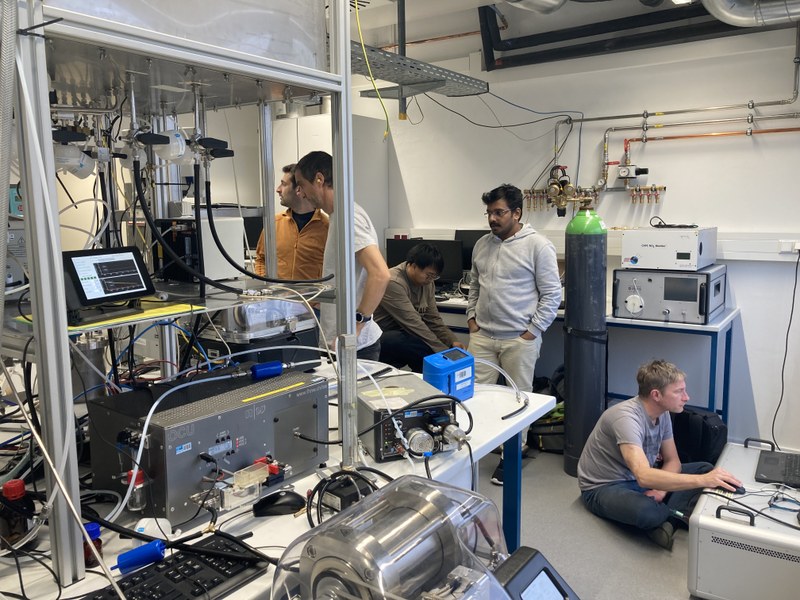
The ISE contributed two important tools to STANBC's measurement campaigns.
The Organic Coating Unit (OCU)
Black carbon particles in the real atmosphere do not stay "fresh" for long. As they travel through the air, they become coated with secondary organic material — a process called aerosol aging — which changes their optical properties and can significantly affect how instruments measure them.
To simulate this in the laboratory, the ISE team brought its Organic Coating Unit (OCU) — an instrument that coats laboratory-generated soot particles with a controlled layer of organic material, replicating the aging process in a reproducible way. For STANBC, the OCU was improved and made available to partner institutes for their calibration campaigns.
By exposing candidate measurement systems to a wide range of aerosol types — from freshly generated soot to heavily aged particles — the partners could rigorously test how well instruments perform across conditions representative of real-world air quality monitoring. This was essential for determining reliable calibration factors.
FATCAT: A Window Into Aerosol Composition
The ISE also brought its own unique instrument to a STANBC measurement campaign: FATCAT (Fast Thermal Carbon Totalizator), developed in-house at FHNW.
FATCAT works differently from the optical methods. Rather than measuring how much light aerosol particles absorb, it measures how particles behave when heated rapidly — producing a fast thermogram, a fingerprint of the carbonaceous content of the aerosol. This gives direct insight into the carbonaceous composition of the particles, without relying on the artificial boundaries that conventional techniques impose between carbon fractions.
While FATCAT does not measure equivalent black carbon directly, its unique design makes it complementary to the optical reference methods used in the project. Participating in the STANBC measurement campaign gave the ISE team valuable data on how FATCAT's thermograms relate to the quantities measured by EMS, PTI, and the photoacoustic instruments. This will help assess whether and how FATCAT could be deployed at air quality monitoring sites in the future — opening the door to richer, composition-resolved aerosol data alongside conventional eBC measurements.
Goals
STANBC set out to fix a fundamental problem in air quality monitoring: the lack of a reliable, agreed measurement framework for black carbon.
The project pursued four interconnected goals:
- The first was to develop traceable reference methods for measuring how much light aerosol particles absorb — the physical quantity that underpins all black carbon monitoring. Two techniques, Extinction Minus Scattering and Photo-Thermal Interferometry, were established as primary standards, with measurement uncertainties below 10%.
- The second was to understand how different black carbon metrics relate to each other — specifically, how optically derived eBC mass, thermally derived EC mass, and laser-incandescence-derived rBC mass compare across different aerosol types and conditions, and what conversion factors are needed to move between them reliably.
- The third was to use these reference methods to calibrate the filter-based photometers widely deployed at monitoring stations across Europe, producing correction factors that account for the varying optical properties of real-world aerosols.
- The fourth, and perhaps most far-reaching, was to translate all of this into documentary standards — working with CEN/TC 264 to ensure that the project's scientific outcomes feed directly into the regulatory frameworks that underpin air quality legislation across Europe.
FHNW's role spanned all four goals: the Organic Coating Unit enabled the generation of realistic test aerosols for calibration campaigns, while FATCAT contributed complementary compositional data to the intercomparison studies.
Results
STANBC brought together national metrology institutes and research groups from across Europe to tackle these problems systematically. The project delivered across seven major work areas:
Establishing reference measurement methods. The project developed and validated two primary reference techniques — Extinction Minus Scattering (EMS) and Photo-Thermal Interferometry (PTI) — that can measure aerosol light absorption with uncertainties below 10%. These serve as the "gold standard" against which other instruments can be calibrated.
Building a traceability chain. A key outcome is a clear, step-by-step calibration chain: from primary laboratory standards, to portable photoacoustic spectrometers used as transfer instruments in the field, down to the filter-based photometers deployed at monitoring sites. This structure — familiar from other measurement fields such as temperature or mass — brings the same rigour to black carbon measurement for the first time.
Understanding relationships between different BC metrics. Through carefully controlled laboratory experiments, the project quantified the relationships between eBC, rBC, and EC mass concentrations across a wide range of aerosol types, including fresh and aged soot. The results highlighted substantial differences between rBC, EC, and eBC — three quantities that are often treated as interchangeable in practice — underscoring why direct comparisons between data from different monitoring networks must be made with care.
Calibrating filter-based photometers. A systematic calibration method was developed for widely used filter-based instruments, using aerosols that span the full range of optical properties encountered in the real atmosphere. Calibration factors were determined with uncertainties below 15%, a major improvement over the current state of the art.
Engaging with standardisation bodies. Perhaps the most lasting outcome: STANBC proposed a New Work Item (NWI) to CEN/TC 264, the European committee responsible for ambient air quality standards. The proposal — on Methods for the determination of black carbon mass concentration, aerosol light absorption coefficient and derived optical parameters in ambient air — has been voted on and approved. To take this forward, the existing working group CEN/TC 264/WG 35 — currently focused on the measurement of organic and elemental carbon — will broaden its scope to include black carbon and light absorption measurements, paving the way for the first dedicated European standard in this area.
More information:
Selected publications:
- Keller, A., Kalbermatter, D. M., Wolfer, K., Specht, P., Steigmeier, P., Resch, J., … Vasilatou, K. (2022). The organic coating unit, an all-in-one system for reproducible generation of secondary organic matter aerosol. Aerosol Science and Technology, 56(10), 947–958. doi.org/10.1080/02786826.2022.2110448
- Keller, A., Specht, P., Steigmeier, P., & Weingartner, E. (2023). A novel measurement system for unattended, in situ characterization of carbonaceous aerosols. Aerosol Research, 1(1), 65–79. doi.org/10.5194/ar-1-65-2023
- Corbin, J. C., Clavel, D., & Smallwood, G. J. (2024). Characterization of two aerosol carbon analyzers based on temperature programmed oxidation: TCA08 and FATCAT. Aerosol Science and Technology, 58(7), 812–829. doi.org/10.1080/02786826.2024.2351991
- Asmi, E., Sipkens, T. A., Saturno, J. et al. (2026). Mass absorption cross-section of ambient black carbon aerosols — a review. npj Climate and Atmospheric Science, 9, 17. doi.org/10.1038/s41612-025-01288-2
Outlook
With the project concluding in May 2026, the work continues within the framework of European standardisation. The results of STANBC directly support the activities of CEN/TC 264/WG 35, which is currently expanding its scope to include black carbon and aerosol light absorption.
For the ISE team, STANBC has strengthened our expertise in traceable aerosol measurement, advanced the OCU as a tool for realistic laboratory aerosol generation, and generated new insights into FATCAT's potential as a field instrument. We look forward to continuing this work with the European metrology and air quality communities.
Project details
- Type
- Research project
- Research field
- Energy and environment, Electrical engineering
- Topics
- Technologies and engineering, Electrical engineering and measurement technology, Environment and sustainability, Environmental technology and recycling
- School
- FHNW School of Engineering and Environment / Institute for Sensors and Electronics
- Partners
- Physikalisch-Technische Bundesanstalt (PTB)
National Centre for Scientific Research “DEMOKRITOS" (NCSR "DEMOKRITOS")
Haze Instruments d.o.o.
Laboratoire national de métrologie et d'essais (LNE)
Eidgenössisches Institut für Metrologie METAS
Leibniz Institute for Tropospheric Research (TROPOS)
National Physical Laboratory (NPL)
National Research Council Canada
Finnish Meteorological Institute (FMI)
Jožef Stefan Institute (JSI) - Funding
- European Partnership on Metrology, co-financed from the European Union’s Horizon Europe Research and Innovation Programme and by the participating states (EPM 22NRM02), and the Swiss State Secretariat for Education, Research and Innovation SERI (F-5235.30181)
- Duration
- 3 Years (from June 2023 to May 2026)
- Team
- Ernest Weingartner, Alejandro Keller