Plastic waste represents valuable resources. By recycling them and returning them to the materials cycle, we make our contribution to a more sustainable economy and at the same time protect our environment. Our focus is on the recycling of glass fiber-reinforced thermosets.
Background
Thermosets such as glass fiber reinforced plastic (GFRP) have excellent properties. They are inexpensive to manufacture, very stable, durable, light, and weatherproof. Because of these characteristics, they are used in numerous industries (automotive, blades of wind turbines, boat hulls etc.).
Due to the excellent properties of GFRP, their production has been increasing continuously for several years. In 2019, more than 1.141 million tons of this material were produced across Europe. At the same time, the amount of GFRP components that reach their EOL and must be disposed of is increasing as well. Especially blades from wind energy plants that were built 20 years ago reach their EOL and need a professional disposal. The number of blades will increase in the coming years and reach up to 60’000 tons per year. In addition, there is as well and increasing amount of leisure boats which reach their EOL due to having reached their estimated lifespan. On top there is every year a tremendous amount of industrial waste that is currently not recycled in a sustainable way. Already today, more than 200,000 tons of GFRP waste must be disposed of in Europe every year, although the quantities will increase significantly soon.
Because this topic was hardly given any importance in the past, there is currently a disposal problem that threatens to worsen. Today GFRP waste is either incinerated or disposed of in landfills meaning that this high-quality material is not recycled in a sustainable way. Sustainable GFRP recycling is therefore urgently needed. To date, however, no recycling method in the sense of circular economy has established itself on the market.
That is why iwas-concepts AG, together with partners from research and industry, develops and implements innovative and sustainable solutions for GFRP recycling to process these high-quality waste products and return them into the material cycle.
Goals
Applications made from glass fiber reinforced thermosets such as boat hulls, blades from wind turbines or other industrial applications are difficult to recycle. Unlike thermoplastic applications (e.g. PET bottles) thermosets cannot be melted and then reprocessed. Therefor different recycling approaches were developed and tested, (pyrolysis, solvolysis etc).
The intention with all these approaches was to recuperate the glass fiber for reuse. Unfortunately, none of these approaches gave the desired result. Rather, additional material and energetic problems arose which made economic recovery almost impossible. Based on these experiences GFRP-waste today is either incinerated or dumped into landfills.
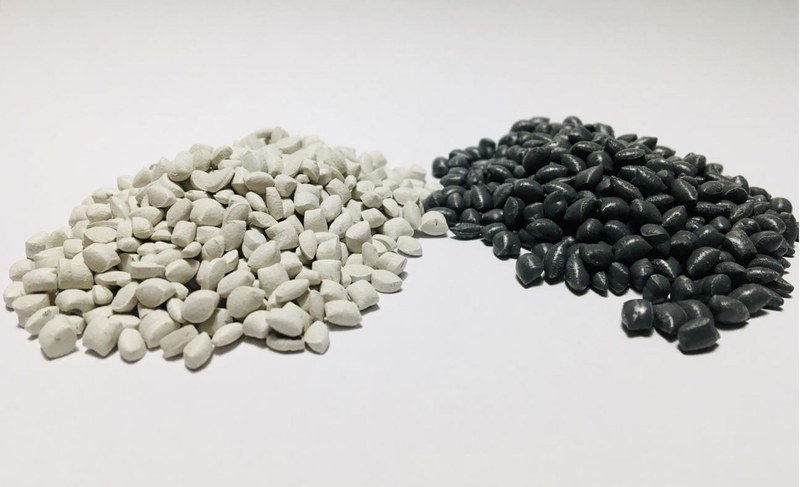
Our way follows a different approach. Our intention is to create a recycled material that can be used on existing production facilities to produce new applications. That is why we designed a process, which allows to transform the thermoset material into a new recyclate with properties like those of a glass fiber reinforced thermoplastic.
After EOL of these applications, the material can be recycled back by 100% into the material cycle. Thus, a sustainable circular economy is supported.
Results
The FHNW Institute of Bioenergy and Resource Efficiency was responsible for preparing an LCA and the FHNW Institut of Polymer Engineering focused on the development of the material formulation and compounding processes.
In a first step we source GFRP-waste according to certain specifications developed by us. The specification depends on the final application and her production method. The waste is processed and sorted in a standardized way to ensure a high process stability and quality of the final recyclate.
Afterwards we supply the conditioned wasted material, different kinds of thermoplastic waste and various additives into a special compounder. The thermoplastics are melted, and the GFRP-waste and several additives are added to the compound. By the movement of the screw conveyor and through shear strain a homogeneous compound is created. The process parameters define the properties of the produced material and they can be adapted custom-designed for injection moulding, impact extrusion and extrusion.
Project details
- Type
- Research project
- Research field
- Micro- and nano-technology, Energy and environment
- Topics
- Environment and sustainability, Environmental technology and recycling, Technologies and engineering, Materials, process engineering
- School
- FHNW School of Engineering and Environment / Institute of Polymer Engineering, Institute of Bioenergy and Resource Efficiency
- Partners
- iwas-concepts AG
- Funding
- Innosuisse
- Duration
- 2 years
- Team
- FHNW: Dr. Christian Rytka, Moritz Thommen, David Botor, Simone Battaglia, Prof. Dr. Michael Boesch, Samuel Solin
Iwas AG: Andre Vögelin, Tim Vögelin
Contact
Prof. Dr. Christian Rytka
- Phone
- +41 56 202 73 81 (Direct)
- christian.rytka@fhnw.ch